
- Collection type
- Object
- Description
- Thighguards [.19], part of complete suit of armour. [El.B 4/4/2007]
- Long description
- The thighguards consist of a belt of turquoise silk brocade with patterns in metallic yarn woven into it. Over the thighs are two flaps of hessian or sacking, covered with the silk brocade, and on top of that lamellar plates laced together with green silk braid. Painted in gold on each thighguard is the figure of a lion. There are straps of silk brocade going round the legs to keep the thighguards in place. [El.B 4/4/2007]
- Geographical reference
- Cultural groups
- Japanese
- Date / Period
- Date made: Before 1901
- Date collected
- By 1901
- Acquisition information
- Donated: 1901
- Materials and processes
- Material Silk Yarn Animal, Material Lacquer Varnish, Material Pigment, Material Textile, Material Yarn Metallic, Process Lacquered Varnished, Process Braided, Process Stitched, Process Painted
- Dimensions
- Length: max 245 mm plated part
- Object numbers
- Accession number: 1901.46.1.19
- Research and responses
The following notes are drawn from research compiled by Andy Mills as part of the DCF Cutting Edge project in 2006-2007. This is a very full suit of highly ornate, and archaistic, armour from the Tokugawa Period. It is either a Presentation Armour for diplomatic gifting between high-ranking individuals, or the Parade Armour of a daimyo, one of his close relatives, or a high-ranking samurai retainer.
The haidate (armoured thigh-guard apron) is constructed from a rectangular brigandine of butted flexible plates linked with cross-lacing under the lacquer. Each thigh-guard has a golden lion (shishi) overpainted on them, facing inwards. Pairs of inward-facing shishi have stood at the gates of Shinto and Buddhist temples in Japan since the 8th century at least. They are understood to repel evil spiritual powers, and offer protection. Conventionally, one has its mouth open, signifying Ah (the first syllable in the Japanese syllabary), and the other has its mouth closed, signifying Un (the last syllable). Thus, like Alpha and Omega in Judeo-Christian symbolism, the two shishi also speak of birth and death (Japanese Buddhist Statuary website www.onmarkproductions.com/html/shishi.shtml) [SM 08/05/2008]
From the diary (in a private collection) of Arthur Heathcote, who accompanied Henry Martin Gibbs to Peru in 1873: Just before we left Lima Gibbs had offered to him for sale a most curious suit of armour, which on finding that the owner was a gentleman in every way reliable who had been for many years in Japan he bought. It is said to be very rare & certainly most curious, I should much like you to see it & perhaps if you go to Tyntesfield after we get back, you may. The Chinese & Japanese are very numerous in Lima & one can get very pretty things in their shops - but (like everything else in Lima) they are very expensive.
- Associated publications
- Illustrated in colour on page 41 of Pitt Rivers Museum: An Introduction, by Julia Cousins (Oxford: Pitt Rivers Museum, University of Oxford, 2004). Caption (same page) reads: 'Complete suit of decorative Samurai armour; made in Japan in the late nineteenth century.' [JC 8 10 2004]
Search terms: Armour Weapon, Figure, Armour, Animal Figure
Further items to explore
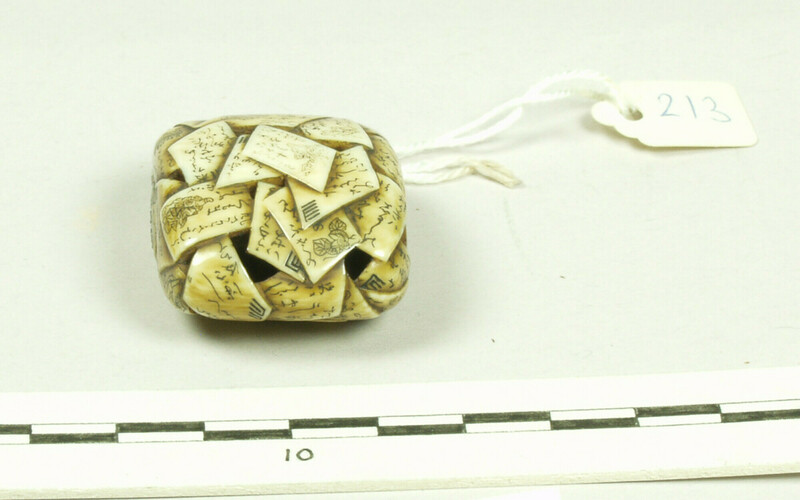 1980.34.213Netsuke toggle showing The Hundred Poems [L.Ph 'DCF 2004-2006 What's Upstairs?' 5/4/2005]1980.34.213
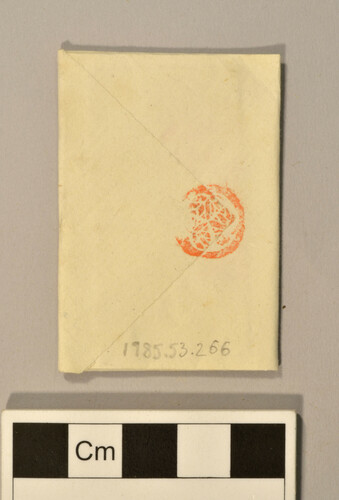 1985.53.266Paper charm with characters in black ink. [MJD 05/03/2013]1985.53.266
 1996.17.225.1Circular bowl with slightly scalloped edges, porcelain, painted with floral pattern in underglaze blue. [MOBB [OPS move] 29/02/2016]1996.17.225.1
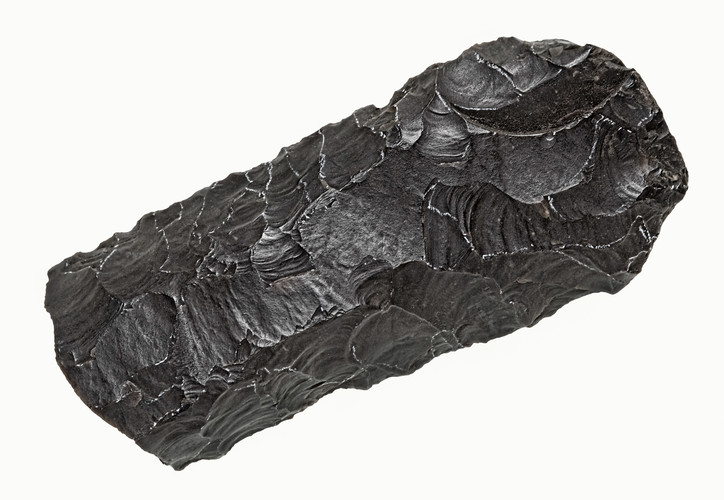 1892.56.89Stemmed stone tool based on elongated flakes. Type A, unifacial rectangular body with a straight working edge. [Fumiko Ohinata, Japanese Archaeology Project 1996-2000]1892.56.89