
- Collection type
- Object
- Description
- Outer shoe [.14], part of complete suit of Japanese armour. [El.B 4/4/2007]
- Long description
- The shoe is made of fur with the hair on the outside. A copper alloy ridge runs down the length of the foot, incised with floral patterns. The sole has a copper alloy edge all round. There is also a copper alloy rim around the ankle, incised with floral patterns. Above the rim around the ankle is a strip of sacking or hessian-like material, covered with yellow silk on the outside. The whole is tied around the ankle with purple silk cord. [El.B 4/4/2007]
- Geographical reference
- Cultural groups
- Japanese
- Date / Period
- Date made: Before 1901
- Date collected
- By 1901
- Acquisition information
- Donated: 1901
- Materials and processes
- Material Copper Alloy Metal, Material Animal Fur Skin, Material Textile, Material Silk Textile Animal, Process Incised, Process Stitched
- Dimensions
- Length: max 290 mm
- Object numbers
- Accession number: 1901.46.1.14
- Research and responses
The following notes are drawn from research compiled by Andy Mills as part of the DCF Cutting Edge project in 2006-2007. This is a very full suit of highly ornate, and archaistic, armour from the Tokugawa Period. It is either a Presentation Armour for diplomatic gifting between high-ranking individuals, or the Parade Armour of a daimyo, one of his close relatives, or a high-ranking samurai retainer.
The bearskin boots (Kuma-no Kawa-no Tsuranuki) are mounted with ornamented brass splints to prevent cuts to the foot. The material of a bushi’s footwear was rigidly controlled and hierarchised, and bearskin was the highest-ranked material in that hierarchy. Such boots, therefore (alongside other elite features, like the war-fan) suggest that this was the armour of a general or daimyo (see The Armour Book in Honcho-Gunkiko , by H. Arai, published 1964.). [SM 08/05/2008]
From the diary (in a private collection) of Arthur Heathcote, who accompanied Henry Martin Gibbs to Peru in 1873: Just before we left Lima Gibbs had offered to him for sale a most curious suit of armour, which on finding that the owner was a gentleman in every way reliable who had been for many years in Japan he bought. It is said to be very rare & certainly most curious, I should much like you to see it & perhaps if you go to Tyntesfield after we get back, you may. The Chinese & Japanese are very numerous in Lima & one can get very pretty things in their shops - but (like everything else in Lima) they are very expensive.
- Associated publications
- Illustrated in colour on page 41 of Pitt Rivers Museum: An Introduction, by Julia Cousins (Oxford: Pitt Rivers Museum, University of Oxford, 2004). Caption (same page) reads: 'Complete suit of decorative Samurai armour; made in Japan in the late nineteenth century.' [JC 8 10 2004]
Search terms: Armour Weapon, Clothing Footgear, Armour, Shoe
Further items to explore
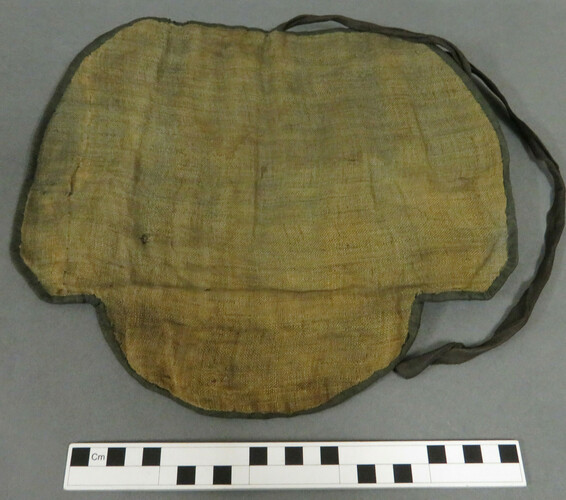 1884.31.40.7One of two greaves [Suneate]. Floral textile design, with fluted and chain mail sewn into it. There is a patch of leather in one corner. [BH [OPS Move] 29/6/2017]1884.31.40.7
 1884.119.489Copper alloy ring1884.119.489
 1884.119.537Copper alloy ring.1884.119.537
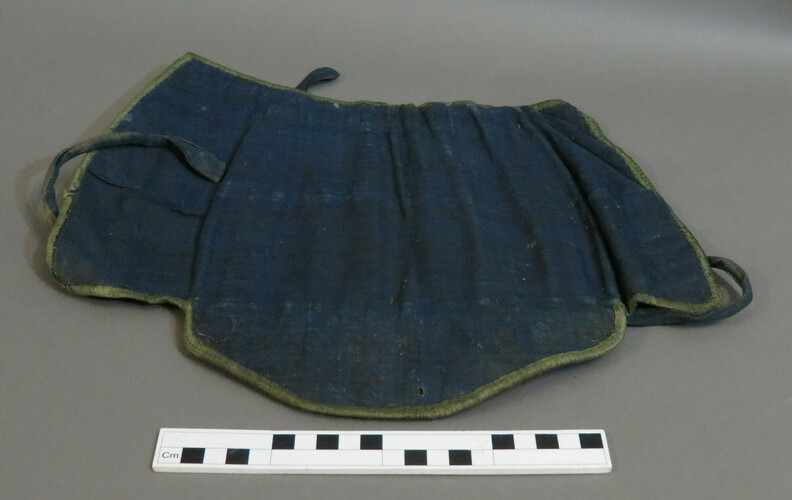 1941.4.53.7Greaves (shin armour), of textile and leather, with embroidered design. [BH [OPS move] 16/8/2017]1941.4.53.7
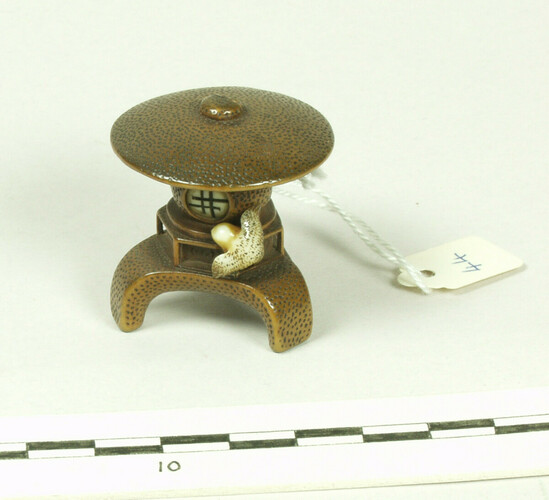 1980.34.44Netsuke toggle of Ishidoro, carved from wood, with a sparrow fluttering round it. The sparrow and one of the lights are of ivory [L.Ph 'DCF 2004-2006 What's Upstairs?' 1/4/2005]1980.34.44
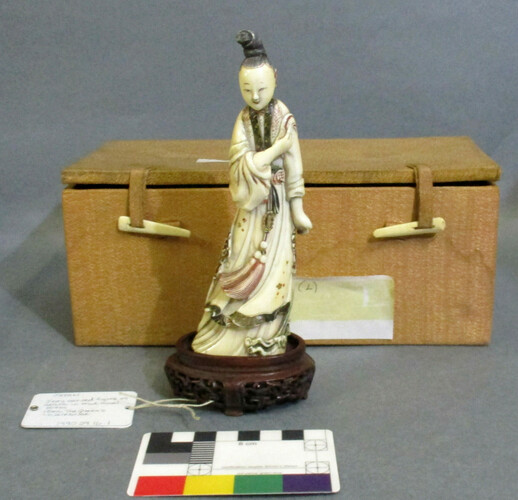 1990.29.16.1Ivory carved figure of a geisha on a wooden ornate pedestal. She wears a long flowing gown with a tassel hanging from her sash. Pigment has been added to the clothing and the hair. Please see [1990.29.16 .2] for the accompanying box. [PR [OPS move] 19/6/2017]1990.29.16.1
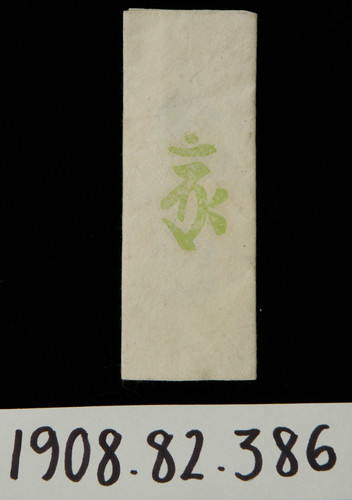 1908.82.386Envelope, stamped in green Sanskrit character on front and with a small circular red stamp on the reverse. [SM 04/12/2008]1908.82.386
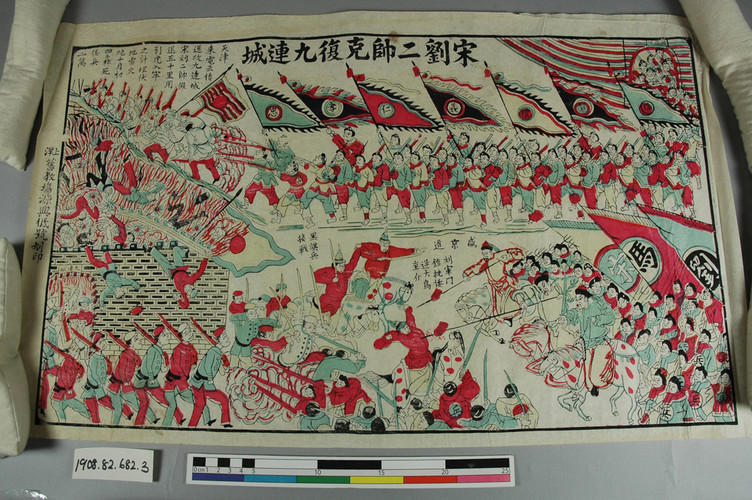 1908.82.682.1Bundle of 6 coloured prints of Chino-Japanese war, consisting of [.1] battle scene [.2] Lao Tung Peninsula (?) [Liaodung?] [.3]Battle of Chiu Lieu Chang [.4] Battle of Ali Shan (?) [.5] trial of Japanese at Port Arthur [Lushun] [.6] Same trial at Port Arthur [Lushun]1908.82.682.1