
- Collection type
- Object
- Description
- Gorget or throatguard [.6], part of complete suit of Japanese armour. [El.B 4/4/2007]
- Long description
- The gorget consists of a ring, not quite closed, lacquered brown, with two lamellar plates in front, laced with green silk braids, with patterned silk braids on the sides and red ones at the bottom. The plates are attached to the ring by a flap of leather painted gold. [El.B 4/4/2007]
- Geographical reference
- Cultural groups
- Japanese
- Date / Period
- Date made: Before 1901
- Date collected
- By 1901
- Acquisition information
- Donated: 1901
- Materials and processes
- Material Silk Yarn Animal, Material Lacquer Varnish, Material Pigment, Material Animal Leather Skin, Process Lacquered Varnished, Process Braided, Process Painted
- Dimensions
- Width: max 212 mm plated part
- Object numbers
- Accession number: 1901.46.1.6
- Research and responses
The following notes are drawn from research compiled by Andy Mills as part of the DCF Cutting Edge project in 2006-2007. This is a very full suit of highly ornate, and archaistic, armour from the Tokugawa Period. It is either a Presentation Armour for diplomatic gifting between high-ranking individuals, or the Parade Armour of a daimyo, one of his close relatives, or a high-ranking samurai retainer.
The kusazuri (thigh/groin-guards) and the nodowa (throat-guard) are constructed of the same hon-kozane technique. The shoulder guards (resting over the back of the shoulders here), however, are of the o-sode (‘great shoulder-guard’) type – an archaic form – and are made with solid, horizontally-laced plates. Thus, this aspect of the suit harks back to high medieval forms. The iron war-fan is used as a symbol of rank, for directing troops, and as a makeshift weapon if need be; it is known as a gunbai-uchiwa (see An Exhibition of Japanese Armour from the L. J. Anderson Collection, by M. I.Moad, published 1982. p6). [SM 08/05/2008]
From the diary (in a private collection) of Arthur Heathcote, who accompanied Henry Martin Gibbs to Peru in 1873: Just before we left Lima Gibbs had offered to him for sale a most curious suit of armour, which on finding that the owner was a gentleman in every way reliable who had been for many years in Japan he bought. It is said to be very rare & certainly most curious, I should much like you to see it & perhaps if you go to Tyntesfield after we get back, you may. The Chinese & Japanese are very numerous in Lima & one can get very pretty things in their shops - but (like everything else in Lima) they are very expensive.
- Associated publications
- Illustrated in colour on page 41 of Pitt Rivers Museum: An Introduction, by Julia Cousins (Oxford: Pitt Rivers Museum, University of Oxford, 2004). Caption (same page) reads: 'Complete suit of decorative Samurai armour; made in Japan in the late nineteenth century.' [JC 8 10 2004]
Search terms: Armour Weapon, Armour, Gorget Armour
Further items to explore
 1932.89.119.1Sword, pata, with long double edged blade and velvet lined gauntlet. For sheath, not yet found, see [1932.89.119 .2] [SM 02/05/2007]1932.89.119.1
 1935.69.4.11Mitten shaped piece of padded textile with interior chain armour. Part of a set of Japanese armour [1935.69.4 .1 - 12]. [MOBB [OPS move] 30/8/2017]1935.69.4.11
 1920.16.13.4Shoulder guard, part of a complete suit of Japanese armour. [El.B 10/4/2007]1920.16.13.4
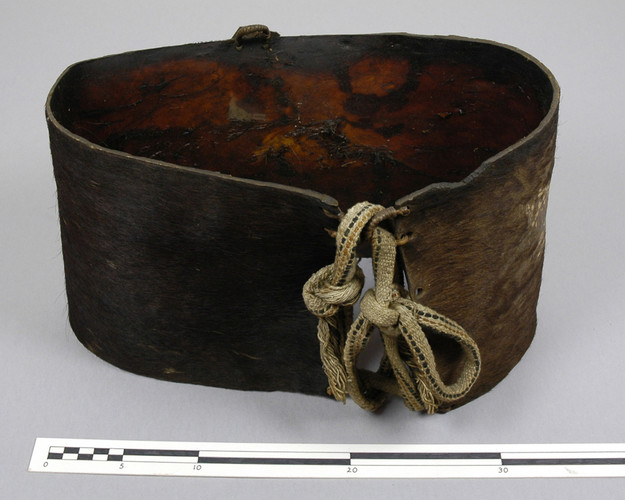 1923.85.545Broad belt or waist armour of buffalo hide, with cane loops and a textile band for fastening. There is also a small cane loop on the upper edge. [El.B 22/3/2007]1923.85.545
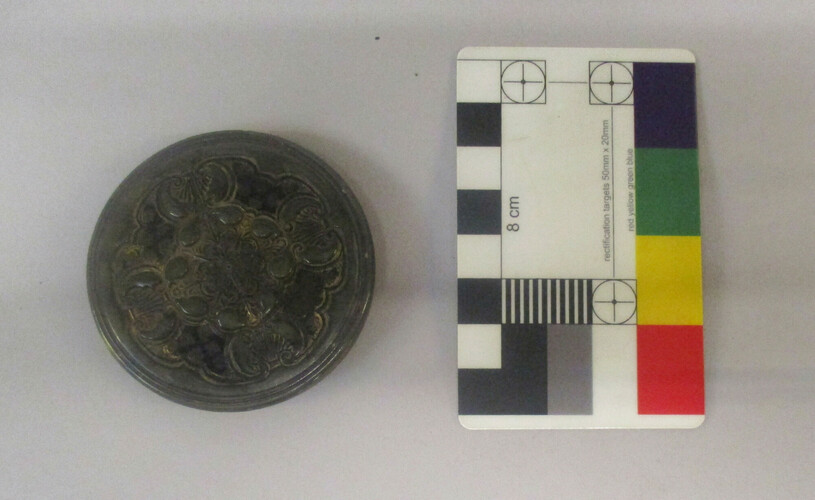 1990.29.19.2Carved and gilded circular lid for box 1990.29.19 .1 [CW [OPS move] 01/07/2016]1990.29.19.2
 1901.46.1.10Epaulette [.10], part of complete suit of Japanese armour. [El.B 4/4/2007]1901.46.1.10
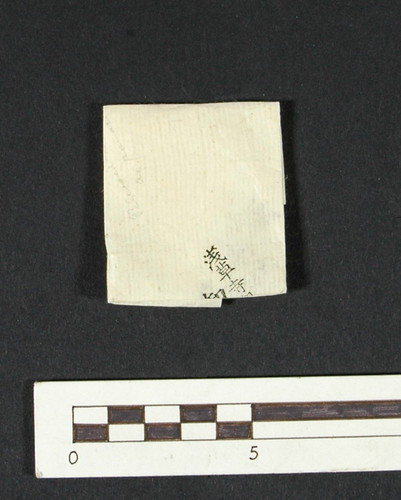 1908.82.207Folded piece of paper with black text characters stamped on the outside, containing rice. [LKG 10/10/2008]1908.82.207
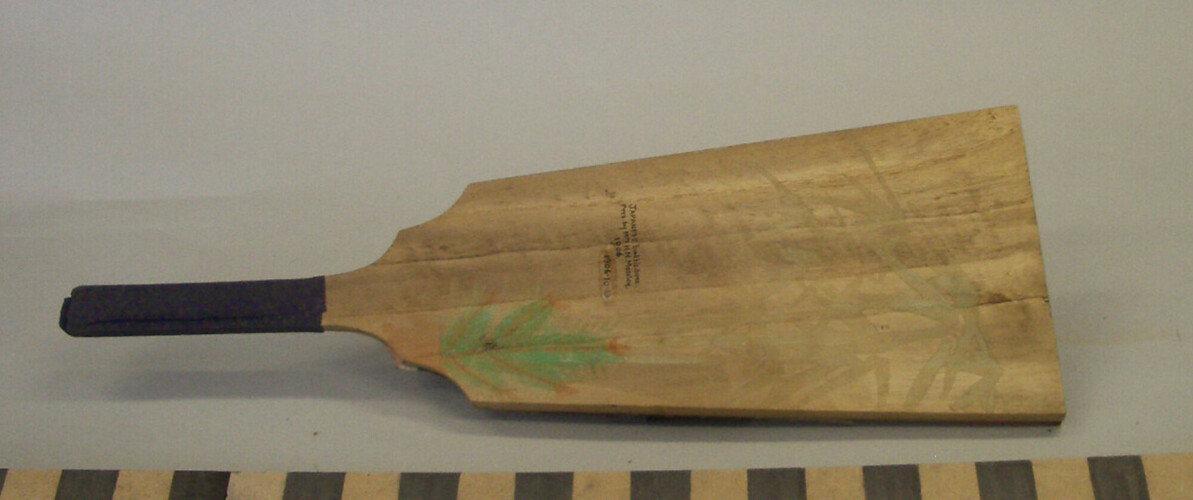 1906.10.10Japanese hagoita (bat) of carved of wood, painted, with figure in textile on one side. [MC 06/10/2022]1906.10.10