
- Collection type
- Object
- Description
- Coscinopora globularis fossil bead. [ZM 28/11/2006]
- Geographical reference
- England Bedfordshire Biddenham near Bedford
- Person
- Maker Unknown Maker
- Field collector Francis Howe Seymour Knowles
- PRM source Francis Howe Seymour Knowles
- Date / Period
- Archaeological period: Palaeolithic
- Date collected
- 1910
- Acquisition information
- Purchased: 1910
- Materials and processes
- Material Fossil, Process Perforated
- Object numbers
- Accession number: 1910.75.158 Other numbers: 1910.ß.396
- Research and responses
According to http://www.irsociety.co.uk/Archives/17/Beds_1.htm the gravel pit at Biddenham was '... owned by S.W. Jarvis & Son, a firm of stone and monumental masons in Alexandra Road, Bedford.' [AP 28/07/2006]
Coscinopora globularis appears to be a fossilized sponge [AP 13/12/2007]
F.H.S. Knowles carried out some analysis of his own collection from Biddenham and used the collection to furnish examples for his publication "Knowles, F.H.S. 1953. Stone-worker's progress: a study of stone implements in the Pitt Rivers Museum. Oxford:University Press" [CB 28/10/2009]
- Associated publications
- A string of 30 of these fossils was published as plate 3.8 on page 123 of Als der Mensch zum Schöpfer wurde: An den Wurzeln der Kultur, by Martin Kuckenburg (Stuttgart: Klett-Cotta, 2001). Copy in Balfour Library. See accompanying caption and related text for further information. [MdeA 12/11/2001; JC 24 4 2002] For a report on the analysis of the PRM's collection of such beads, see 'Critical Reassessment of Putative Acheulean Porosphaera globularis beads', by Solange Rigaud, Francesco d'Errico, Marian Vanhaeren, and Christian Neumann, in Journal of Archaeological Science, Vol. 36, no. 1 (January 2009), pp. 25-34. These thirty beads are illustrated in colour, strung and unstrung, as Figure 2a on page 28. (Printout of PDF file in RDF: Researchers: Rigaud.) [JC 15 3 2019]
Search terms: Specimen, Geology, Animalia, Picture and Graphic Art, Fossil
Further items to explore
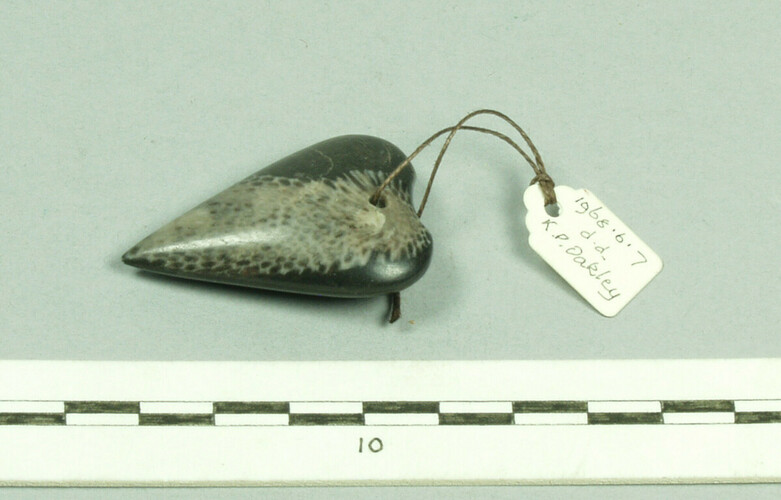 1968.6.7Pointed heart-shaped pendant of fossil coral with a hole for suspension. [N.B. 'DCF 2004-2006 What's Upstairs?' 9/6/2005]1968.6.7
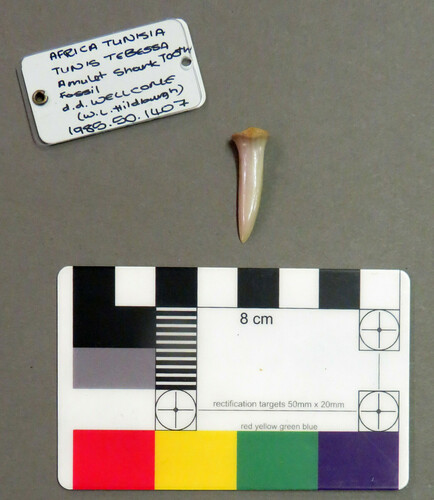 1985.50.1407.1Amulet, a grey fossilised shark's tooth. [EH [OPS move] 22/11/2017]1985.50.1407.1
 1985.52.2340.2Amulet, one of four circular fossils [1985.52.2340 .1- .4], in an octagonal maroon cardboard box. [ACA 27/07/2012]1985.52.2340.2
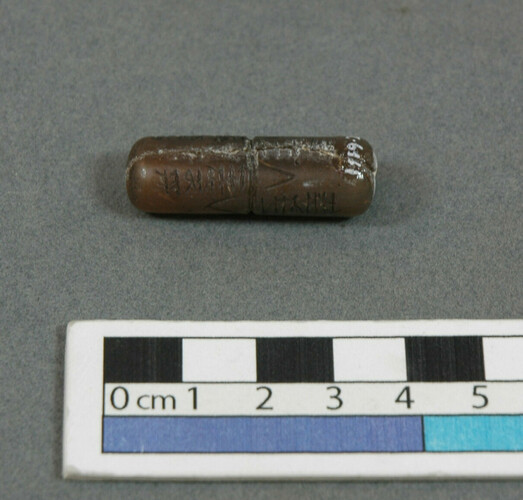 1919.24.1Portion of a belemnite inscribed with runic characters; an amulet.1919.24.1
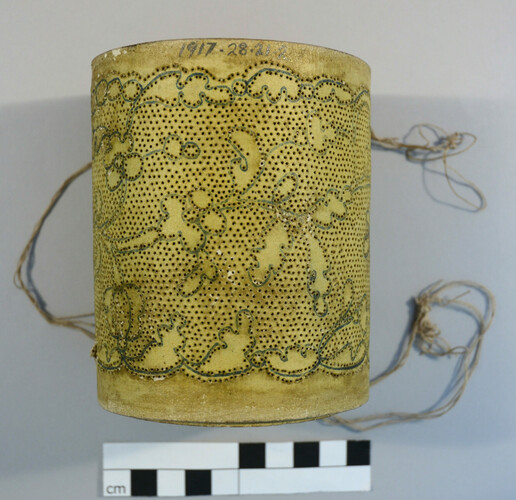 1917.28.21.2Paper pattern slip for lace-making. [MJD 20/04/2015]1917.28.21.2
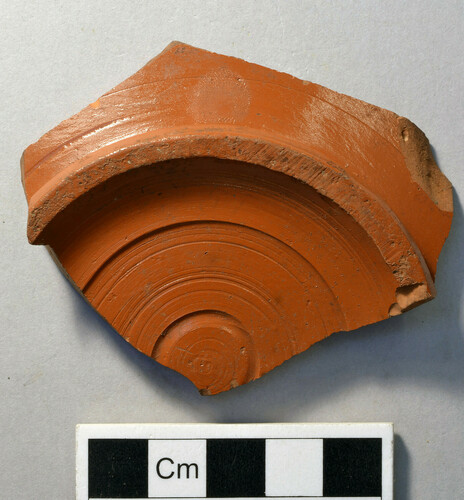 1884.41.89Ceramic sherd; Samian base fragment1884.41.89
 1884.137.11.37Ceramic sherd1884.137.11.37
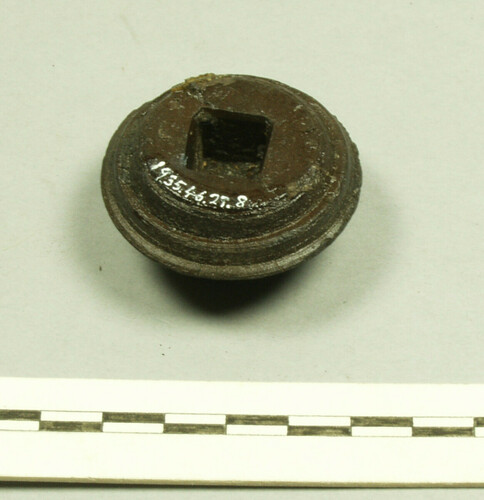 1935.46.27.8Turned disc of Kimmeridge shale: waste from an armlet factory. With square perforation where it was held by the lathe. [LM 'DCF 2004-2006 What's Upstairs?' 11/10/2005]1935.46.27.8