
- Collection type
- Object
- Description
- Notebook containing inscriptions by Rani Gaidinliu. Part of a set of twelve notebooks [1928.69.1570.3-.14] found inside basket 1928.69.1570.1-.2.
- Long description
- Notebook containing inscriptions by Rani Gaidinliu. Part of a set of twelve notebooks [1928.69.1570.3-.14] found inside basket 1928.69.1570.1-.2. The notebook is a ruled exercise book with no front or back cover.
- Geographical reference
- Date / Period
- Date made: Before 1932
- Date collected
- March 1932
- Acquisition information
- Donated: 1932, uncertain
- Materials and processes
- Material Ink, Material Pencil, Material Paper Plant, Material Metal, Process Written, Process Printed, Process Stapled
- Dimensions
- Width: max 165 mm, Length: max 205 mm
- Object numbers
- Accession number: 1928.69.1570.11
- Research and responses
Notes on Gaidinliu by Julia Nicholson 2008: In the early 1930s a rebellion spread through the Kacha, Zeliang (Zemi) and Kabui Naga communities based on a new religious movement. Initially this cult was led by a seer named Jadonang and his devoted disciple, a young woman called Gaidinliu. Following Jadonang’s execution by the British (after he was convicted of the murder of four Manipuri traders) Jadonang was succeeded by Gaidinliu. Both Jadonang and Gaidinliu were considered to have special visionary powers and were described by followers as maibas (traditional shamans) who could foretell the future and cure the sick. They were treated as god and goddess and collected large amount of tribute from their followers. The religion they practiced was highly ritualistic and new gods and shrines were established based on Naga animism embellished with a mixture of Hinduism and Christianity. The magical symbols in the Gaidinliu notebooks were an important part of this belief system. The repetitive symbols resemble writing but are of no known language. It is said that Gaidinliu used these pages to enhance her power and they were sent as messages to her followers with the messenger providing a verbal translation. At this time of deprivation for Kacha, Zeliang (Zemi) and Kabui Naga communities, oppression by their Kuki enemies and resentment of the imposition British administration, it was believed by cult followers that adherence to this new set of religious practices would usher in a new era of plenty and the fall of the oppressors. After some years people got tired of the unending demands for tribute for the “goddess” and Gaidinliu was betrayed by one of her people, captured by the British and sentenced to 14 years in jail. Before her arrest Gaidinliu had told her followers that even if she was caught by the police, her real and divine self could not be imprisoned and her spirit would return to the people in a disguise so that her enemies would not recognise her. So the hope that Gaidinliu would return to lead her followers to freedom lived on. An interesting footnote is that in the early days of her fieldwork among the Zeliang (Zemi) in Nagaland, Ursula Graham Bower (Betts) was revered as a reincarnation of Gaidinliu. [JN 06/05/2008] See also pages 161 to 163 of The Nagas: Hillpeoples of Northeast India, by Julian Jacobs and pages 46 to 50 in Messianic Movements in Primitive India by Stephen Fuchs, 1965. [JN 06/05/2008]
- Associated publications
- See Longkumer, Arkotong (November 2016) "Lines that speak" The Gaidinliu notebooks as language, prophecy, and Textuality, HAU: Journal of Ethnographic Theory, 6, pp.123-147 [NC 15/02/2017] [copy in RDF]
Search terms: Religion, Writing, Religious Object, Amulet, Book, Document
Further items to explore
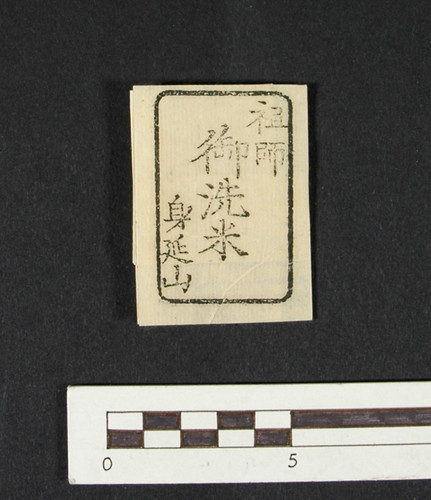 1908.82.239Sacred Rice in folded paper on the front of th paper black ink text symbols are printed inside a black border. [LKG 10/10/2008]1908.82.239
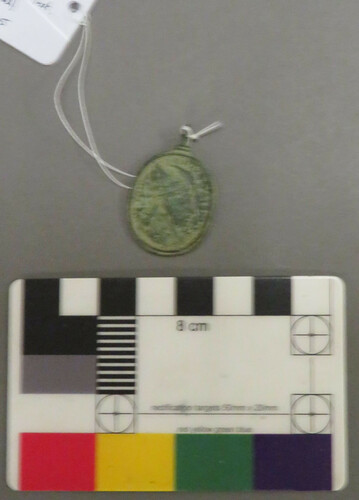 1985.50.445Amulet, made from an oval medal with a circular suspension loop at the top. On one face of the medal is a depiction of St. Thomas, on the other st. Nicholas of Tolentino with a crucifix. [CW [OPS move] 22/9/2017]1985.50.445
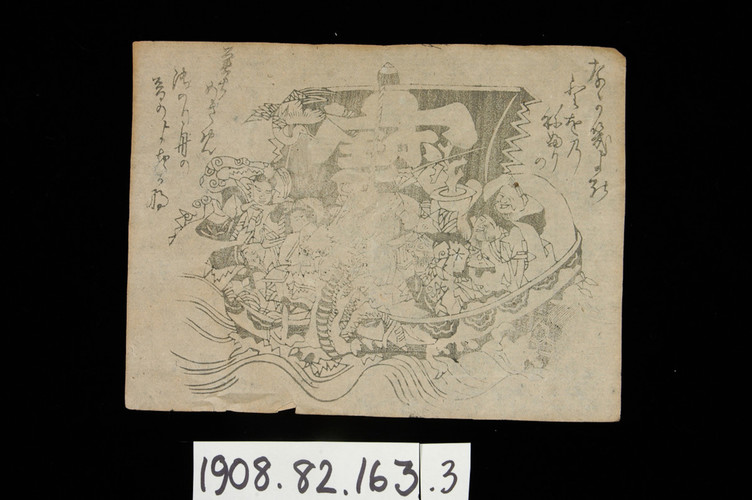 1908.82.163.3Dream amulet placed under a pillow at night. It depicts the seven gods of good fortune aboard a boat. [SM 19/09/2008]1908.82.163.3
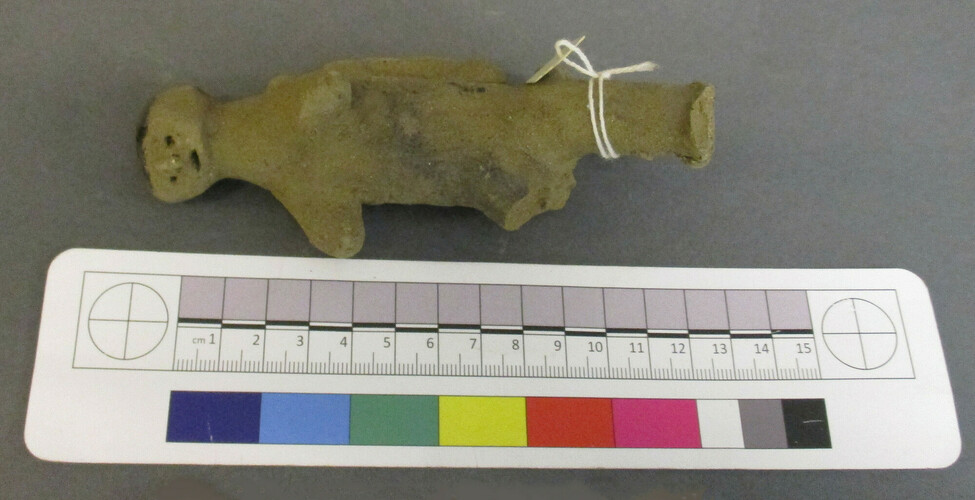 1958.11.1.20Clay Mkaramo figurine. Anthropomorphic figure of a woman with a young child child on her back. Female figure has a cylindrical body, that flares at the base in two directions to represent buttocks. Figure has two elongated and triangular breasts that extend outwards, and appears to be missing her arms. Painted at the top of head to represent hair. [IL [OPS Move] 19/4/2017]1958.11.1.20
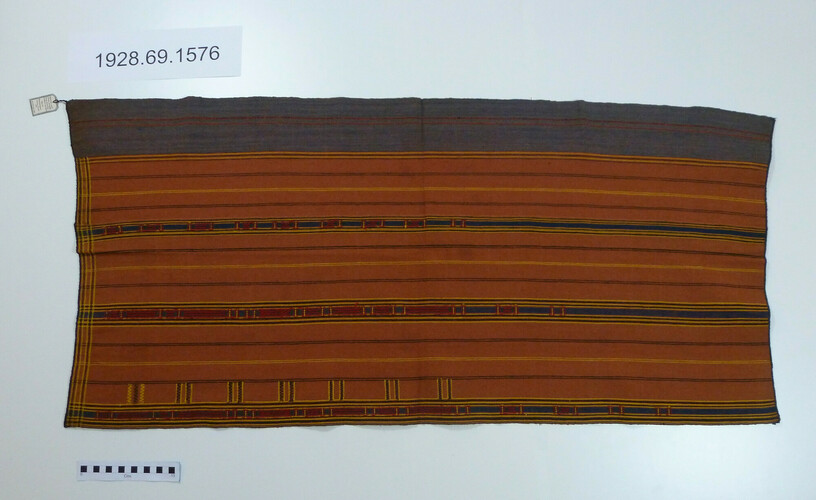 1928.69.1576Skirt of red with a grey red striped selvage, with narrow blue bands edged with black and yellow lines, the bands worked with designs in red and yellow.1928.69.1576
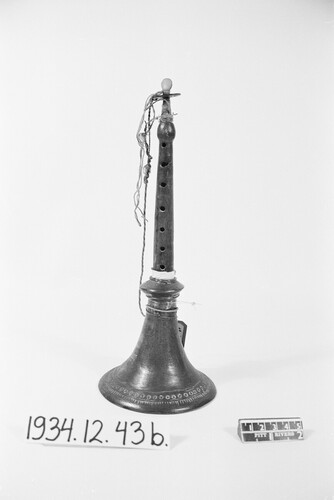 1934.12.43.2Oboe, with wide bell-mouth of cast brass, wooden tube with 7 stops and palm-leaf sounding reed. Pirouette made from an Indian coin on which the date 1835 is legible.1934.12.43.2
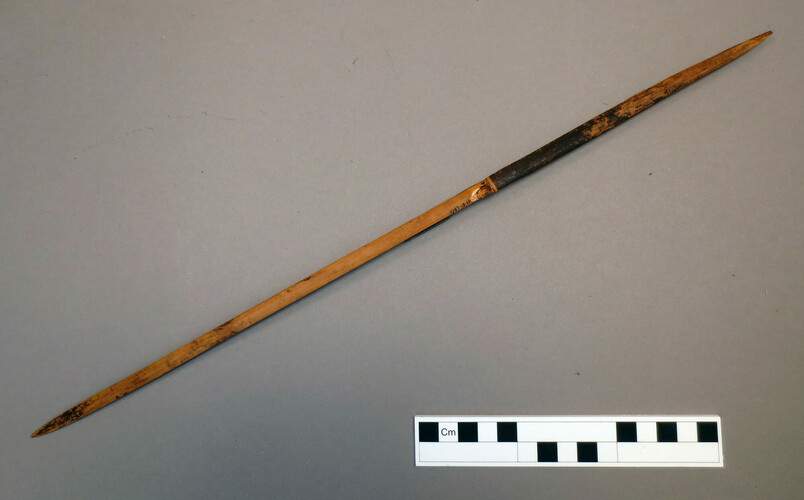 1983.13.17Sliver of bamboo that is pointed at both ends. [SM 21/11/2007]1983.13.17
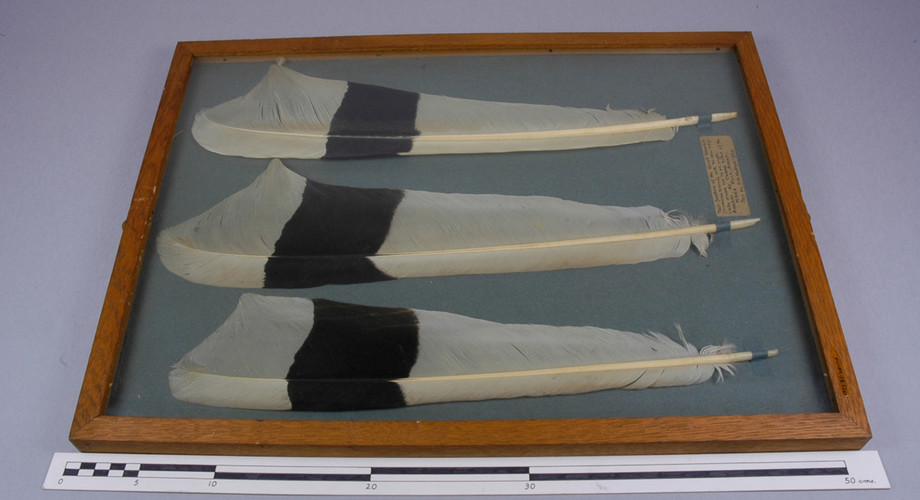 1923.85.261.1Hornbill feather with the vane drawn out to an angle.1923.85.261.1