
- Collection type
- Object
- Description
- Skirt made from cotton. Printed in red, green, blue, and yellow, with a repeat pattern image of King George VI. [JP 29/10/2004]
- Long description
- Skirt made from cotton. Printed in red, green, blue, and yellow, with a repeat pattern image of King George VI in coronation regalia with crown and sceptre on a stool and standing between draped red curtains at the foot of steps leading to the throne. [JP 29/10/2004]
- Geographical reference
- Person
- Maker Printed at the Newton Bank Print Works, Hyde, Cheshire by F. W. Ashton.
- Field collector Unknown Collector
- PRM source Sarah Lasenby
- Date / Period
- Date made: 1936-1980
- Date collected
- By 2004
- Acquisition information
- Donated: 2004
- Materials and processes
- Material Cotton Seed Fibre Textile Plant, Material Metal, Material Pigment, Process Printed, Process Stitched, Process Dyed
- Dimensions
- Length x Width 1150 x 1100 mm at hem
- Object numbers
- Accession number: 2004.198.1
- Research and responses
Printed textiles this kind were manufactured in Manchester for export to the West African market. It is possible that this textile was also exported to the Caribbean because the previous owner, now deceased but who was known to the donor [see donation form in related documents file], was originally from the Caribbean. An identical textile is in the collections of the Whitworth Art Gallery, Manchester. The information about the manufacture of this textile were obtained through correspondence with the Whitworth Art Gallery - see RDF. [JP 29/10/2004]
I think that the Caribbean reference is a red herring because it was assumed that a black parishioner at SS Mary and John Church, Cowley Road in Oxford was from the West Indies, whereas in fact it was far more likely that she was from West Africa, probably Nigeria'. [JN 19/03/2014]
Notes from Dr Maria Friend (Adjunct Senior Lecturer in Anthropology, James Cook University, Australia): 'As regards the fabric: this is very definitely an early commemorative cloth, printed most probably in UK for Africa. Very exciting! In attachment I am sending a photo of another fabric printed in UK on that occasion, accompanied by a caption (it is from J. Picton's book "The Art of African Textiles. Technology, Tradition and Lurex", Barbican Art Gallery 1995). The second photo, with Queen Elizabeth II, is stylistically more similar to the image that features on the skirt (the second photo is from Magie Relph's book "African Wax Print. A Textile Journey") - unfortunately there is no information provided as to who printed it. I am not sure whether the fabric is a wax-print or a direct print (it would help to see the other side). The commemorative prints are usually direct roller prints, but the early ones sometimes used wax resist, similar to Javanese batik (if you recall, the commemorative prints are a shoot-off the imitations of Javanese batiks printed for Africa.) Of course, this fabric is relevant to trade - for a number of years UK factories used to print fabrics for Africa (and the roots of this tradition probably go to the slave trade). As regards the design, most probably it was registered and could be found in one of the UK archives. The earliest examples of such fabrics are known from the 1930s - that's why I think that the skirt in your collection is an early example. I presume it was made in UK and therefore it may be possible to find in the archives the copyrights of the design. We know very little about the beginnings of this group of fabrics, although nowadays commemorative fabrics (printed in Africa) are very popular.' [FB 12/10/2011]
Notes from Dr Maria Friend (Adjunct Senior Lecturer in Anthropology, James Cook University, Australia) after research visit of 25 October 2011 to look more closely at the skirt: 'The skirt has been printed on both sides as a direct print except for the areas of George VI's face and legs (the blue dotted parts) where the wax resist method has been used. The rest of the skirt is printed imitating wax resist. The fact that the skirt is printed on both sides attests to the early date of the skirt. Such commemorative fabrics were being printed no earlier than 1930 only in the UK and the Netherlands. The pattern can be traced through the archives of the ABC company as the design would have been registered on production. The ABC company were still manufacturing fabrics in the UK for a West African market up until 2009 when they were bought by a Chinese company, they still have offices in the midlands, UK but all of the production is now in China. The cut of the skirt is very fitted and European, was it made for the donor to wear in West Africa?.' [FB 25/10/2011]
- Associated publications
- Illustrated in colour detail on page 26 and whole on page 27 of Made for Trade by Julia Nicholson and Faye Belsey, the booklet produced to accompany the temporary exhibition with the same title Made for Trade held at the Pitt Rivers Museum from 18 July 2011 to 27 January 2013. Illustrated with the caption "skirt depicting George VI made of fabric printed in Manchester, for export to West Africa around 1936'. [FB 16/01/2013] Featured in 'Ikat Dyed Cotton Cloth, Indonesia Printed cotton skirt, England: Two Apparently Unassuming Textiles from the Pitt Rivers Museum Contain a Wealth of Cross-Cultural History', by Rachel Meek, Hali, no. 179 (Spring 2014), pp. 32-33. Discussed on page 32: 'The curious skirt belonged to a West African parishioner who on her death left all her effects to the church of St Mary and St John in Oxford that she had regularly attended. The person depicted in its folds is King George VI in full coronation regalia. Apparently Edward VIII was due to be the figure in the printed repeat, but the monarch's face was changed following the 1936 abdication. [n/p]Printed in Manchester, England around that year, fabrics of this type emulated the vibrant batiks made in Java for the West African market. Hugely popular in Nigeria, many commemorative textiles were exported from Manchester from the late 19th century up to the 1950s. Most of the design is a direct print applied to both sides of the fabric. The exception is the blue dotted areas of shading on the figure, achieved using the wax resist method that the rest of the design imitates.' Illustrated in colour on page 33 with the following caption: 'Printed cotton skirt, Manchester, England, mid-1930s. 1.15 m x 1.1 m (3' 9" x 3' 6"). Pitt Rivers Museum, Oxford, donated by Sarah Lasenby, 2004.198.1. A printed repeat shows King George VI in coronation regalia next to a stool with a crown and sceptre; he is at the foot of a staircase leading up to the throne. This commemorative skirt was made for export to West Africa. Apparently the monarch's face was changed: the original design depicted King Edward VIII, who abdicated in 1936 before the cloth was put into production.' (Copy in RDF.) [JC 17 7 2014]
Search terms: Clothing Textile, Skirt
Further items to explore
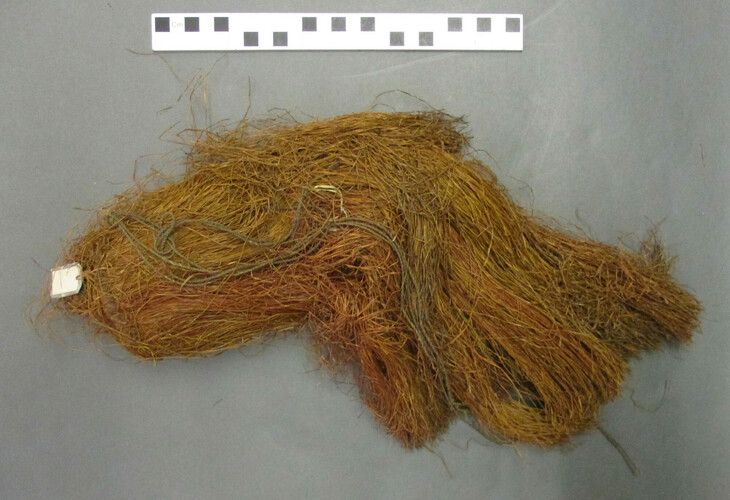 1943.4.16Skirt made of split plant fibre fringing tied in bundles to plant fibre waistband. [FB 26/02/2015]1943.4.16
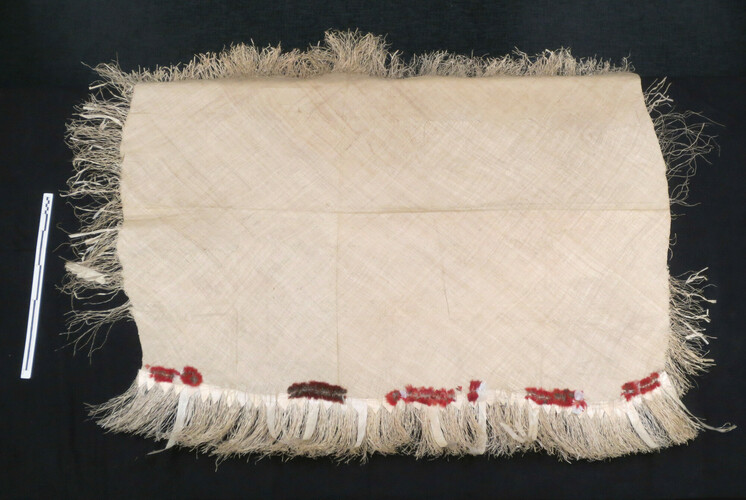 1948.12.1BMat skirt of pandanus leaf strips with border of red parrot feathers and white feathers. [DCF?; JC 21 7 2005]1948.12.1B
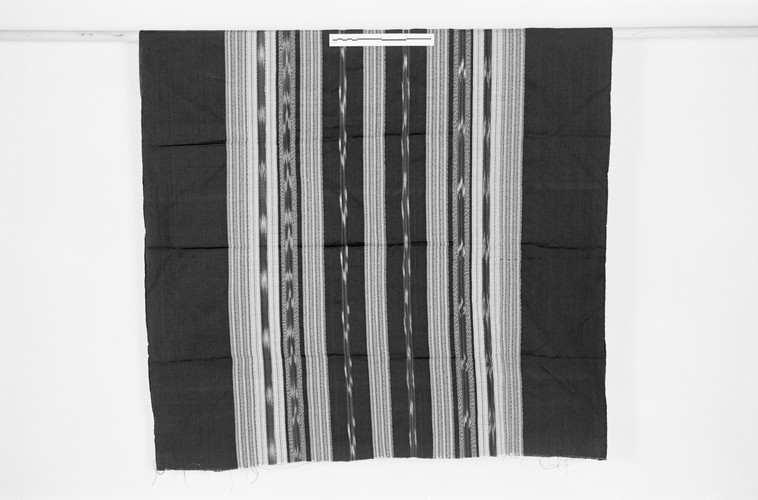 1997.28.23Woman's skirt, green base colour with predominantly red and pink stripes in sections.1997.28.23