
- Collection type
- Object
- Description
- Short length of plant fibre cord strung with 7 glass beads [RTS 30/6/2004].
- Long description
- Bead string made from a short length of plant fibre cord, composed of two strands twisted together, that has been knotted at one end and left free at the other, where the fibres are beginning to unwind. A series of 7 short cylindrical translucent turquoise blue-green beads have been threaded onto this cord (Pantone 7474C); these have been cut to different lengths, sometimes at a slight angle. These beads may have been manufactured by being drawn. The string is 35 mm long, and is probably incomplete as it is currently too short to be used as either an anklet or a waist string. The beads vary in length from 4 to 5 mm, and in diameter from 3.7 to 4.5 mm, with a total weight of 0.8 grams [RTS 30/6/2004].
- Person
- Field collector Charles Gabriel Seligman
- Field collector Brenda Zara Seligman
- PRM source Brenda Zara Seligman
- Date / Period
- Date made: Before 02/1922
- Date collected
- 2nd or 3rd February 1922
- Acquisition information
- Acquired: 08/1946 Acquired: 30/06/2004
- Materials and processes
- Material Glass, Material Plant Fibre, Process Twisted, Process Knotted, Process Drawn
- Dimensions
- Diameter 3.7 mm smallest bead, Diameter 4.5 mm largest bead, Length: max 35 mm string, Length 4 mm smallest bead, Length 5 mm largest bead, Weight 0.8 g
- Object numbers
- Accession number: 1946.8.101.7
- Research and responses
Comparison with other beads in this group (1946.8.101) suggests that these beads are not the true gwen bor type, which have an opaque white core and solid blue green exterior layer, but are probably an imitation or substitute chosen for its similar colouring. The same type of bead is found in 1946.8.101.4 and 1946.8.101.6 [RTS 30/6/2004].
Brenda Seligman discusses the gwen bor beads in her journal entry for 2nd February 1922, while at Tarangala: "I have noticed the special bor beads + spoke of them, they [unspecified villagers] told me their men had gone to Bor with Omunok (?Emin) + brought them back. In the afternoon I made Ikan [informant] a present of some beads + she exchanged a few of these for trade beads. At Bor they are almost priceless", and adds in the entry on February 3rd: "In the afternoon they all came up for farewells. Ikan sent a bowl of honey in exchange for beads. She had given me honey before, + very good it is. Then at the last she took off her waist string of Bor beads + gave them to me [=1946.8.101.1]. Ibrahin gave me a small sitting stool. A general presentation of beads and salt followed". The journal from which this exerpt has been taken is held in the London School of Economics Library archives, file 1/4/6 (FL 7/9/2004).
Search terms: Ornament, Bead, Currency, Leg Ornament, Waist Ornament
Further items to explore
 1971.15.1308.3Iron bead[s] with severe corrosion damage. [LKG 10/07/2009]1971.15.1308.3
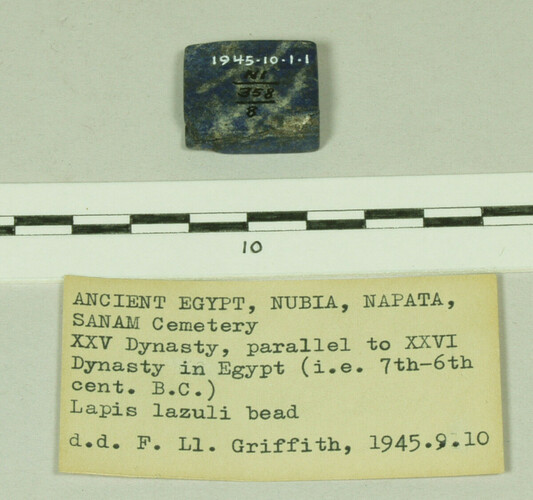 1945.10.1.1A collection of beads and pendants, kept together on a tray: [.1] is a square bead of lapis-lazuli.1945.10.1.1
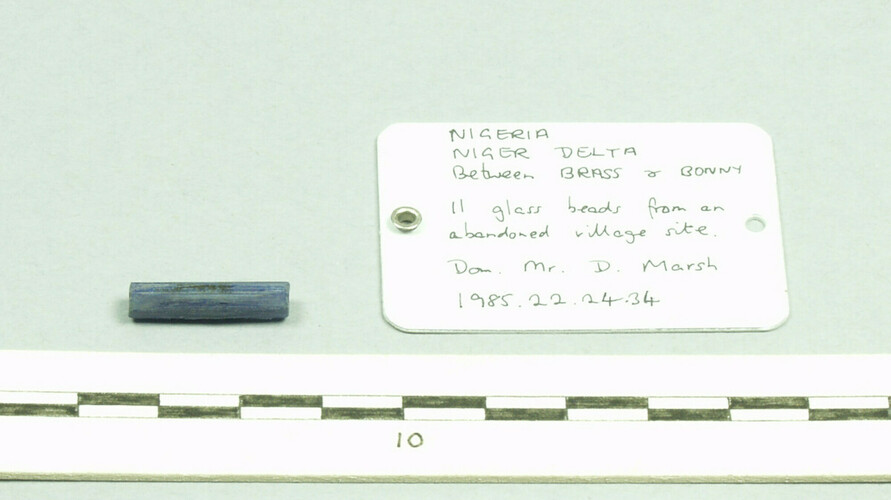 1985.22.26Tubular dark blue glass bead. [N.B. 'DCF 2004-2006 What's Upstairs?' 1/7/2005]1985.22.26
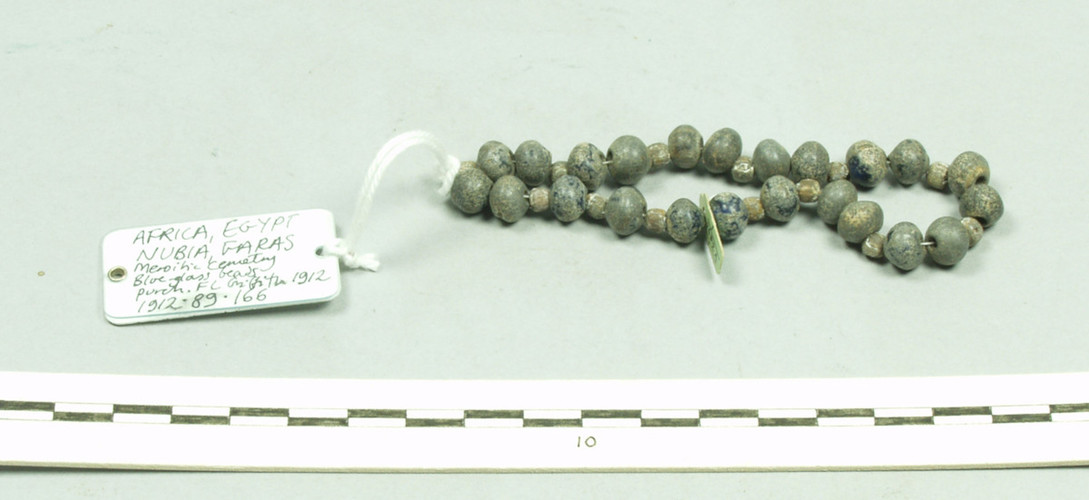 1912.89.166Beads [L.Ph 'DCF 2004-2006 What's Upstairs?' 23/6/2005]1912.89.166
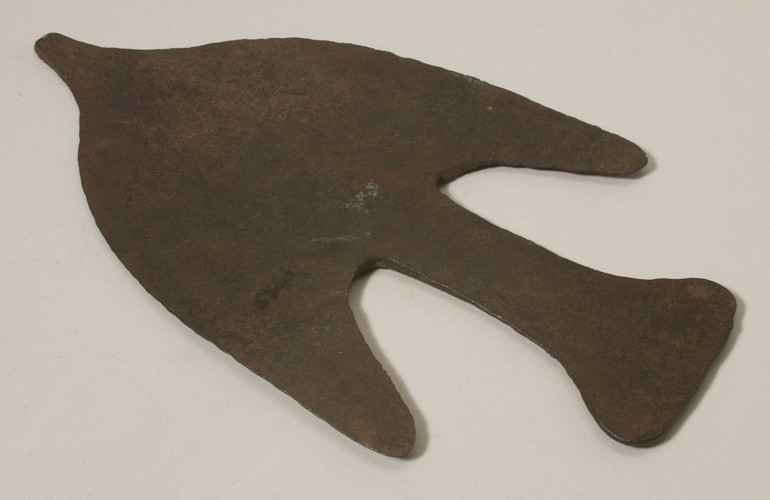 1898.61.1Flat iron spade blade with plate tang, used as a form of currency.1898.61.1
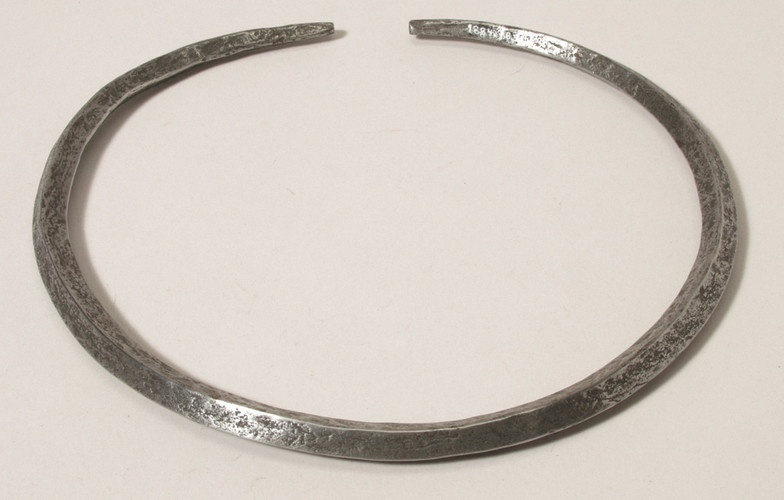 1884.78.31Heavy penannular iron torque with lozenge-shaped section and notched decoration [RTS 28/4/2004].1884.78.31
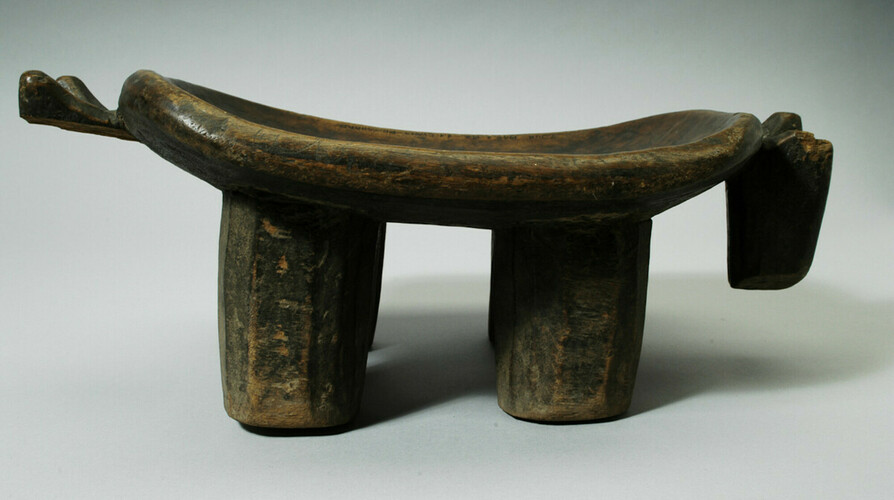 1948.2.142Sub-rectangular wooden platter with two stylised horned animal-head handles and four thick legs [RTS 13/4/2005].1948.2.142
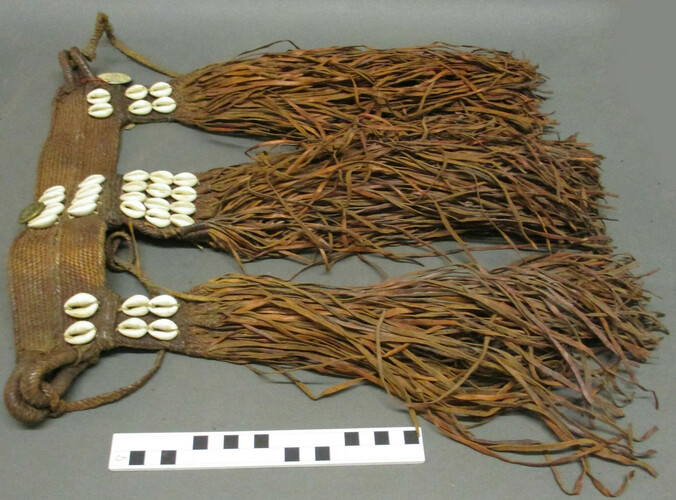 1954.5.170.1Leather trappings for head of bull, made of 3 sets of fringes on a band decorated with cowrie shells and a brass button. For the corresponding objects see [1954.5.170 .2 for woven strip with bells and 1954.5.170 .3 and .4 for the leather pieces with fringe.] [SB [OPS Move] 6/6/2017]1954.5.170.1