
- Collection type
- Object
- Description
- Annular armlet carved from elephant toe [RTS 24/3/2004].
- Long description
- Annular armlet carved in a single piece, apparantly from part of an elephant toe. The inner face where it would fit around the arm is slightly convex, with two grooves, partially worn, that look to be a natural part of the raw material; the upper and lower surfaces are flat and the outer face is concave. The colour ranges from a light brown (Pantone 465C) to a dark brown (Pantone black 7C). The object is complete and intact, but has cracks across the underside, inner and outer faces. There are two patches of wear, on opposite sides of the outer face, perhaps where the armlet has rubbed against the owner's body. The length across the armlet is 72 mm, the width across it 68.5 mm; the diameter across the inside edges is 53 mm, with a thickness of 9.3 mm and a height of 14.9 mm. The armlet weighs 33.3 grams [RTS 24/3/2004].
- Cultural groups
- Shilluk
- Date / Period
- Date made: Before 1903
- Date collected
- By 1903
- Acquisition information
- Donated: 1903
- Materials and processes
- Material Elephant Nail Animal, Material Elephant Bone Animal, Process Carved
- Dimensions
- Height: max 14.9 mm, Width: max 68.5 mm, Length: max 72 mm, Weight 33.3 g
- Object numbers
- Accession number: 1903.16.109.2
- Research and responses
According to the Encyclopedia Britannica Online, the Shilluk are from Sudan, and thus this is assumed to be the correct provenance [CW 15/12/99]. Although the term 'Upper Nile' is now used to refer to a modern administrative district, covering a stretch of the Bahr el Abiad from Geigar to Malakal, and the Sobat River to Nasir, at the time this object was collected the term was used differently. Up until 1981, it was the name of a province that covered the districts now known as Upper Nile, Jonglei, Wahda and part of el Buheyrat. It may also have been used to describe the Bahr el Abiad and/or Bahr el Jebel rivers [RTS -12/11/2003].
Search terms: Ornament, Arm Ornament
Further items to explore
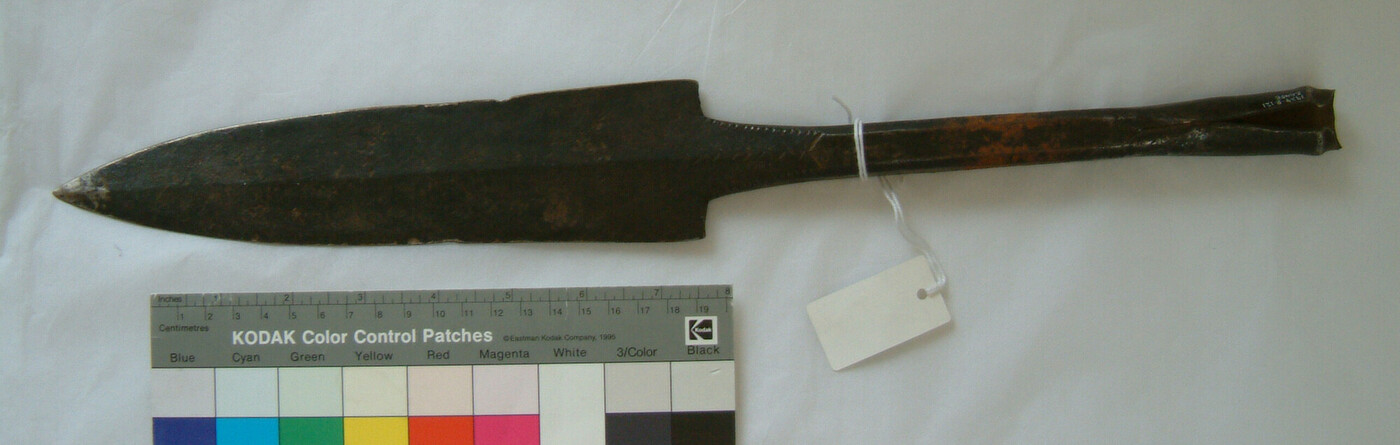 1934.8.121Iron spear-head with narrow triangular blade on a solid, decorated shank with socketed base [RTS 27/6/2005].1934.8.121
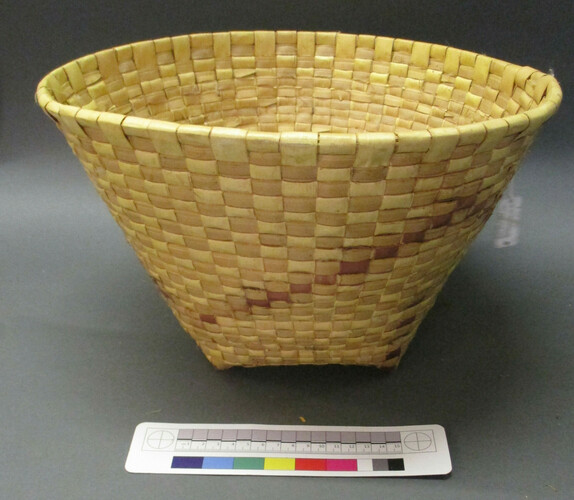 1979.20.7Decorated basket chequerwoven from strips of palm fibre, with circular mouth and square base [RTS 20/9/2005].1979.20.7
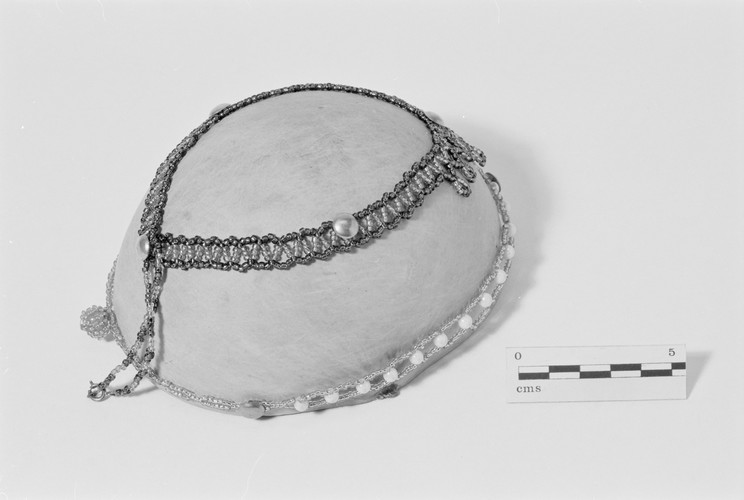 1998.9.17Decorated half calabash, used as a wall ornament. [FB 21/05/2015]1998.9.17
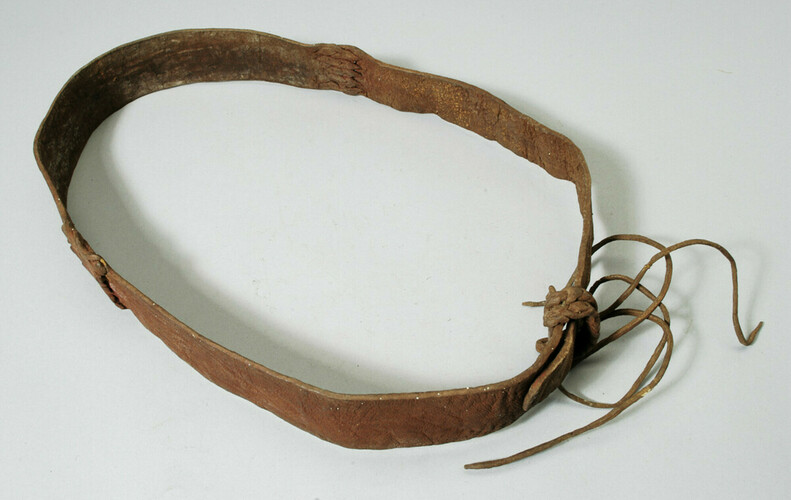 1940.7.0883 pieces of thick hide, joined to form a long rectangular belt with double loop and fringe at one end, worn by women [RTS 31/3/2005].1940.7.088