
- Collection type
- Object
- Description
- Moth shaped crest from helmet with detached yellow metal ring and bracket. Part of an unmatched suit of Japanese armour. [BH [OPS move] 21/8/2017]
- Long description
- Moth shaped crest from helmet with detached yellow metal ring and bracket. The moth crest has a hook on the back, which slots into the metal bracket. The bracket as two perforations which attaches it to the metal ring. These three components together create the crest. Part of an unmatched suit of Japanese armour. For associated objects please refer to [1953.5.1 .1-.23] [BH [OPS move] 21/8/2017]
- Geographical reference
- Cultural groups
- Japanese
- Date / Period
- Date made: Before 1861
- Date collected
- 1861 - 1875
- Acquisition information
- Donated: 05/1953
- Materials and processes
- Material Metal
- Dimensions
- Height: max 107 mm, Depth: max 30 mm moth crest, Width: max 201 mm
- Object numbers
- Accession number: 1953.5.1.13
- Research and responses
Some interesting features of kabuto (Japanese helmets): The crown-tube (Tehen / Hamchiman-Za) is of particular interest. Historically, the construction of a hollow tube at the crown of the helmet is a feature acquired ultimately from the Mongols; the Japanese bushi of the remote past – alongside the Koreans and other peoples influenced by Mongol culture – drew his long hair up through the tehen, and wore it into battle as a natural plume. While the practice was abandoned, the hollow tube permitting this remained. In more recent times, the tehen came to be known as Hachiman-Za (‘the seat of Hachiman’). Hachiman is a Japanese Buddhist deity, the God of Worldly Prosperity and God of War, and the leader of the Shi-Tenno (Four Guardian Gods). He was the patron deity of bushi, and the tehen can consequently be seen as a means of taking the deity into battle. Hachiman is closely related to Bishamon – another major Japanese god of war, and both are understood by the Japanese to be forms of the martial bodhisattva Daibosatsu. Similarly, a number of Japanese helmets bear four rivets on their bowls - pointing NE, SE, SW, NW – which are known as the Shi-Tenno-Byo (‘Rivets of the Four Guardian Gods’). These, again, invoke major deities of protection and military success, and take them into battle (Arai, 1964: 49-51). When armourers worked, their finest pieces were invariably offered to Bishamon or Hachiman, in order to reciprocate his assistance in further works. The fore-crest (datemono) was often created from gilt brass, and those kabuto which do not bear datemono often bear a two-pronged oharaidate or ‘august prayer-slip stand’ – alluding to the fact that protective Buddhist texts on paper were historically worn over the forehead. Relevant Reading: Norman, F.J. (1905) The Fighting Man of Japan: The Training & Exercises of the Samurai. London: Archibald Constable & Co. Swann, P.C. (1958) An Introduction to the Arts of Japan. Oxford: Bruno Cassirer. Ryukasu, T., de Bary, W.T. & Keene, D. (1962) Sources of Japanese Tradition. New York: Columbia University Press. Arai, H. (1964 (1709-22) The Armour Book in Honcho-Gunkiko. London: The Holland Press. Robinson, H.R. (1965) A Short History of Japanese Armour. London: HMSO. Moad, M.I. (1982) An Exhibition of Japanese Armour from the L.J. Anderson Collection. Rochester-upon-Medway: City Council Guildhall Museum. Bottomley, I. & Hopson, A.P. (nd) The Samurai Armour at Snowshill Manor. London: The National Trust. Carey, J. (1995) Samurai Undressed. Torquay: The Devonshire Press. Research Conducted for DCF Cutting Edge Project 2006/2007 [AM]
Search terms: Armour Weapon, Ornament, Clothing Headgear, Insignia, Armour, Helmet
Further items to explore
 1920.16.13.2Mask, part of a complete suit of Japanese armour. [El.B 10/4/2007]1920.16.13.2
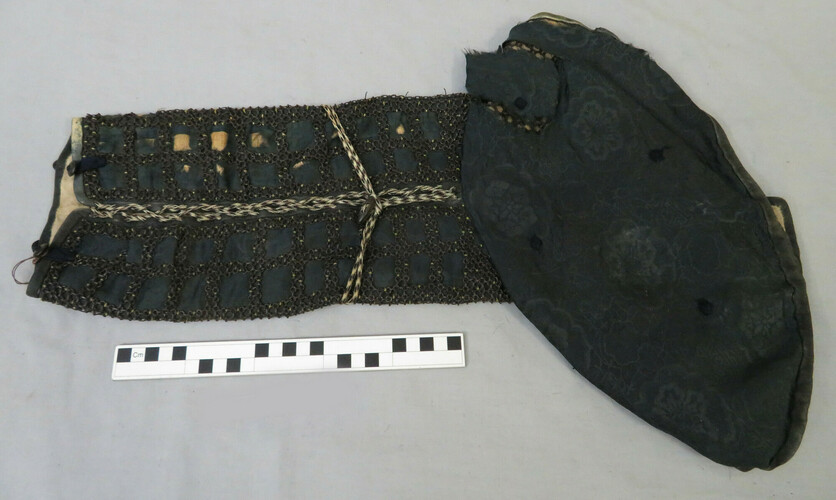 1898.50.1.10Sleeve [kote], part of Samurai armour set. It is made of green patterned textile with chain mail attached, and has a yellowish cloth lining. It is close-fitting around the arm and flares at the shoulder area. It is fastened together by a mottled braided cord. There are four lengths of black braided cord in the shoulder area, and four horn toggles near the cuffs.1898.50.1.10
 1985.46.1.2Leather gauntlet, right, with beadwork decoration and fringes. [N.B. 'DCF 2004-2006 What's Upstairs?' 31/3/2005]1985.46.1.2
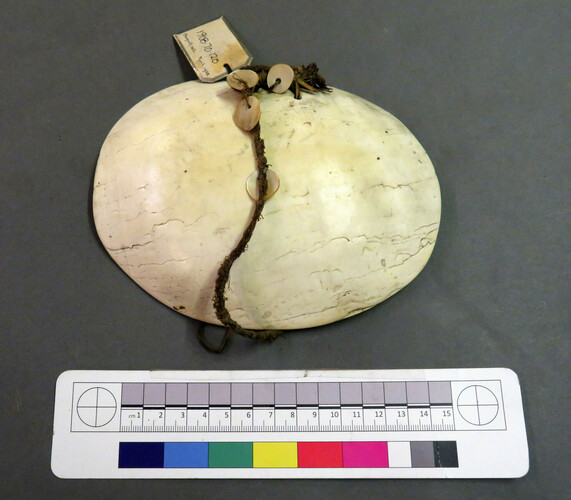 1908.70.120Shell protection for lower half of face. [MOBB [OPS move] 1/9/2017]1908.70.120