
- Collection type
- Object
- Description
- Gilt bronze band; now broken into 2 pieces
- Long description
- Copper-alloy band (broken in half) with four studs that have been pierced through the band and soldered or fuse welded in place. The two finished ends come to a tear-drop point with perforations. The object appears to be gilded. [CG [Excav. PR] 24/01/2013]
- Geographical reference
- England Kent Shepway Folkestone Castle Hill [Caesar's Camp] "Outer rampart"
- Person
- Maker Unknown Maker
- Field collector Augustus Henry Lane Fox Pitt-Rivers
- PRM source Augustus Henry Lane Fox Pitt Rivers founding collection
- Date / Period
- Archaeological period: Medieval
- Date collected
- 1878 June 12
- Acquisition information
- Donated: 1884
- Materials and processes
- Material Copper Metal, Material Gilt Metal, Process Gilded, Process Perforated
- Dimensions
- Thick: max 8 mm, Thick: max 8 mm, Width: max 9 mm, Width: max 9 mm, Length: max 65 mm, Length: max 66 mm, Weight 11 g
- Object numbers
- Accession number: 1884.138.34.1 Accession number: 1884.138.34.2 Other numbers: 34 PR no.: ?/ 12191
- Research and responses
Described by Pitt-Rivers (1883: 442, 464) as "Copper gilt band ornamented with four studs similar to the one on fig. 27, perhaps a fragment of horse furniture; found 3 feet 10 inches (1.169m) beneath crest, in body of Outer Rampart, June 12th.'", and illustrated as Fig. 34 on Plate XIX [CG [Excav. PR] 24/01/2013] [Dan Hicks 20/03/2013]
Further described by Pitt-Rivers (1883: 447-448) as: "a copper gilt band (Plate XIX. fig. 34), ornamented with four studs on one side exactly similar to that represented in Plate XIX. fig. 27, and found in the trenches in the interior of the Citadel. The section of the band of copper is flat on one side and convex on the other, its greatest thickness 0.13 inch (0.002 m.) and breadth 0.24 inch (0.006 m.), the studs are on the convex side, and it is bent towards the flat side. The ends are pointed and turned up towards the convex side and pierced with holes 0*14 inch (0*002 m.) in diameter for the reception of nails or rivets. What use it served I am unable to conjecture; the gilding adhered to the copper in places; it is 4-86 inches (0-123 m.) in length." [Dan Hicks 20/03/2013]
Further information and research notes on this site compiled in the 1970s by Revd. AH Gibson are held at Folkestone Library (see correspondence and copies of Gibson's notes in RDF) [JC 7.11.96]
OED online: Clench: I. That which clenches or is clenched. 1. That part of a nail or bolt which is turned back in clenching. Also CLINCH. [AP 03/10/2006]
- Associated publications
- Pitt-Rivers, A.H.L.F. 1883. Excavations at Caesar’s Camp, near Folkestone conducted in 1878. Archaeologia 47: 429-465 - illustrated as Fig. 34 on Plate XIX. [Dan Hicks 20/03/2013]
Search terms: Tool, Unidentified Object
Further items to explore
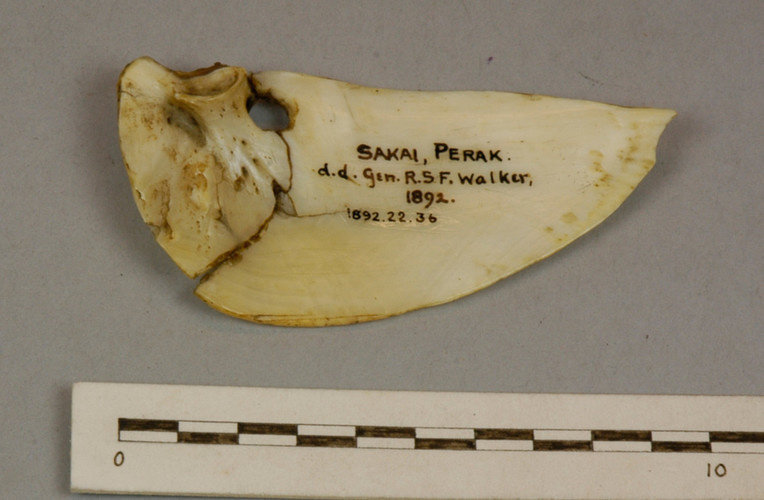 1892.22.36Object made of tortoise bone (?plastron) with a perforation near one edge. [SM 13/11/2007]1892.22.36
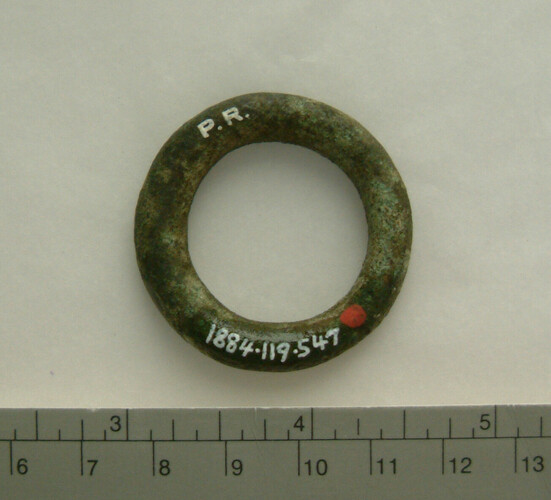 1884.119.547Metal ring.1884.119.547
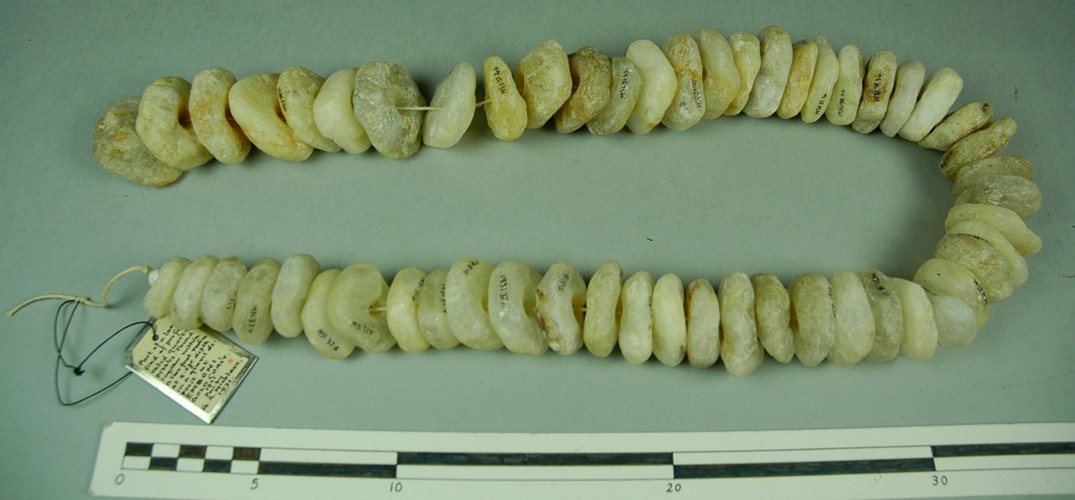 1931.37.1Circular roughly carved quartz stone with small perforated hole in the centre. [MJD 15/12/2009]1931.37.1
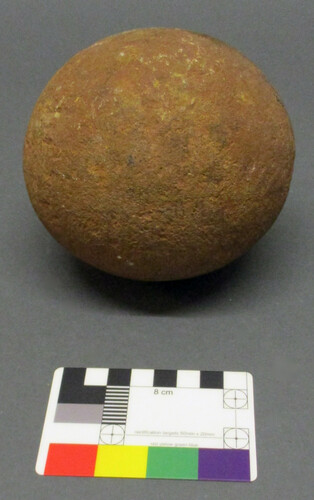 1952.3.11Stone. Roughly spherical red stone. Possibly a pounder. [AB [OPS Move] 31/10/2016]1952.3.11
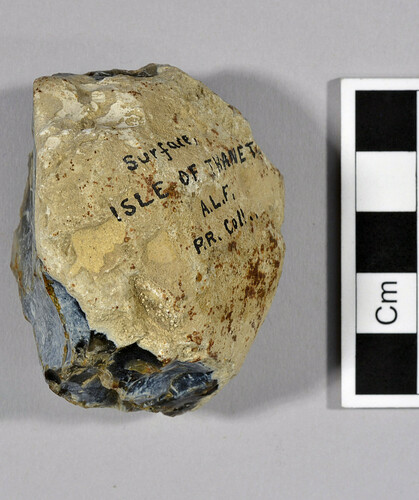 1884.123.293Stone core; recorded by Pitt-Rivers as a 'flint ball'.1884.123.293
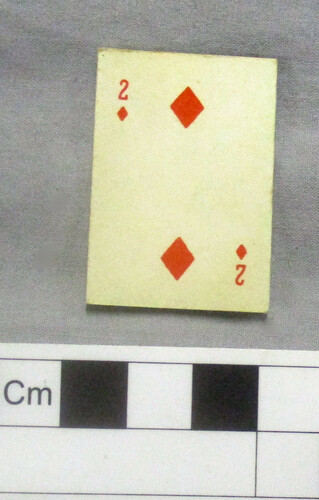 1985.36.214.3Two of Diamonds playing card. The reverse of the card is printed green with a white rabbit and butterfly depicted in the centre of the card. See 1985.36.214 .1 for the box and 1985.36.214 .2 - .53 for the cards that are part of this set. [ASh [OPS move] 20/06/2016]1985.36.214.3
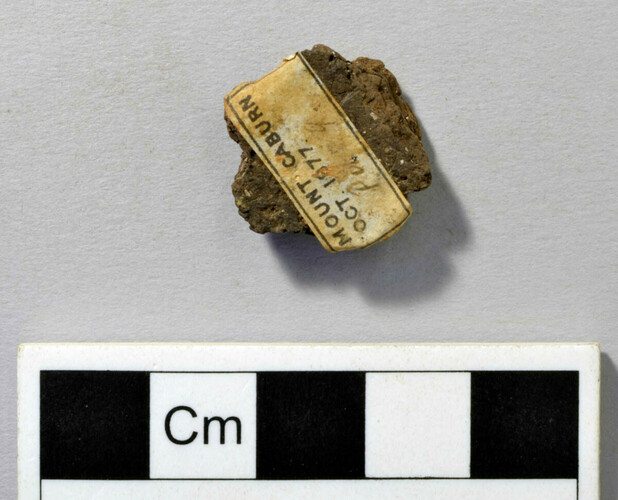 1884.137.58.77Ceramic sherd1884.137.58.77
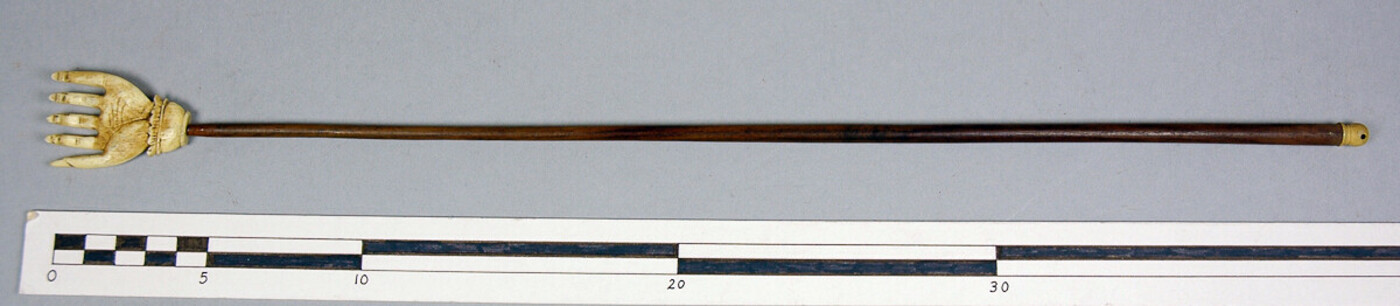 1895.50.1Back scratcher in the form of a hand carved from ivory on the end of a long thin wooden handle. [JP 29/10/2001]1895.50.1