
- Collection type
- Object
- Description
- Axe, probably for ceremonial use, with semi-circular tanged blade set in curved wooden handle bound with bands of decoration in brass and copper wire. [LM 16/07/2007]
- Long description
- The handle of the axe is made of a length of dark wood which widens out into a crescent shape at the top. The blade is inserted into the centre of the crescent shaped section. The blade is made of iron (badly rusted) and is roughly semi-circular with a protruding pole running from the middle of the straight edge of the semi-circle. This pole fixes the blade to the main body of the axe. The axe is decorated at points along its length with binding in copper and brass wire. At the end the handle is perforated and a strip of hide has been tied through to enable the axe to be hung up or carried with the hide. [MdeA 14/2/2002]
- Geographical reference
- Date / Period
- Date made: Circa by 1950?, uncertain
- Date collected
- By circa 1950?
- Acquisition information
- Donated: 25/05/2000
- Materials and processes
- Material Wood Plant, Material Iron Metal, Material Brass Metal, Material Copper Metal, Material Metal Wire, Material Animal Skin, Process Bound, Process Forged (Metal), Process Carved
- Dimensions
- Width: max 177 mm, Length: max 697 mm
- Object numbers
- Accession number: 2000.21.5
Search terms: Weapon, Tool, Ritual and Ceremonial, Axe, Ceremonial Object
Further items to explore
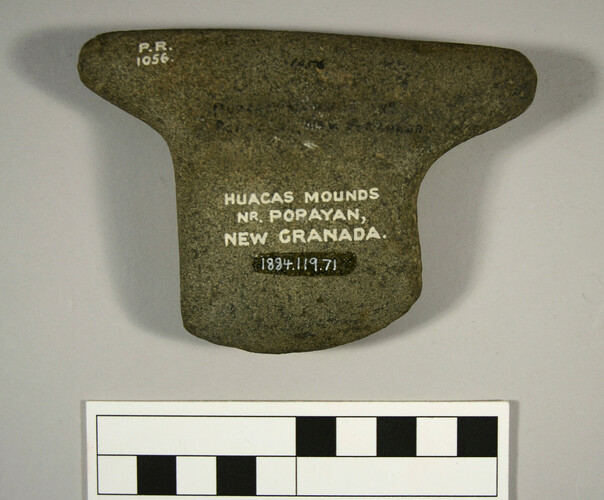 1884.119.71Stone axe with projecting lugs at straight top and curved blade. [MJD (Verve) 30/3/2016]1884.119.71
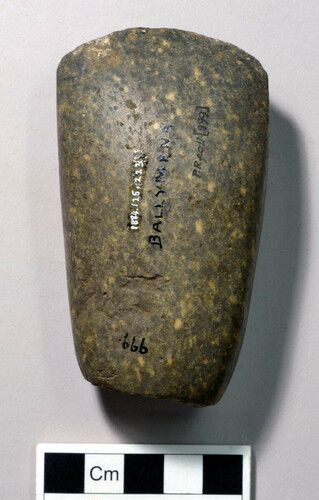 1884.125.223Stone axe1884.125.223
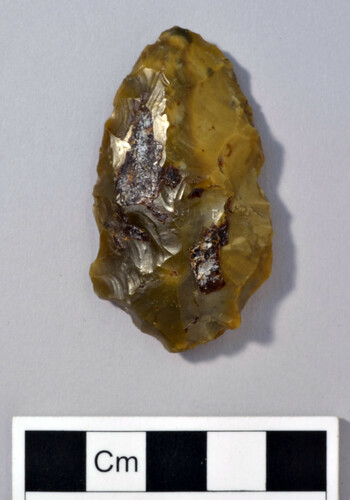 1884.123.397Stone arrow-head or axe1884.123.397
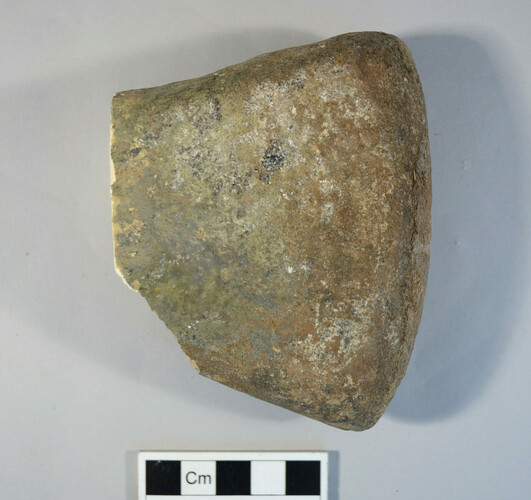 1978.20.415.1Half of a large ground stone axe. [MJD (Verve) 22/5/2017]1978.20.415.1
 1935.13.106.544Stone flake of yellow ochre colour with strong dorsal crest and short straight proximal and distal edges.1935.13.106.544
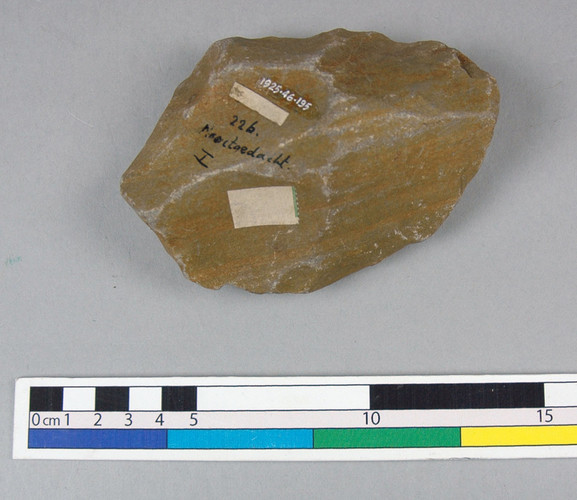 1925.46.195Stone tool - water worn handaxe. [LKG 17/02/2010]1925.46.195
 1935.13.106.202Yellowish white semi translucent stone flake with one curved edge.1935.13.106.202
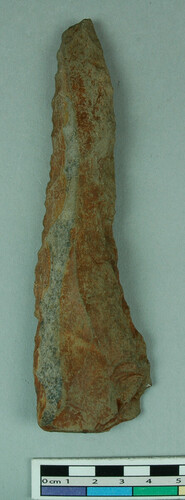 1946.3.1Stone tool; gently tapering towards the distal edge with a dorsal ridge. [MJD 09/07/2010]1946.3.1