
- Collection type
- Object
- Description
- Roughly made arrow head. [MJD 09/04/2014]
- Geographical reference
- Midwestern USA Ohio Licking County Flint Ridge
- Cultural groups
- Native American
- Person
- Field collector William Henry Holmes
- PRM source Smithsonian Institution
- PRM source William Henry Holmes
- Date
- Date collected
- By 1894
- Acquisition information
- Exchanged: 1894
- Materials and processes
- Material Chalcedony Stone, Process Flaked
- Dimensions
- Depth: max 18 mm, Width: max 33 mm, Length: max 52 mm
- Object numbers
- Accession number: 1944.11.2.51 Other numbers: S.I. Cat. No. B. Eth. 698.
- Research and responses
On page 82 of Michael Petralgia and Richard Potts 2004 Smithsonian Contribution to Anthropology volume (no. 48) 'The Old World Paleolithic and the Development of a National Collection' the exchange of objects between the Smithsonian and Balfour is described: "In 1891, the U.S. National Museum exchanged specimens with Henry Balfour, curator of the Ethnographical Department, Pitt Rivers Collection, University Museum, Oxford, England...Part of the small exchanged collection [sent to the Smithsonian] consisted of Paleolithic objects from Les Eyzies, France, and the rest were from an unknown location in France. Balfour and Holmes exchanged collections and corresponded on the similarities and differences between Old World Paleolithic artifacts and Native American specimens from Piney Branch Quarry in Washington, D.C." The Smithsonian online catalogue http://anthropology.si.edu/onlinedatabases.html shows 18 objects donated by Balfour to the Smithsonian, one in 1899 (accession no. 22646), six in 1890 (accession no. 23266) and eleven in 1891 (accession no. 24708). It has not been possible based on the PRM catalogue to determine which objects Balfour sent Holmes in exchange for the Smithsonian North American stone tools, and it may be that Balfour was acting in a private capacity and donating from his personal collection. [MN 08/10/2009]For a background to this material see p 228 of Swanton, R. J. (1935) Biographical Memoir of William Henry Holmes 1846-1933. National Academy of Sciences of the USA, Biographical Memoirs Volume XVII,223-252:
" After his appointment to the Bureau of American Ethnology in 1889 to take charge of its archeologic field work, Holmes made an exhaustive study of the Indian quarries on Piney Branch Creek and the west side of Rock Creek in the District of Columbia and later extended his survey to include the entire valley of the Potomac and the region west of it as far as the Alleghany,as also the tidewater sections of Maryland and Virginia. Incidental trips were made to mound groups in Wisconsin, Arkansas, Georgia, Mississippi, and Ohio, the novaculite quarries at the Hot Springs of Arkansas, quarries at Flint Ridge, Ohio, and in the northeastern part of the present Oklahoma, and the red pipestone quarries of Minnesota, besides the aboriginal copper mines on Isle Royale, Lake Michigan. In 1892-93 he examined the
site of the famous Trenton finds in the Delaware Valley.
Much of this work was motivated by a heated discussion among the archeologists of the period as to the occurrence of paleolithic implements in America similar to those in the Old World. Numbers of crudely flaked stones had been collected and gathered into museums under the name of "paleoliths" and finds of such implements in situ were reported from various places in North America, particularly the Delaware Valley, where it was claimed that human artifacts had been found under glacial gravels, while remains indicating a far greater antiquity were reported from California. Noting the striking resemblance of most of these so-called "paleoliths" to rejected material he had observed about Indian workshops, Holmes took a pronounced stand against the validity of the paleolithic theory as applied to America, and, so far as the bulk of this material was concerned, his views were soon triumphantly substantiated, the protagonists of any but a very moderate antiquity for man in America being placed wholly on the defensive, though it should be added that Holmes himself perhaps inclined somewhat too far in the opposite direction." [AS 16/07/2010]
Search terms: Archery Weapon, Tool, Arrow-head
Further items to explore
 1921.91.404.52Barbed and tanged arrow-head. One barb is rounded, the other is squared. The arrowhead has a very heavy patina. [MN 20/11/2008]1921.91.404.52
 1911.86.92.2Glass arrowhead.1911.86.92.2
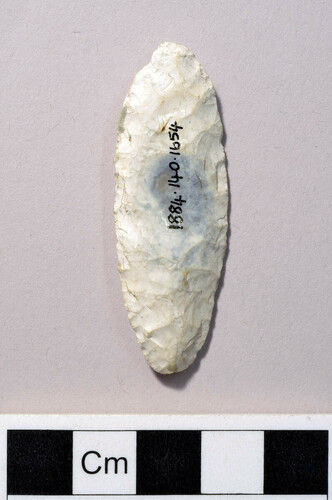 1884.140.1654Stone arrow-head1884.140.1654
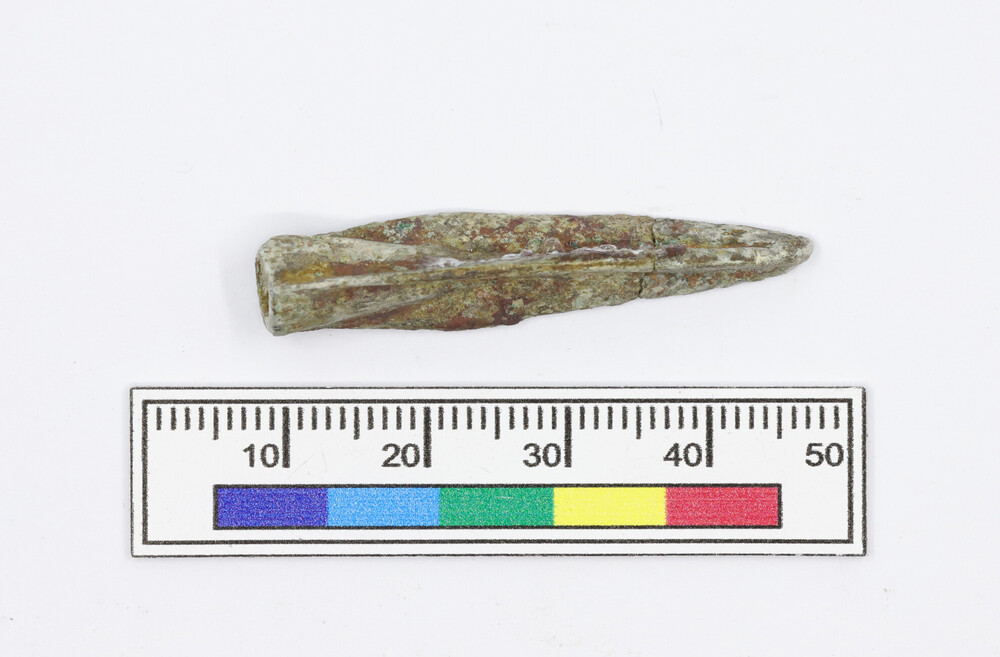 1926.80.2Bronze socketed arrowhead.1926.80.2
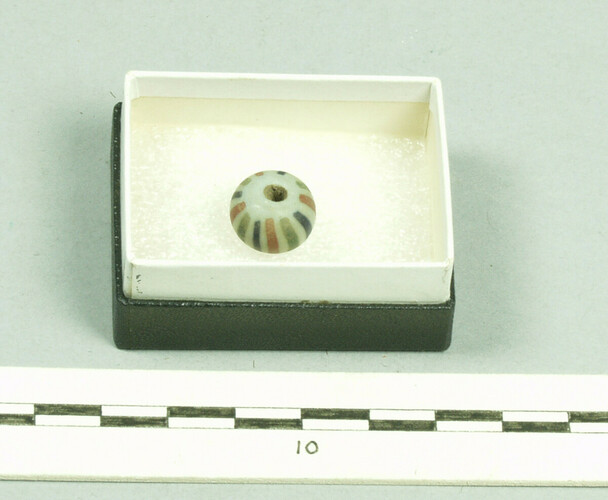 1955.5.72 glass beads [one of which is missing?]1955.5.7
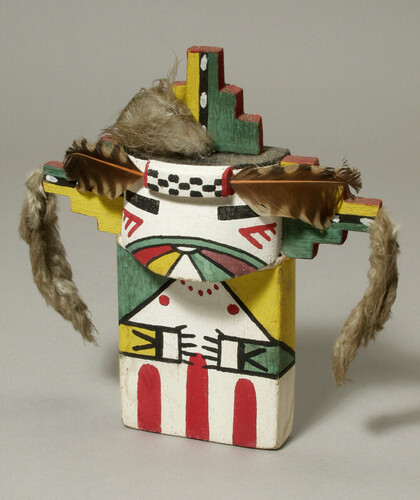 2001.66.5Wooden kachina doll, flat rectangular wooden body, with headdress, and feathers at top of the head and on both sides of face. [ZM 28/11/2005]2001.66.5
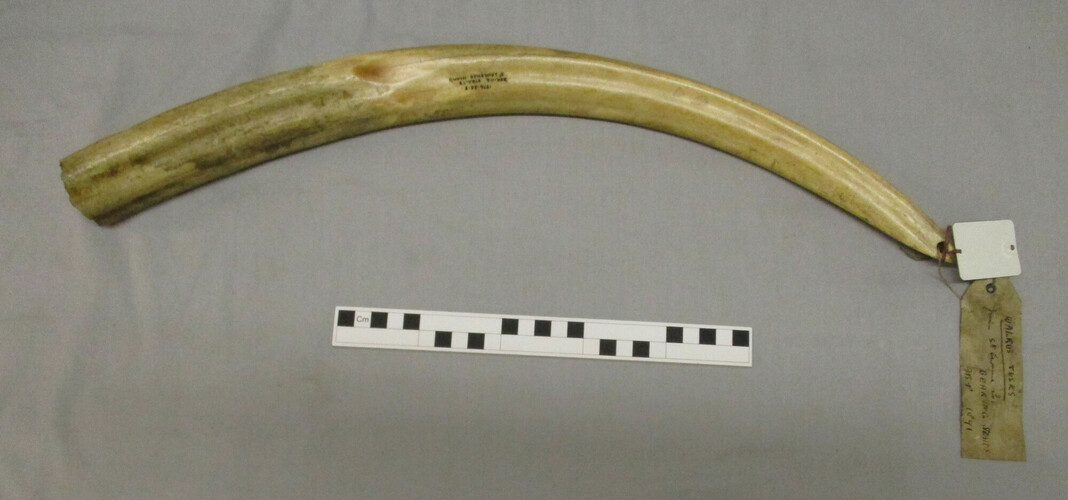 1974.22.9Walrus tusk which has been perforated at the tip. [CW [OPS move] 26/7/2016]1974.22.9
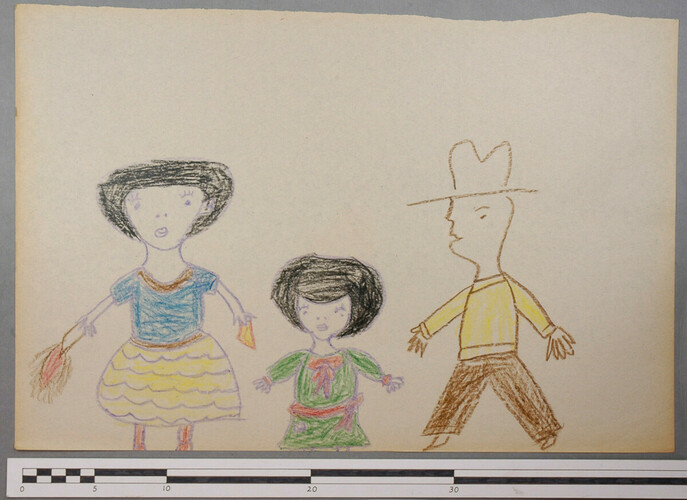 1994.15.1887Drawing in coloured crayon of a man, woman and girl. The woman and girl both have short black hair, the man is wearing a hat. [SM 13/05/2008]1994.15.1887