
- Collection type
- Object
- Description
- White pearl shell shank of fish hook used as currency. [ZM 5/9/2005]
- Geographical reference
- Senyavin Islands Pohnpei Island [Ponape]
- Date / Period
- Date made: Before 10/1873
- Date collected
- 20 September - 12 October 1873
- Acquisition information
- Donated: 1921
- Materials and processes
- Material Pearl Shell, Process Carved
- Dimensions
- Length: max 101 mm
- Object numbers
- Accession number: 1921.93.329
- Associated publications
- PRM Objects 1899.82.5.1-.31 and 1921.93.329-.330 are discussed on pages 219-220 of 'The Role of Fishing Lure Shanks for the Past People of Pohnpei, Eastern Caroline Islands, Micronesia', by Paul Rainbird, in Atholl Anderson, Kaye Green, and Foss Leach (eds), Vastly Ingenious: The Archaeology of Pacific Material Culture in Honour of Janet M. Davidson (Otago: Otago University Press, 2007), pp. 217-226. Rainbird writes: 'F. W. Christian...recovered 80 shell lure shanks from the central tomb on the mortuary islet of Nan Douwas. The Pitt Rivers Museum in Oxford, England, holds in its collection 31 [1899.2.5.1-.31] of the lures excavated by Christian and a further two collected by C. F. Wood in 1873 [1921.93.329-.330]. The two collected by Wood are labelled "former currency" and although one is pearl white [1921.93.329] the other, a larger specimen 113 mm in length [1921.93.330], has eye-catching bright shades of gold, copper and silver. Although not reported directly in his publication...these lure shanks appear to have been carefully curated and remembered locally as having previously held a special value. [np] The Christian collection is described in the museum catalogue, taken from the writing on the box as perhaps originally accessioned, as "unfinished pearl shell fishing hook shanks". On inspecting the collection I found that it is clear that these are not unfinished, but apparently completed, used and broken prior to deposition in the tomb.... [219/220] Of particular note in regard to the Christian collection is that certainly 30 of the 31 have been broken in antiquity and possibly the exception has too, but this was difficult to discern. Most commonly the shank has been broken somewhere near the base, thus reducing the length of the lure. This contrasts with the two collected by Wood, which are clearly unbroken and complete. Could it be that broken lure shanks have deliberately been deposited in the tomb.' Eight of the objects in the Christian collection are illustrated in Figure 14.1 on page 220: 'A selection of lures from the Christian collection.' (Photocopy of article in RDF.) [JC 8 10 2019]
Search terms: Fishing, Currency, Fishing Accessory, Token
Further items to explore
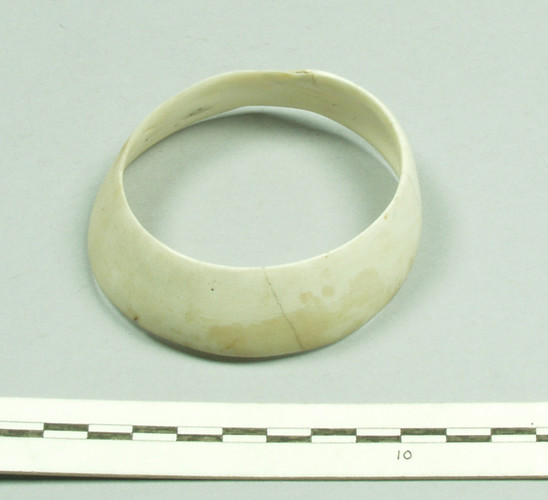 1921.93.312Armlet made by cutting transverse sections through a white shell. [El.B 'DCF 2004-2006 What's Upstairs?' 24/11/2005]1921.93.312
 1921.27.15Fish-hook of shell shank and shell hook. The hook and small tuft of plant fibre is bound to the shank with plant fibre string. [MJD 16/03/2009]1921.27.15
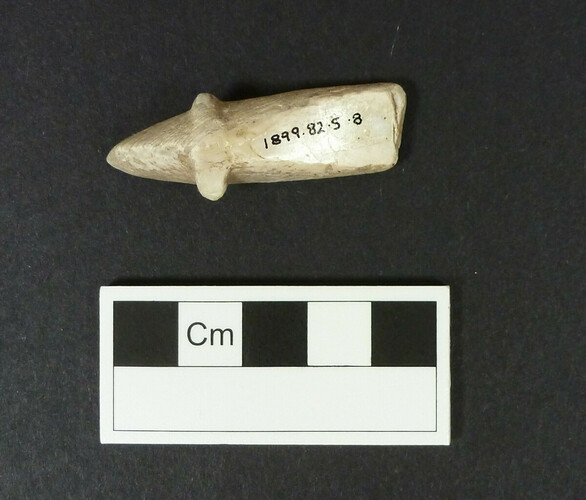 1899.82.5.8Unfinished shell shank of fishing hook, from excavations at the central vault at Nan Madol.1899.82.5.8
 1908.73.3Woven sash1908.73.3