
- Collection type
- Object
- Description
- Bamboo weeding hoe. [JC [OPS Move] 15/12/2016]
- Long description
- Bamboo weeding hoe. It consists of one strip of bamboo bent into a triangular loop with the handles crossed, to form a straight cutting edge and an X-shaped handle. The junction is bound with cane. [JC [OPS Move] 15/12/2016]
- Geographical reference
- Northern Shan State Kachin Hills Manbat
- Cultural groups
- Singpho
- Date / Period
- Date made: Before 1934
- Date collected
- By 1934 [By 1931 ?*]
- Acquisition information
- Donated: 1934
- Materials and processes
- Material Bamboo Plant, Material Cane Plant, Process Bent, Process Tied, Process Bound
- Dimensions
- Depth: max 31 mm, Width: max 133 mm, Length: max 238 mm
- Object numbers
- Accession number: 1934.81.57
- Research and responses
It is most likely that Green collected this item at source. [SHD 5/2/2001]
'Kachin' in many sources often includes all or most of the Tibeto-Burman speaking peoples of the Kachin State area. Green, however, is more precise than this, using the term only for Jinghpaw speaking peoples, specifically the southern Jinghpaw speakers whom he calls Jinghpaw, and the northern Jinghpaw speakers, whom he calls Hkahku. In this case we can therefore be confident that 'Kachin' refers to Jinghpaw people. [SHD 7/2/2001]
At first it seemed to SHD that this collection may have some to Oxford as early as the end of 1930, and thus have been collected in Burma before that time. One suspected this because of it originally having been listed with the G D Walker collection (see comment at the beginning of the accession book entry, above). The Walker collection (1931.87) was accessioned in 1931 but sent from Assam, India by Walker before 11 November 1930 (see his letter to this effect in Related Documents File). Included in this Green collection (1934.81) however, are items indicated by a related document to have been collected in 1931 by Green from W. ?Biber (1934.81.9, 12, 31-51 & 82). In practice, the Green collection may simply have been entered in the same notebook as the Walker collection because there remained pages to be filled in that book - i.e. there may or may not be a substantive connection between the two collections. [SHD 30/1/2001]
The objects referred to by the single entry in accession book IX were given the retrospective number 1934.55 in that accession book. Those objects are entered individually in the Green collection catalogue. In this volume, the collection had been given the retrospective accession number 1934.81, and this is the number used. [CW 6/4/2000]
Search terms: Tool, Agriculture and Horticulture, Hoe, Agricultural Tool
Further items to explore
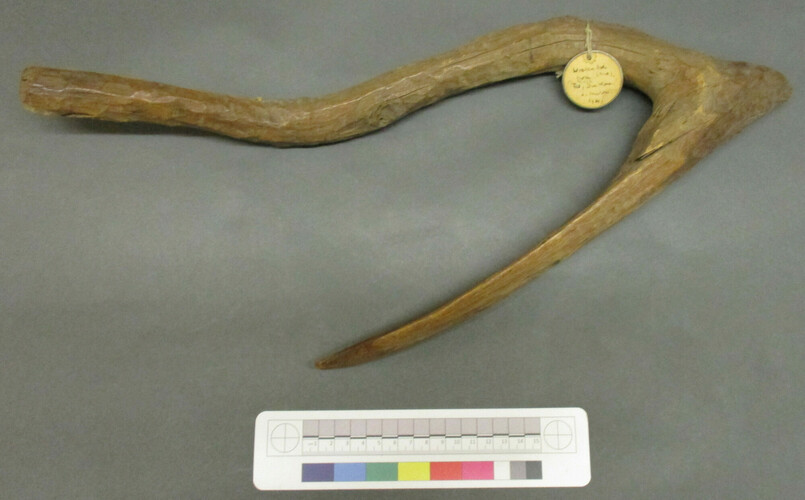 1954.5.82Wooden hoe. Roughly carved from wood with an angular blade head with a pointed tip. The handle curves naturally with the wood. [AB [OPS Move] 2/12/2016]1954.5.82
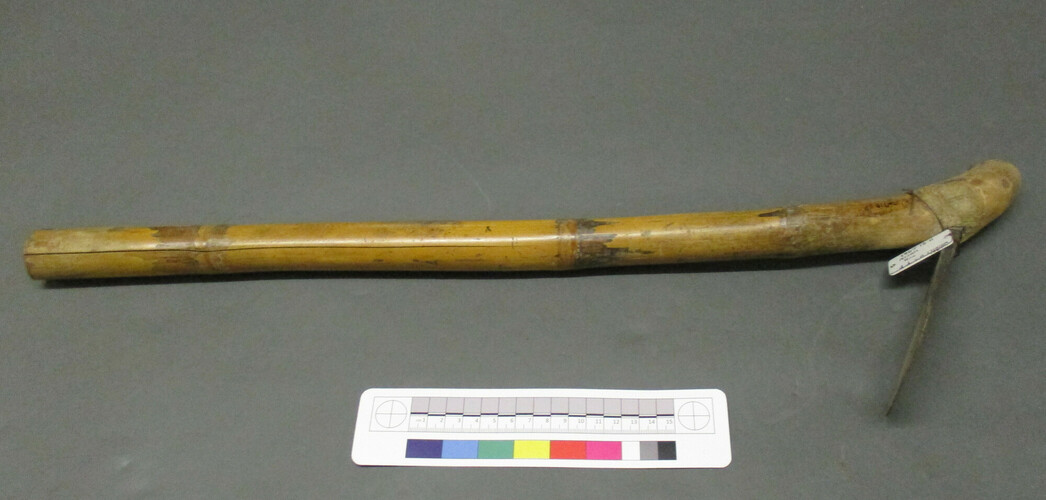 1967.18.11Hoe. With an iron blade set into a bamboo handle. The blade flares from the tang and has a rounded cutting edge, it is set into the root-end of the bamboo handle at an acute angle. The handle is mostly straight, it curves slightly at the head where it becomes the root. [AB [OPS Move] 12/1/2017]1967.18.11
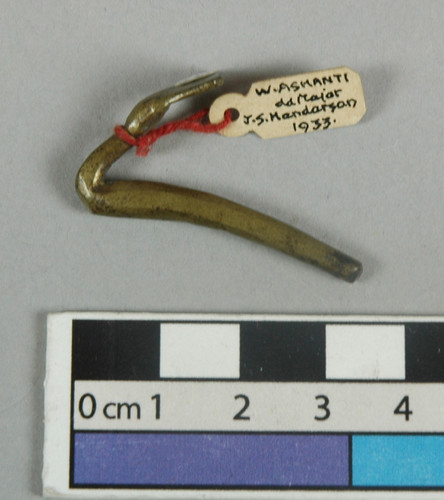 1933.66.24Copper alloy weight for weighing gold representing a hoe. [MJD 22/06/2011]1933.66.24
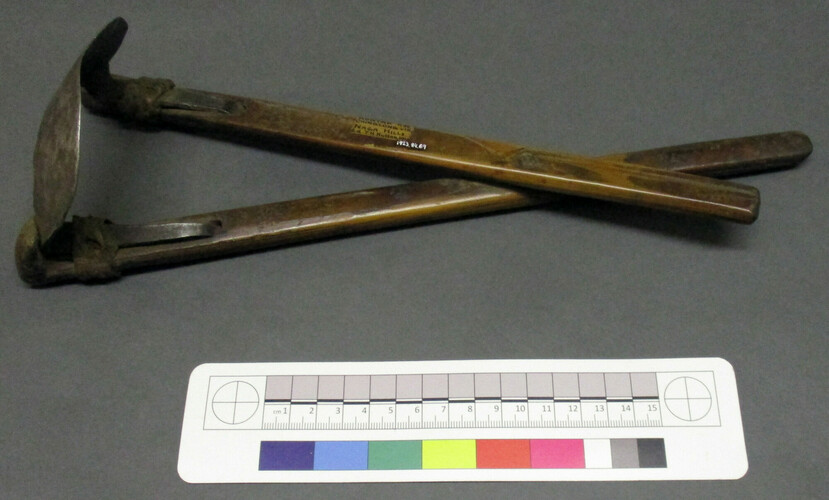 1923.84.69Hoe, with an iron blade set into two wooden handles, which cross and are fixed with a wooden peg. [AB [OPS Move] 13/12/2016]1923.84.69
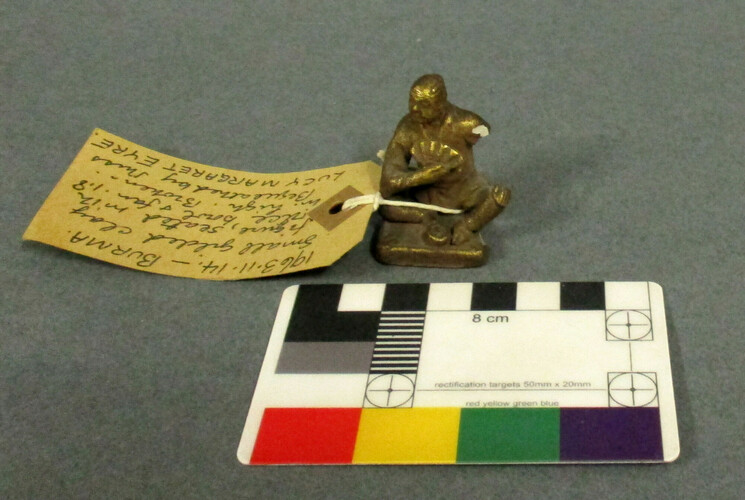 1963.11.14Figure of gilded plaster. Figure of a seated man holding a fan and a rice bowl on a square-shaped base. [BA [OPS move] 14/6/2017]1963.11.14
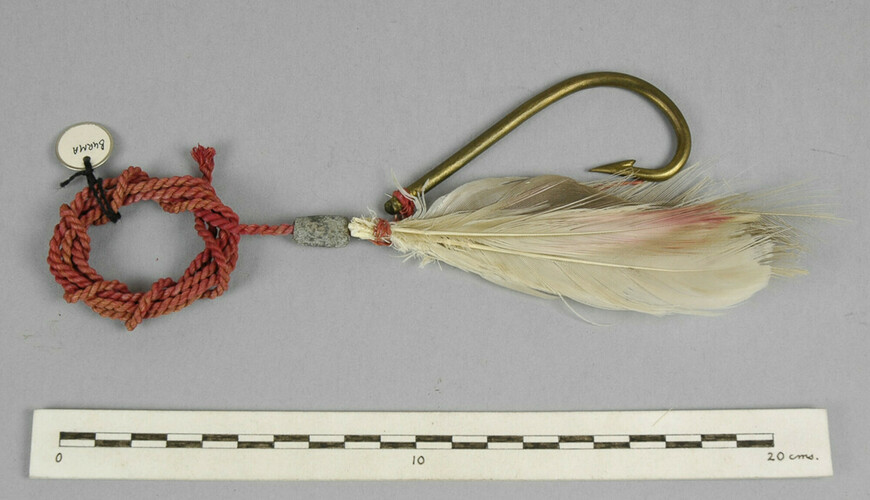 1889.9.52Single-barbed, brass fish-hook with bunch of feathers as a lure, attached to red cord with lead weight. [LM 09/05/2007]1889.9.52
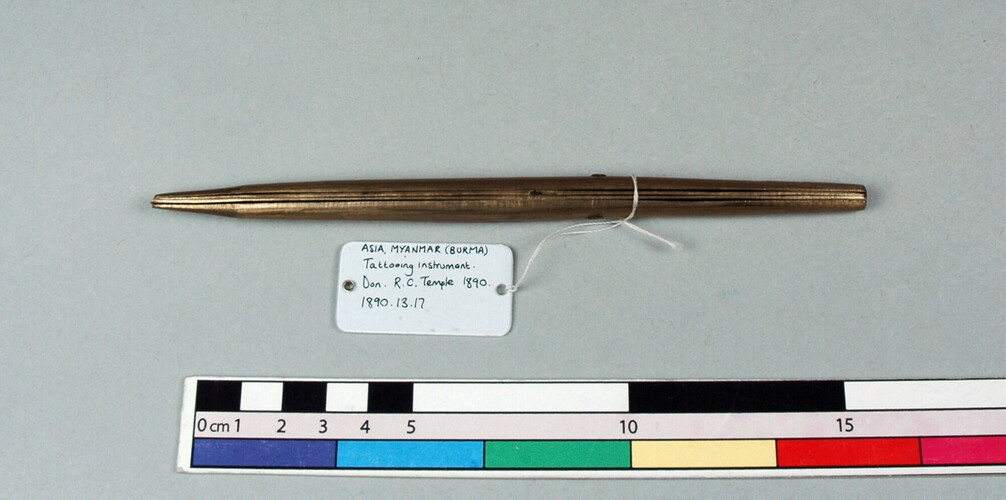 1890.13.17Tattooing instrument : Pencil shaped brass tool split longitudinally into 6-8 pieces fastened together.1890.13.17
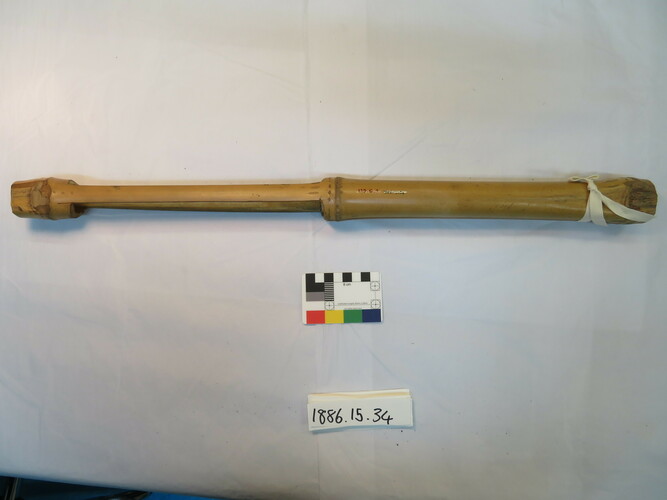 1886.15.34Clapper made from a piece of split bamboo.1886.15.34