
- Collection type
- Object
- Description
- Carved spiral bark belt. Incised and carved with an elaborate decoration on the exterior, which has been infilled with lime. Perforated with two holes vertically at the end of the belt. Threaded through with plant fibre. [ASh [OPS move] 18/08/2016]
- Geographical reference
- Gulf Province Kikori District Orokolo Bay
- Cultural groups
- Orokolo (Western Elema)
- Date / Period
- Date made: Before 1937
- Date collected
- By 1937
- Acquisition information
- Donated: 1938
- Materials and processes
- Material Bark Wood Plant, Material Pigment, Material Plant Fibre, Material Bark Cloth Textile Plant, Process Carved, Process Painted, Process Beaten, Process Perforated
- Dimensions
- Diameter: max 245 mm, Height: max 115 mm
- Object numbers
- Accession number: 1938.36.149 Other numbers: Blackwood ii 149
- Research and responses
The carving and incising of kava and other wooden objects in Papuan Gulf societies was conventionally the remit of specialist carvers known as evera-haero or mai-ore-haera – ‘men with skill of hand’. Papuan Gulf art tends to take the human figure (usually sexed) as its subject, and it is a distinctive characteristic of the regional composition style to depict the figure within a lozenge-shaped cartouche. To fit this lozenge-shaped zoning, the figure is surrounded with ‘filler’ motifs. This style of ornamental composition is essentially the same on kava, shields, harps and double suspension-hooks from the region. It is unclear who the figures depict. The kava was the insignium of adult masculinity, and signified that a man belonged to the Semese (‘warrior’) age class. The Semese is the third and final stage of initiation which Elema youths underwent. When adolescent Elema had attained the previous initiation grade of Heapu, they were permitted to don the range of headdresses, armshells, neck ornaments, and clubs and spears, which they had been learning to manufacture during their period of seclusion in the Initiation House (Eravo). They were somewhere in between children who had begun to be initiated (Heava) and the adult warriors (Semese). During the Heapu stage, Elema youths were instructed in several important matters of citizenship, including military skills, the responsibilities and legalities of married life, sexual morality, the responsibilities of individuals to perform infanticide in cases of extreme hardship or twin births, and so on. Heapu were permitted to associate with fully initiated Semese, and their body ornaments indicated that they were in transition to full warriorhood. However, their lack of a kava belt showed that they had not yet completed their training. Prior to complete attainment of the status of Semese, the Heapu were required to undergo a number of ordeals to demonstrate their fortitude. Central among these were the chewing of large quantities of ginger root (upe), and drinking the urine of the Semese chief. Provided a youth could undergo these ordeals, he was taken into the bush and introduced to the ‘god’ Tiparu – a fearsome entity who is described as being a source of much fear for Elema children and women. Upon initiation, the new Semese were shown that Tiparu is nothing more than the bullroarer, and instructed in its use and various drones. Those Elema born illegitimately were not permitted to undergo initiation, were not considered to be true Elema, and never served as warriors in defence of the group. Consequently, the kava was not only the insignium of warriorship and adulthood, but of valid and legitimate Elema ethnicity also. Relevant Reading: Holmes, J. (1902) Initiation Ceremonies of Natives of the Papuan Gulf. In: The Journal of the Anthropological Institute of Great Britain and Ireland, Vol.32, pp.418-25. Williams, F.E. (1936) Papuans of the Trans-Fly. Oxford: Clarendon Press. Williams, F.E. (1940) Drama of Orokolo: The Social & Ceremonial Life of the Elema. Oxford: Clarendon Press. Guiart, J. (1963) The Arts of the South Pacific. Newton, D. (1963) Multiple Human Figures in Western Papuan Gulf Art. In: Man, Vol.63, pp.86-90. London: Thames & Hudson. Research Conducted for DCF Cutting Ede 2006/2007 [AM]
Search terms: Clothing, Armour Weapon, Belt, Armour
Further items to explore
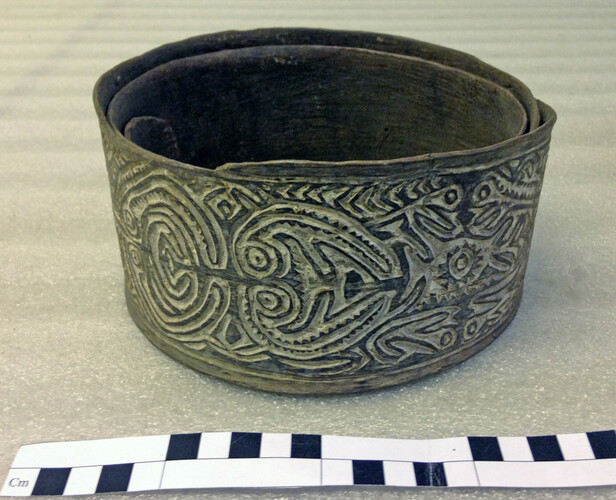 1902.79.25Bark belt carved on one side with anthropomorphic designs highlighted in white lime. Perforated with four holes near to the end of the belt. [FB 05/03/2015]1902.79.25
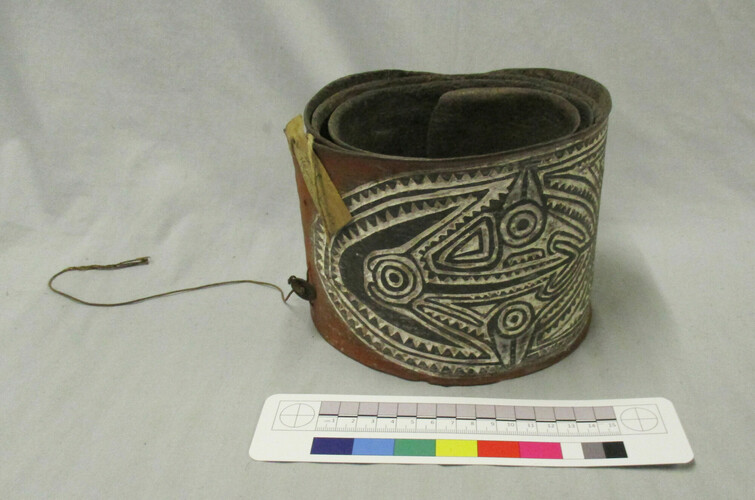 1938.36.356Carved spiral bark belt with incised and carved decoration on the surface that has been infilled with lime and ochre. Perforated with two holes at the end of the belt and threaded with a plant fibre thread. There is a button attached to the end of the string. [ASh [OPS move] 18/08/2016]1938.36.356
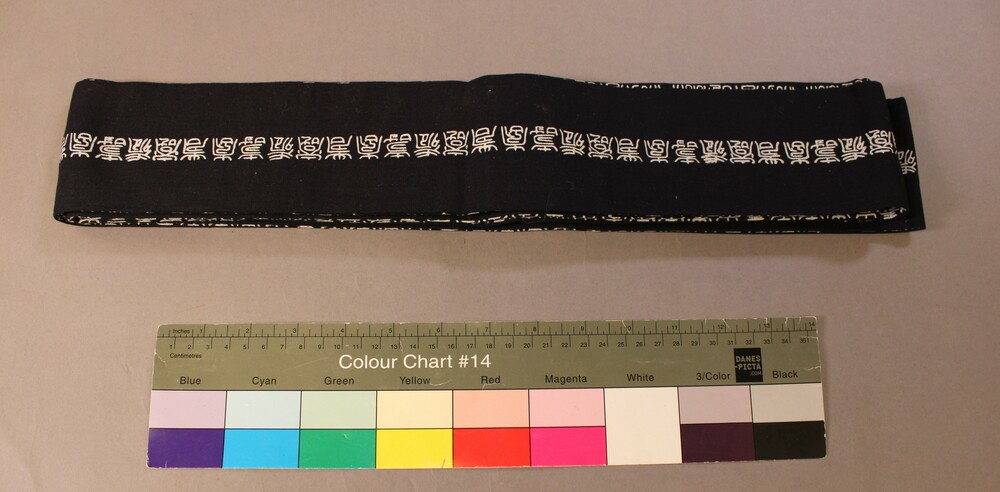 1996.17.271An obi (sash) for a man, dark blue decorated with a line of kanji characters in a formal Chinese style.1996.17.271
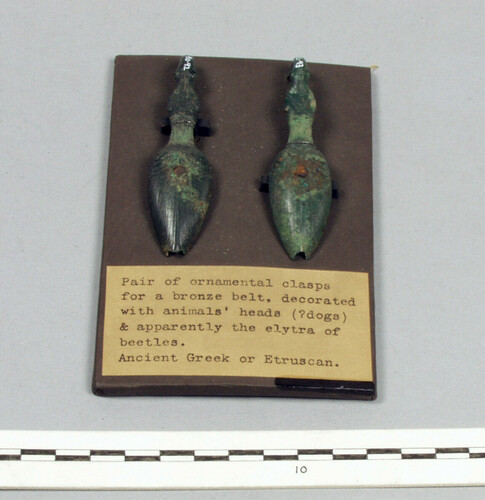 1884.80.42Bronze belt ornament from Greece or Italy [Dan Hicks 01/05/2012]1884.80.42
 1938.36.571Bamboo tobacco pipe.1938.36.571
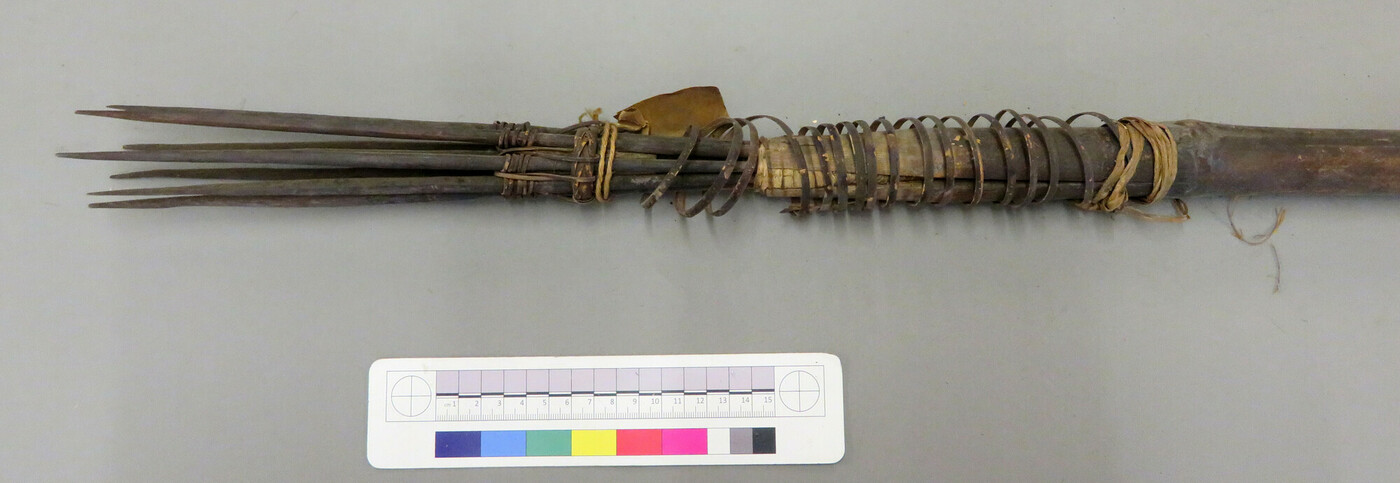 1938.36.70Fishing spear with 8-pointed head and bamboo shaft. Points are bound on with caning and plant fibre. Head is tanged. [VS [OPS move] 20/8/2018]1938.36.70
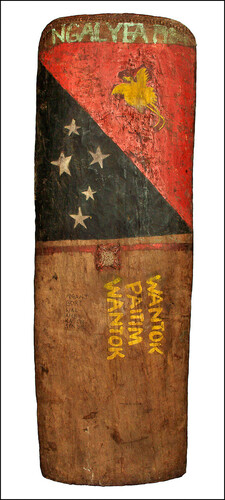 2001.56.2Wooden shield.2001.56.2
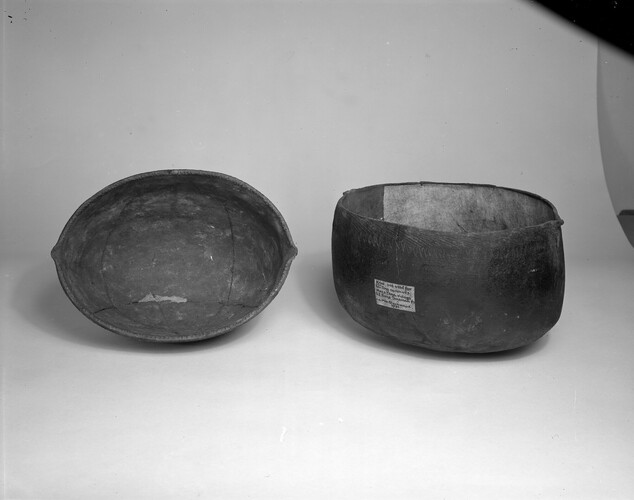 1931.86.66Elliptical pottery bowl with lip at each end. Rim decorated with incised lines.1931.86.66