
- Collection type
- Object
- Description
- Bundle of palm leaves dyed red. [LM 'DCF 2004-2006 What's Upstairs?' 21/9/2005]
- Date / Period
- Date made: Before 10/1930
- Date collected
- By October 1930
- Acquisition information
- Donated: 1931
- Materials and processes
- Material Palm Leaf Plant, Material Pigment, Process Dyed
- Dimensions
- Length: max 670 mm
- Object numbers
- Accession number: 1931.86.262 Other numbers: Blackwood number 261
- Research and responses
Excerpt from Beatrice Blackwood's notes on Upis: 'These hats are worn by adolescent boys in North Bougainville. They used to be worn in Buka also but there have been discontinued. They are put on at the age of 7 or 8 (approximately) with elaborate ceremony/which takes place in the bush and is tambu to women. From this time onwards the boy's hair may not be cut, but is pushed up inside the hat. He may never be seen wihtout it, except in the privacy of the boy's houses (tobar), where he must sleep. He may not enter any house in which a woman lives, not even that of his own mother. There are numerous other restrictions, some of which are removed after a second ceremony (watawutch), which takes place at the discretion of the chief, when there is enough food. The final ceremony (wasipsip) at which the hair is cut and the upi finally taken off and burnt, may be deferred till the youth is seventeen or eighteen years old. After this he may live with his wife, and is a fully fledged member of the community. The Upi is made of the leaves of a small palm (win) which is plentiful in the bush. The leaves are dried in the sun, and then flattened out, and fixed upon a basis of cane. For cermonial use a pattern is cut out of some of these leaves dyed red, and red leaves are also introduced into the plain upis worn on ordinary days. The dye is made of the bark of one tree and the root of another. The latter is known to all the people, but the former is the secret property of the inland tribes, from whom the red leaves are brought by the coast tribes. It acts as a mordant, apparently, since the dye obtained by using the root alone, though effective at first, fades rapidly. The shape differs a little in various localities. The patterns are traditional.' Photographs: 'palm from which upis are made'; 'ceremonial upis'; 'boys wearing upis'; boy with upi removed.' [GI 29/11/2001]
Search terms: Clothing Headgear, Ritual and Ceremonial, Plant, Specimen, Status
Further items to explore
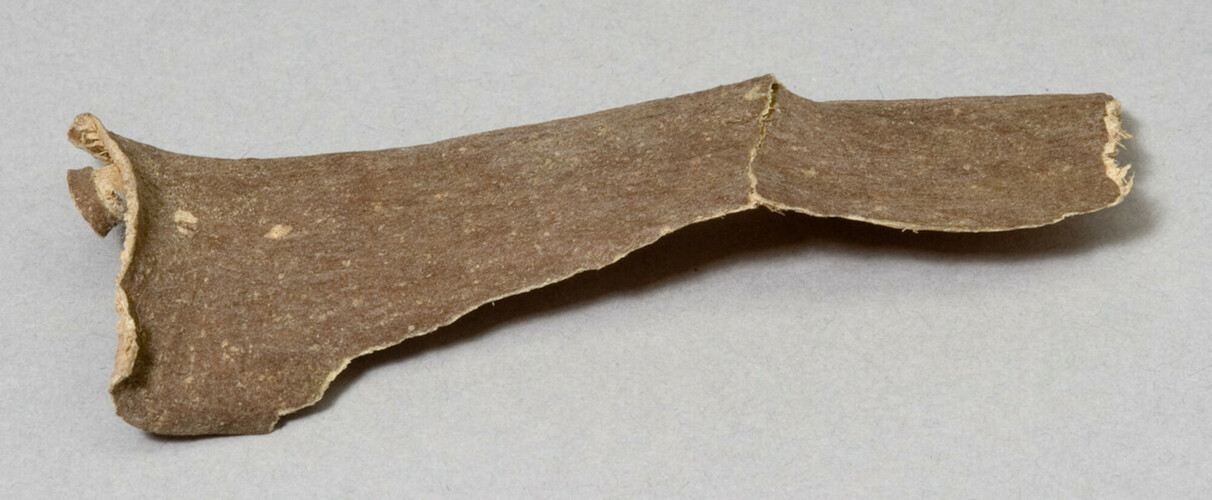 2005.114.13.11Piece of bark. Possibly a dye. Found inside [2005.114.13 .1 - .2] along with [2005.114.13 .3 - .10] and [2005.114.13 .12 - .18] [EH [OPS Move] 8/5/2017]2005.114.13.11
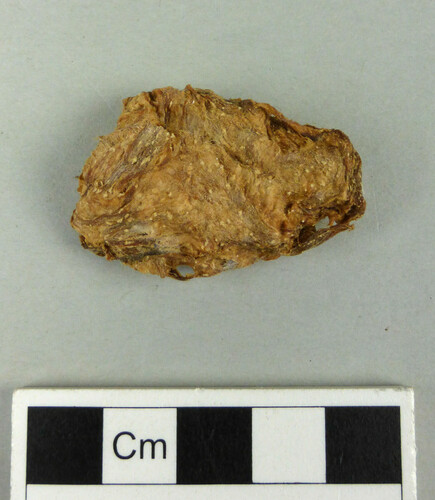 1948.10.39Sample of bark-pulp for paper-making. Part of a set of paper-making materials.1948.10.39
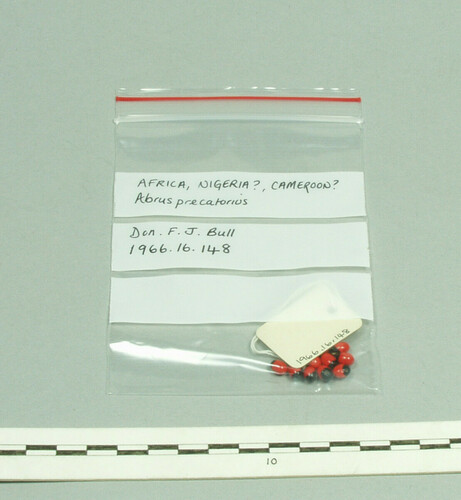 1966.16.148One of a collection of beads and seeds. Ten red and black abrus precatorius seeds. [JP 16/1/2003]1966.16.148
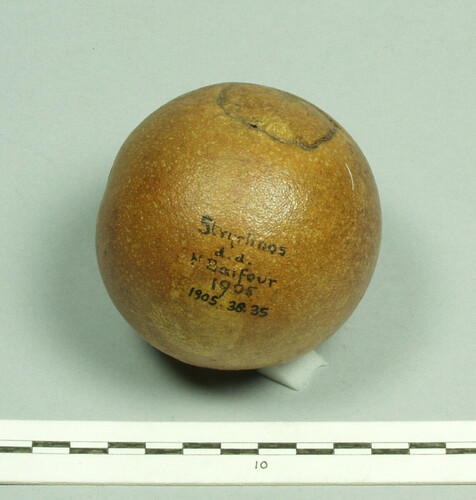 1905.38.35Orange fruit.1905.38.35
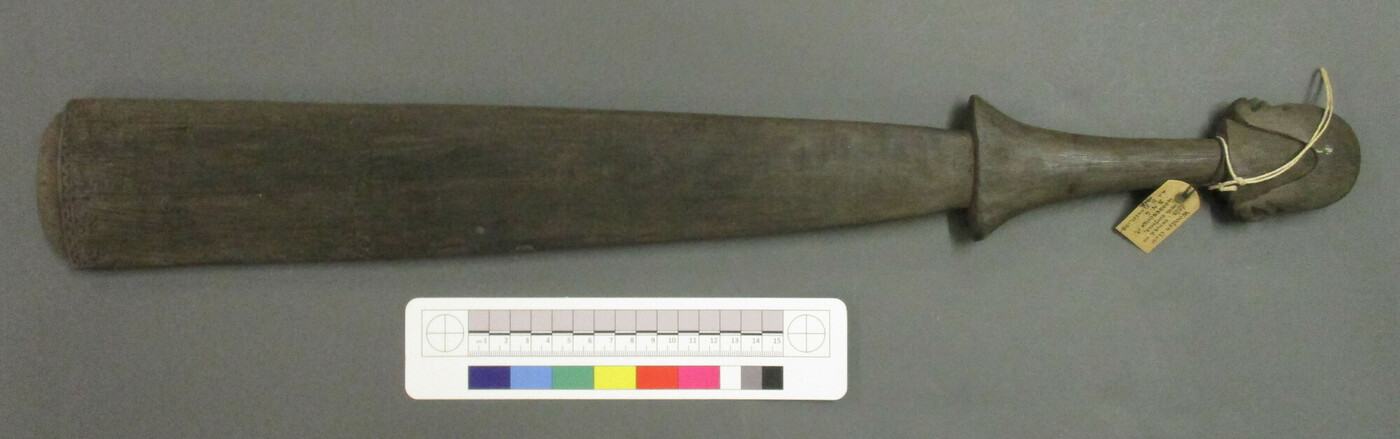 1919.58.108Spatulate club with incised scrollwork at the top of the blade on both sides and a restricted, rounded projection at the distal edge. There is a flared grip and rounded butt carved with a face on each side. [JC [OPS Move] 16/09/2016]1919.58.108
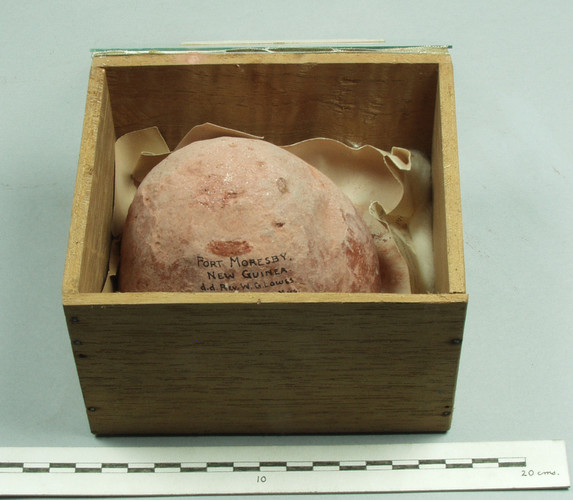 1887.1.545Conical cake of red earth (used as cosmetic) [El.B 'DCF 2004-2006 What's Upstairs?' 17/2/2006]1887.1.545
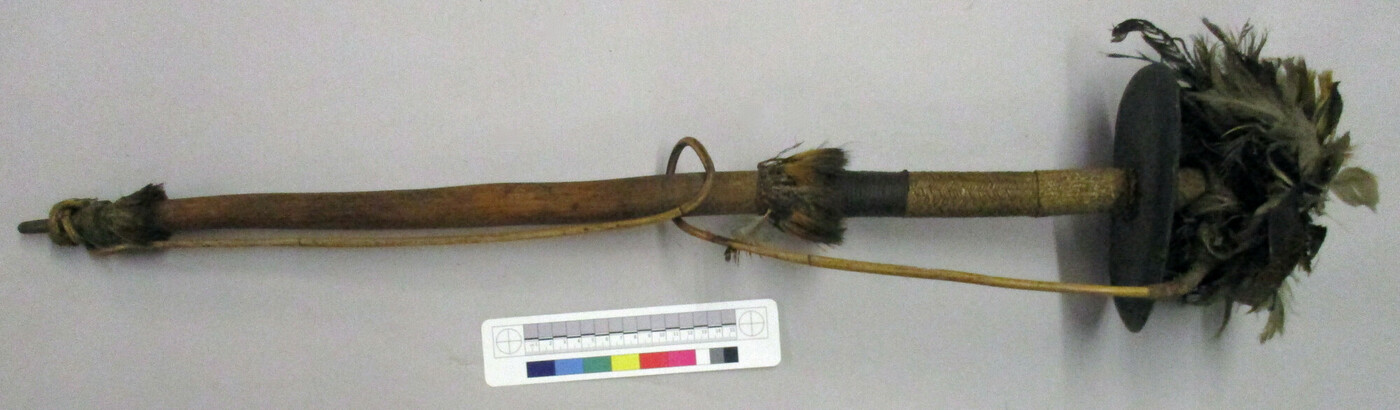 1904.60.13Club with perforated discoidal stone head. [BS [OPS Move] 16/08/2016]1904.60.13
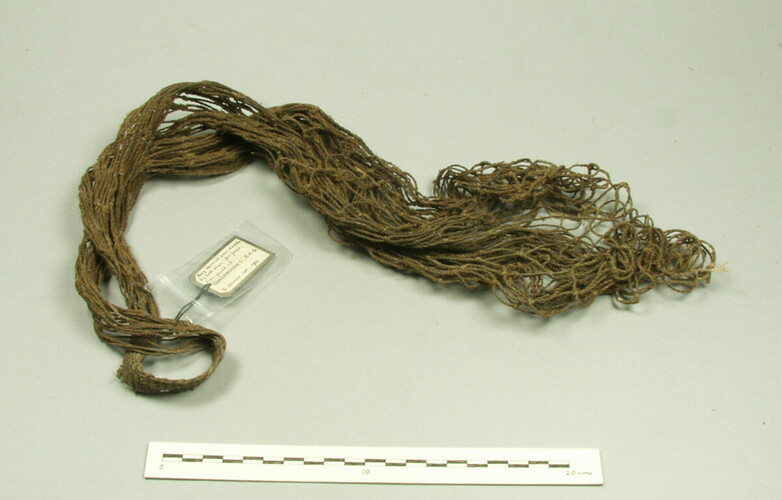 1913.88.165Knotted string bag with shoulder strap, used by both sexes for carrying food, lime-gourd, etc. [LM 'DCF 2004-2006 What's Upstairs?' 17/1/2006]1913.88.165