
- Collection type
- Object
- Description
- Stone tool, hand axe
- Long description
- 'A quartzite biface made either from a flake struck from a nodule, or more likely from a split pebble. It is markedly plano-convex in profile, but does not have a typical Wolvercote pointed-pyriform shape. The butt is unworked on the less flat face, and the original pebble surface can be seen.' (From page 74 of The Wolvercote Channel Handaxe Assemblage: A Comparative Study, by Joyce A. Tyldesley (BAR British Series 153), Oxford: B.A.R. (1986).) [AS 20/07/2011; JC 15 1 2015]
- Geographical reference
- England Oxfordshire Oxford Wolvercote Wolvercote Brick Pit
- Person
- Maker Unknown Maker
- Field collector Alexander James Montgomerie Bell
- PRM source Archibald Colquhoun Bell
- Date / Period
- Archaeological period: Lower Palaeolithic Acheulian
- Date collected
- 1908
- Acquisition information
- Purchased: 1920
- Materials and processes
- Material Quartzite Stone, Process Flaked
- Dimensions
- Width: max 85 mm, Length: max 125 mm, Weight 355 g
- Object numbers
- Accession number: 1921.91.473.23
- Research and responses
In 1894 Alexander James Montgomerie Bell published two articles about Palaeolithic remains from Wolvercote in volume 30 of the journal Antiquary. Full references: Bell, A.M. 1894. 'Palaeolithic Remains at Wolvercote, Oxfordshire'. Antiquary 30: 148 - 152. and Bell, A.M. 1894. 'Palaeolithic Remains at Wolvercote, Oxfordshire, No. II'. Antiquary 30: 192 - 198. [MN 05/06/2009]
In 1900 a third paper was published by Bell updating his discoveries at the site. Full Reference: Bell, A.M. 1900. 'On the Occurrence of Flint Implements of Palaeolithic Type on an Old Land-Surface in Oxfordshire, Near Wolvercote and Pear-Tree Hill, Together with a Few Implements of Various Plateau Types' The Journal of the Anthropological Institute of Great Britain and Ireland 50: 81. This paper can be accessed online through JSTOR. The stable URL is http://www.jstor.org/stable/2842715. [MN 05/06/2009]
A. M. Bells most detailed publication on the Wolvercote deposits was published in 1904 in the Quarterly Journal of the Geological Society. Full reference: Bell, A.M. 1904. 'Implementiferous Sections at Wolvercote (Oxfordshire)'. Quarterly Journal of the Geological Society 60: 120-132. This paper can be accessed online through the Geological Societies Lyell Collection. The URL is http://jgslegacy.lyellcollection.org/cgi/content/abstract/60/1-4/120. [MN 05/06/2009]
The Oxford University Museum of Natural History also holds a considerable number of geological specimens collected by Bell from Wolvercote, see: Q.00285 - Q.00378, Q.00829 - Q.00909 and Q.01758 - Q.01763. The OUMNH catalogue can be accessed online at http://www.oum.ox.ac.uk/database/geology/pleicene.htm. [MN 05/06/2009]
The Wolvercote Brick Pit [SP 4977 1043, now a lake] from which this object was recovered is recorded on the English Heritage maintained National Monuments Record under monument no. 336734. This record can be accessed online at http://pastscape.english-heritage.org.uk/hob.aspx?hob_id=336734. [MN 05/06/2009]
This object was studied by Hyeong Woo Lee as part of his doctoral dissertation submitted in 2000, entitled A Study of Lower Palaeolithic Stone Artefacts from Selected Sites in the Upper and Middle Thames Valley, with Particular Reference to the R.J.MacRae Collection. Lee numbered each object according to his own system, with objects labelled with a small, round red sticker. This sticker was removed when numbered. This tool was numbered by Lee '62' [AS 03/02/2011].
This object was examined by Joyce Tyldesley for her PhD published with B.A.R. in 1986. See publications list below. [AS 21/07/2011]
Thirty-four handaxes from Wolvercote in the PRM's collections formed one of the datasets discussed in 'A Re-Examination of Variability in Handaxe Form in the British Palaeolithic', by Kate Emery (London: University College London, Ph.D. thesis, 2010). (Available online at http://discovery.ucl.ac.uk/19299/1/19299.pdf .) [JC 5 5 2017]
- Associated publications
- Described on page 74 and illustrated (Figure 2.76) on page 75 of The Wolvercote Channel Handaxe Assemblage: A Comparative Study, by Joyce A. Tyldesley (BAR British Series 153), Oxford: B.A.R. (1986). Tyldesley writes (page 74): '(76) Figure 2.76* L 109mm, B 85mm, T 41mm [no weight given; JC]. A quartzite biface made either from a flake struck from a nodule, or more likely from a split pebble. It is markedly plano-convex in profile, but does not have a typical Wolvercote pointed-pyriform shape. The butt is unworked on the less flat face, and the original pebble surface can be seen.' [AS 19/07/2011; JC 21 1 2015]
Further items to explore
 1917.9.15.29Stone tool, flake. [MJD 31/05/2013]1917.9.15.29
 1884.122.76Stone implement1884.122.76
 1954.7.13.22Stone tool; implement of roughly textured light brown colour, with broken off distal tip, converging lateral sides & dorsal crest. [LKG 26/07/2010]1954.7.13.22
 1921.91.405.142Flint flake, dark greyish orange in colour, roughly rhombus shaped. [MJD DDF Body Arts Project 2010/2011 10/02/2011]1921.91.405.142
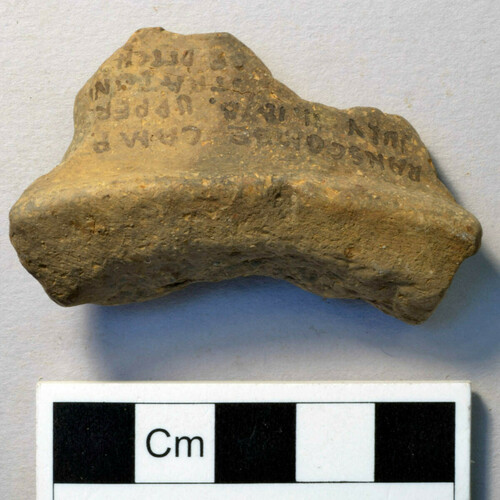 1884.136.8.16Ceramic base sherd1884.136.8.16
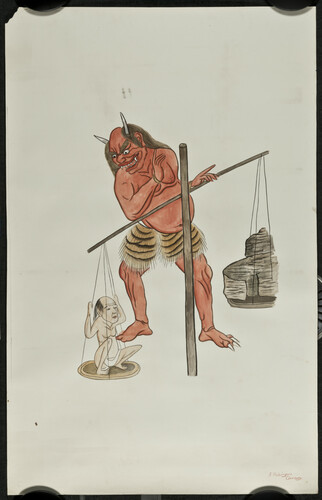 1944.1.73Watercolour painting showing one of a number of ideas regarding death and the afterlife1944.1.73
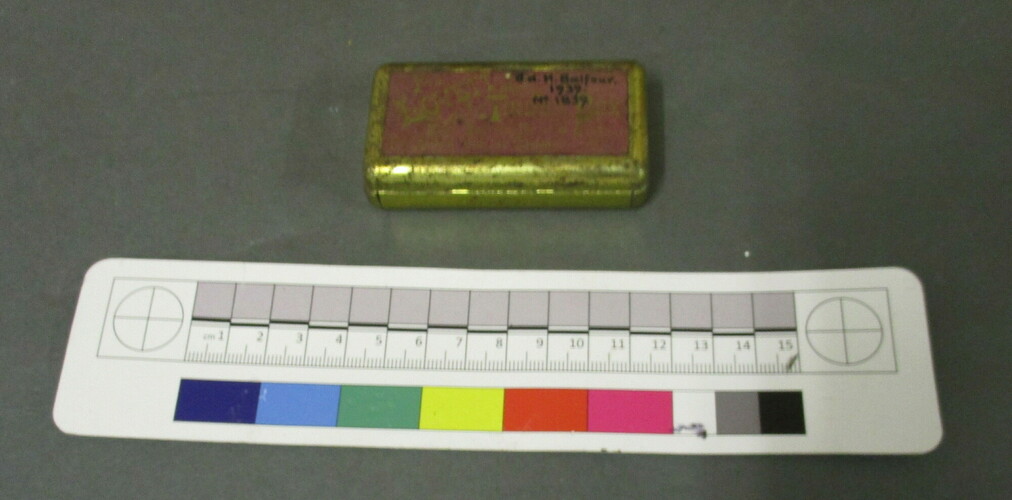 1938.35.1171.1Brass tinder box with hinged lid. Rectangular in shape with rounded corners. For the other constituent parts see [1938.35.1171 .2 - 5]. [CW [OPS Move] 29/3/2017]1938.35.1171.1
 1900.37.2Heavily patinated natural flake (an eolith) of flint stone. Patina is a dark orangish brown colour. [MN 25/02/2009]1900.37.2