
- Collection type
- Object
- Description
- Flint flake with possible retouch on one dorsal edge suggesting possible use as a side scraper. [MN 12/02/2009]
- Long description
- Flint flake with possible retouch on one dorsal edge suggesting possible use as a side scraper. On the dorsal face approx. 95% of cortex remains. The flake is heavily weathered and rolled with a well developed orangish mid brown patina. [MN 12/02/2009]
- Geographical reference
- England Oxfordshire Oxford Iffley Cornish's Pit
- Person
- Maker Unknown Maker
- Field collector Alexander James Montgomerie Bell
- PRM source Archibald Colquhoun Bell
- Date / Period
- Archaeological period: Lower Palaeolithic Acheulian
- Date collected
- By 1920
- Acquisition information
- Purchased: 1920
- Materials and processes
- Material Flint Stone, Process Flaked, Process Retouched
- Dimensions
- Depth: max 13 mm, Width: max 34 mm, Length: max 53 mm, Weight 25 g
- Object numbers
- Accession number: 1921.91.459.61 Other numbers: 415
- Research and responses
The gravel pit from which the Iffley palaeolithic tools were recovered is often recorded as being located at SP 525 044 [see page 91 of John Wymer’s 1968 book Lower Palaeolithic Archaeology in Britain, as Represented by the Thames Valley] or in the vicinity of SP 528 033 [see page 250 of Derek Roe’s 1968 report A Gazetteer of British Lower & Middle Palaeolithic Sites, Council for British Archaeology, Research Report 8]. The former location is adjacent to the Thames and Donnington Bridge and underneath the City of Oxford Rowing Club, the latter centred on the Rose Hill estate built to the south of Iffley village in the mid 20th century. Both locations are inaccurate, and it is believed the actual location is 250m further east than the Wymer reference, and 1.3km further north than the Roe reference. Near contemporary reports place the site at 'Cornish's Pit' [see http://england.prm.ox.ac.uk/englishness-Iffley-Bell.html for details]. Historic Ordnance Survey maps show only one gravel pit in the area, this pit is present on the 1st Edition 1:2500 County Series [published for this area between 1875 and 1878] and has disappeared by the time of the first revision [published between 1899 and 1900]. By the mid 20th century the pit had been built upon, and it is now buried beneath the rear garden of number 43 Donnington Bridge Road [SP 5272 0450]. [MN 24/02/2009]
Related Documents File - In box 106 [objects now transferred to box 104] a hand written card and a typed sheet of A4 were discovered. Both were written by R J MacRae. They both record MacRae's sorting of the Iffley Palaeolithic tools, the card in 1995 and the A4 paper on the 12th October 1990. Both documents are now in the RDF filed under 1921.91.459. Both the 1995 and the 1990 texts refer to Box 1 and Box 2, these are now boxes 104 and 103 respectively. The ruled card contained the following text: "Box 1 62 FLINT flakes + miscellaneous worked fragments. Box 2 56 fragments of flint + quartzite, ALL natural i.e. not artefacts. Many heavily rolled. R.J.M. [R.J. MacRae] sorted 1995." The typed A4 sheet contained the following text: "Two Storage Boxes. Box 1 contains undoubted artefacts, mainly much-rolled small bifaces and flakes in flint. One small quartzite biface. A few of the flint pieces are relatively sharp, but no mint-fresh. Severe edge-damage is noted on nearly all the pieces, and because of the heavily-rolled condition of the pieces it is sometimes difficult to distinguish from secondary working or trimming, especially on the flakes. There is an unusual proportion of 'points' on small flakes or chips. Small bifaces and unifaces are all pointed, and the majority are made on flakes. Box No 2. [pencil note adds 'Unknown box'] contains a slightly larger number, consisting of 'eoliths' and 'pot lids' which are patently natural. Some of the pieces are so very heavily abraded that identification is difficult (some may fall into the 'doubtful' category). Bell, as an early collector, had a liking for 'borers' and many of the natural pieces resemble these. Such shapes, however, are very common in the S/R [Summertown Radley] gravels, and are fragments of Northern Drift flint. The box of 'naturals' should be retained, however, for future comparison." He then goes on to briefly compare the Iffley collection with the material Bell collected from Wolvercote stating that "At no other site in the upper Thames are there so many artefacts worked on 'local' Drift flint". [MN 26/02/2009]
It seems that the only published reference to Iffley by Bell is on p129 in "Bell, A.M. 1904. 'Implementiferous sections at Wolvercote (Oxfordshire)'. Quarterly Journal of the Geological Society 60:120- 132." (copy in Related Documents File under 1921.91.473) [CB 29/10/2009]
- Associated publications
- In 2000 a selection of 145 Iffley tools were analysed by Hyeong Woo Lee as part of his PhD thesis on Lower Palaeolithic Stone Artefacts from Selected Sites in the Upper and Middle Thames Valley [St Cross College, University of Oxford]. The thesis was published as a British Archaeological Report [number 319, British Series] in 2001 under the same title. This object was one of those investigated by Lee under catalogue number 415 [2001: 198]. Lee describes this object as a side scraper made from local flint. Photographed on page 252 [2000]. Full references: Lee HW. 2000. A Study of Lower Palaeolithic Stone Artefacts from Selected Sites in the Upper and Middle Thames Valley, with Particular Reference to the R. J. MacRae Collection. Oxford University (St. Cross College): Unpublished D.Phil Thesis. Lee HW. 2001. A Study of Lower Palaeolithic Stone Artefacts from Selected Sites in the Upper and Middle Thames Valley, with Particular Reference to the R. J. MacRae Collection. Oxford: B.A.R (British Series 319). [MN 11/02/2009]
Further items to explore
 1928.68.337Flaked stone implement, brown in colour. [MJD 26/04/2010]1928.68.337
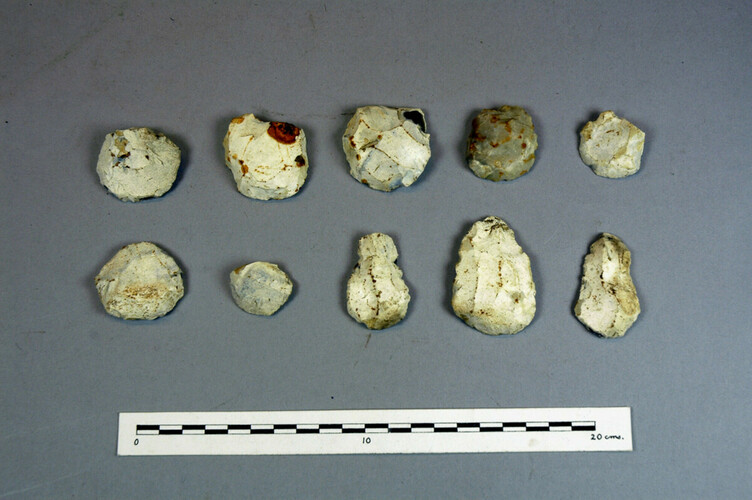 1905.75.1.11?Horseshoe? flint scraper, with retouch on the distal, right and left dorsal edges. [MN 22/10/2008]1905.75.1.11
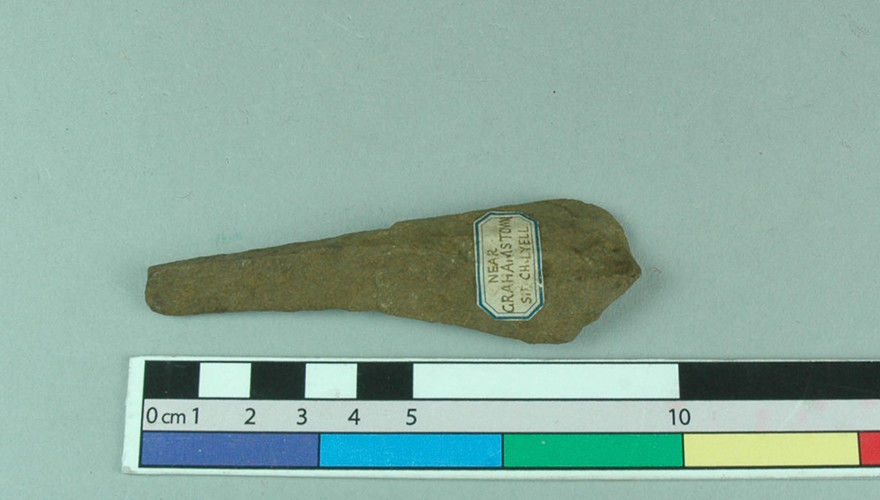 1928.68.385Flake implement of brown stone. Tapering from the proximal edge to a narrow distal edge. [LKG 28/04/2010]1928.68.385
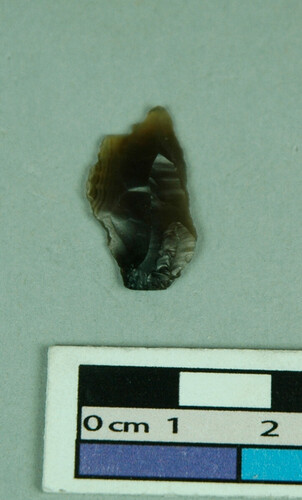 1927.42.27Stone flake, translucent and brown in colour, with edges retouched. [MJD 19/03/2010]1927.42.27
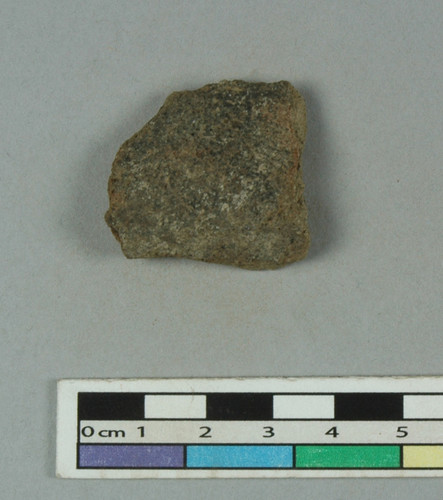 1884.138.5.105Ceramic sherd1884.138.5.105
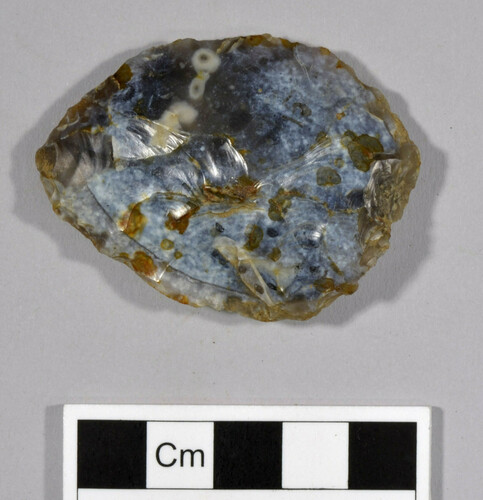 1884.140.1298Stone arrow-head or spear-head1884.140.1298
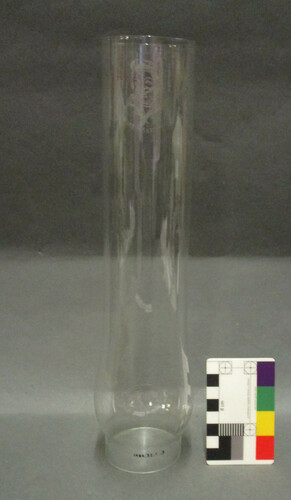 1986.32.1.3Clear glass chimney for use with brass oil lamp [1986.32.1 .1]. Towards the top of the chimney a sailor's head is etched, under which the words 'MADE IN SAXONY' are also etched. [MOBB [OPS move] 20/6/2017]1986.32.1.3
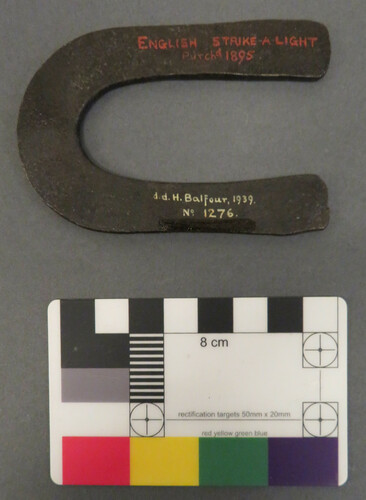 1938.35.594Fire steel. Flat sectioned, hippocrepiform in shape. [BS [OPS move] 6/9/2017]1938.35.594