
- Collection type
- Object
- Description
- Flint flake, grey in colour, with retouched concave notch on the right edge. [MJD DDF Body Arts Project 2010/2011 15/02/2011]
- Long description
- Flint flake, grey in colour, with retouched concave notch on the right edge. The flake has a dorsal crest. [MJD DDF Body Arts Project 2010/2011 15/02/2011]
- Geographical reference
- England Oxfordshire Oxford New Iffley
- Person
- Maker Unknown Maker
- Field collector Alexander James Montgomerie Bell
- PRM source Archibald Colquhoun Bell
- Date / Period
- Archaeological period: Neolithic, uncertain
- Date collected
- 5 December 1908
- Acquisition information
- Purchased: 1920
- Materials and processes
- Material Flint Stone, Process Flaked, Process Retouched
- Dimensions
- Thick: max 8 mm, Width: max 31 mm, Length: max 43 mm, Weight 11 g
- Object numbers
- Accession number: 1921.91.405.296
- Research and responses
The Neolithic artefacts comprise the majority of the Iffley collection of stone tools collected by Alexander James Montgomerie Bell, yet until recently the collection location was subject to ambiguity. The artefacts themselves were recorded as being from a 'Neolithic site at Iffley' in the Museum catalogue. Bell published nothing on the Neolithic tools, and the Museum holds no details of the location of the Neolithic remains [the manuscript which may hold Bell's original notes being lost, see http://england.prm.ox.ac.uk/englishness-Bell-collection.html ]. Luckily Percy Manning, a prolific recorder of archaeological data in Oxfordshire, made a copy of Bell's notes and recorded that the site was located "Behind Fairacre House, towards Donnington House over about 10 acres" [quote from Manning archive 692, and is copyright The Ashmolean Museum, University of Oxford]. Based on this description it is possible to place the site at SP 5278 0470 [approx. centre], between Fairacres Convent of the Incarnation and Donnington Lodge. The English Heritage maintained National Monuments Record agrees with this location placing the site "behind Fairacre House, towards Donnington House and spread over an area of about 10 acres" (centered around SP 5277 0473). The site is recorded under monument no. 338524 and can be accessed online at http://www.pastscape.org.uk/hob.aspx?hob_id=338524. For more information on Bell's collecting activities at Iffley please see http://england.prm.ox.ac.uk/englishness-Iffley-Bell.html . [MN 06/04/2009; MN 18/09/2010]
On the 16th May 1907 Alexander James Montgomerie Bell presented a lecture to the Ashmolean Natural History Society on 'Prehistoric Oxford: Neolithic Settlement at New Iffley'. A report of this lecture was printed in the Oxford Times on May 25, 1907. Percy Manning (a well known local antiquarian) also kept notes on the lecture, these are held as part of the Manning Archive at the Ashmolean Museum, unique ID: Manning 886. [MN 06/04/2009]
The site is recorded on the Oxfordshire Historic Environment Record as a "Multi-Period Flint factory and Occupation Site" under PRN 3652. [MN 06/04/2009]
Further items to explore
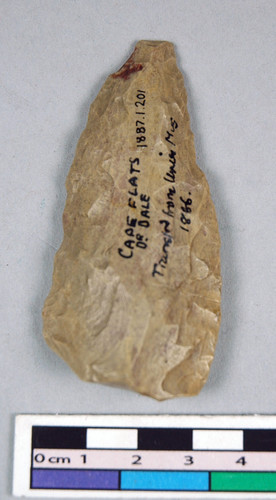 1887.1.201Stone flake, yellowish grey in colour, worked to a flat point at the distal edge. [MJD 08/01/2010]1887.1.201
 1921.91.404.95Barbed and tanged arrow-head with bifacial retouch extending across both faces. Both barbs are broken. [MN 24/11/2008]1921.91.404.95
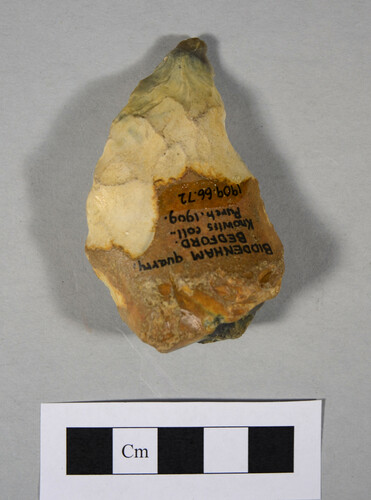 1909.66.72Stone tool, flake. [MJD 22/05/2013]1909.66.72
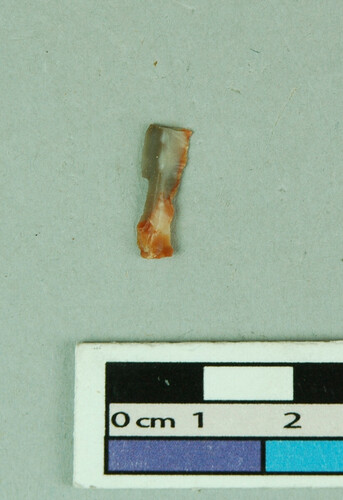 1929.24.68.18Stone flake, grey and red in colour and roughly rectangular shaped. [MJD 07/05/2010]1929.24.68.18
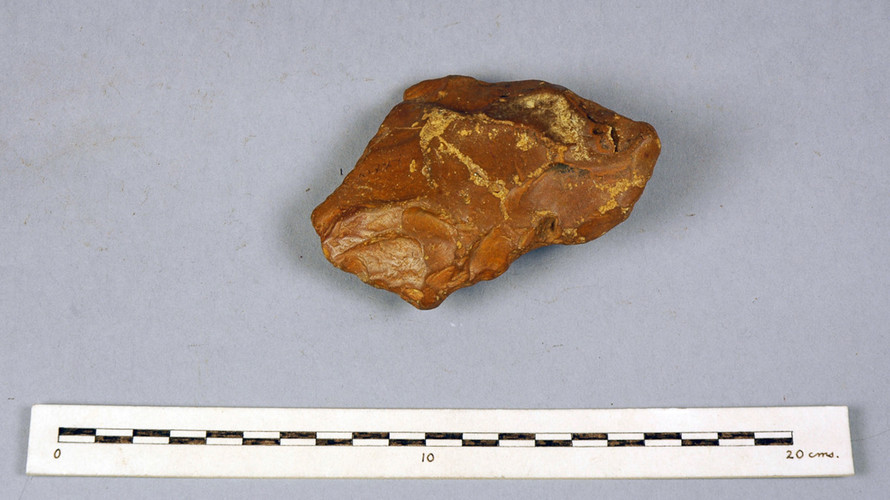 1921.91.459.122Bifacial cordate handaxe with a broken butt. The flint has a well developed patina on all surfaces dark orangish brown in colour. [MN 03/08/2009]1921.91.459.122
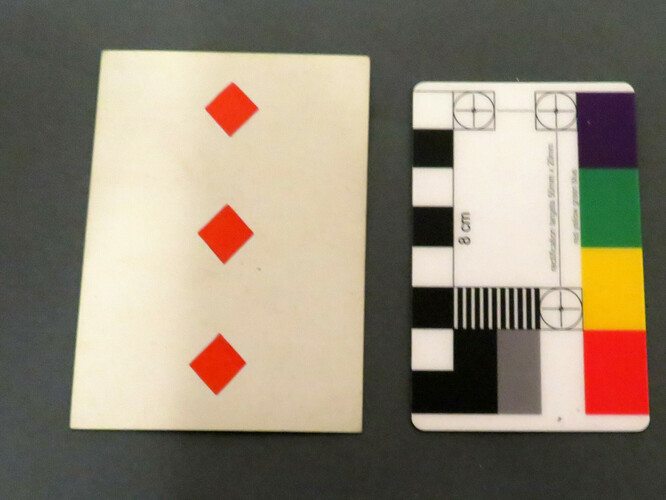 1992.8.3.174Playing card, three of diamonds. Purple coloured reverse with gold border and floral and foliate designs in pink, green and gold. For the other playing cards in this incomplete set of 49, see [1992.8.3 .134 - 173] and [1992.8.3 .175 - 185]. [CW [OPS Move] 24/3/2017]1992.8.3.174
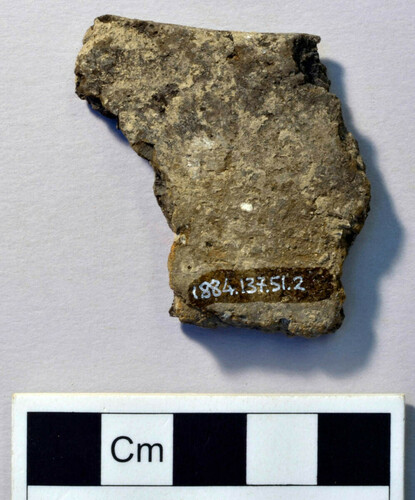 1884.137.51.2Ceramic rim sherd1884.137.51.2
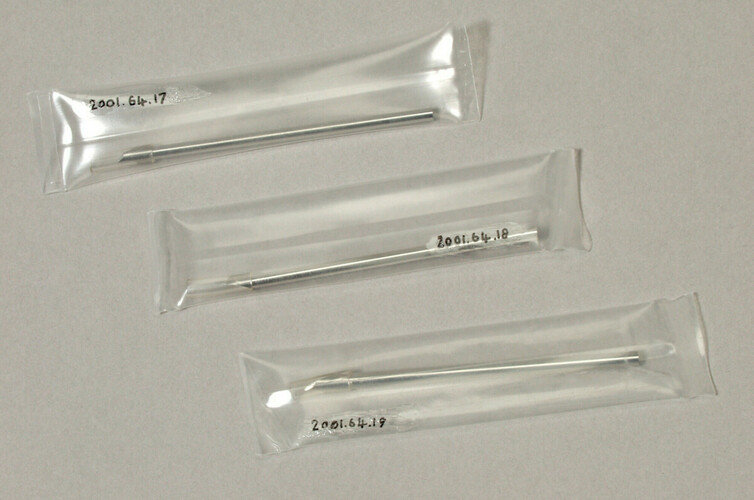 2001.64.1713 gauge tubular needle inside a clear plastic oblong packet. The sharp tip of the needle is covered with a short length of plastic tube. Used for a piercing at the tip of the penis known as a 'Prince Albert'. [JP 21/9/2001]2001.64.17