
- Collection type
- Object
- Description
- Seven banded onyx stone beads [.1-.7] of various styles. Strung together by the collector. [SM 03/11/2010]
- Long description
- Seven banded onyx stone beads [.1-.7] of various styles. Strung together by the collector. [.1 and .2] are conical shaped beads that are brown with white at the widest end. [.3 and .4] are tapering beads that are white in the centre, dark brown at one end and light brown at the other. [.5-.7] are short cylindrical beads that are white in the centre with brown ends. [SM 03/11/2010]
- Geographical reference
- Date / Period
- Date made: Before 1948
- Date collected
- By 1948
- Acquisition information
- Donated: 26/10/1971
- Materials and processes
- Material Onyx Stone, Material Bead, Process Strung, Process Ground
- Dimensions
- Diameter: max 9 mm, Diameter: max 7 mm, Diameter: max 5 mm, Diameter: max 4 mm, Diameter: max 5 mm, Diameter: max 4 mm, Diameter: max 5 mm, Length: max 26 mm, Length: max 25 mm, Length: max 25 mm, Length: max 22 mm, Length: max 5 mm, Length: max 5 mm, Length: max 5 mm
- Object numbers
- Accession number: 1971.15.580.1 Accession number: 1971.15.580.2 Accession number: 1971.15.580.3 Accession number: 1971.15.580.4 Accession number: 1971.15.580.5 Accession number: 1971.15.580.6 Accession number: 1971.15.580.7
- Research and responses
This bead type may be related to the earlier term, psomit, used by Arab and European traders in mid 19th century Sudan (P. Santi & R. Hill 1980, The Europeans in the Sudan 1834-1878, p. 123). Judging by their descriptions, somit appear to be banded beads, many of which are cylindrical or barrel-shaped; imitation somit were also produced in glass in Germany and Czechoslovakia [RTS 29/1/2004].
Further items to explore
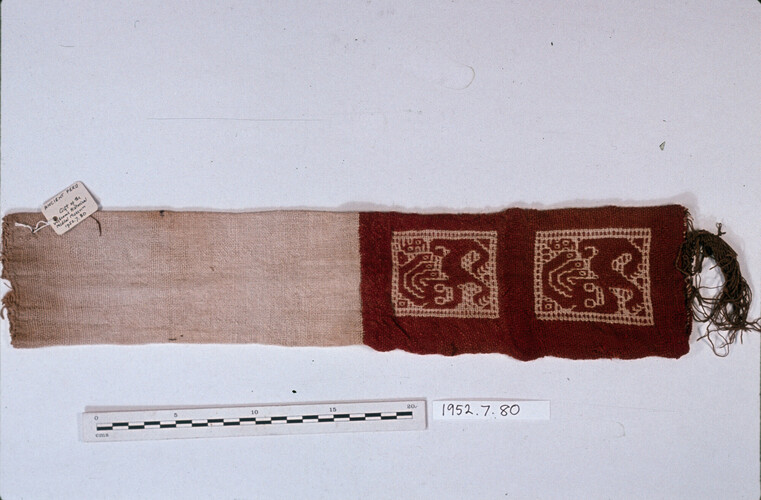 1952.7.80Textile neck-tie; from a mummy1952.7.80
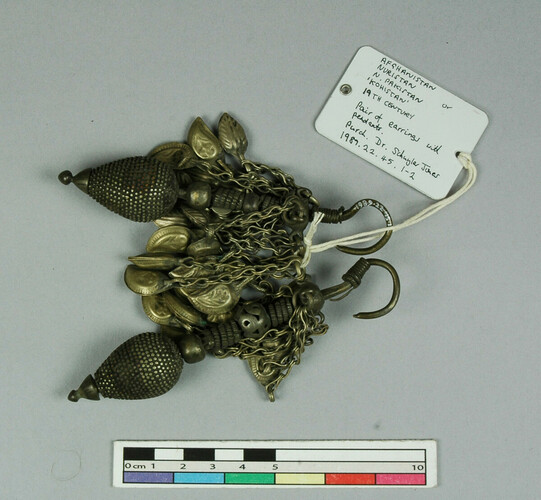 1989.22.45.1Pair of heavy earrings of ?copper-silver alloy, decorated with spiral wire and granulated globular terminals. [El.B DDF Body Arts Project 2010/2011 01/11/2010]1989.22.45.1
 1938.36.250.7Looped earring of cassowary quill, one from a set of seven. [JMC 27/6/2019]1938.36.250.7
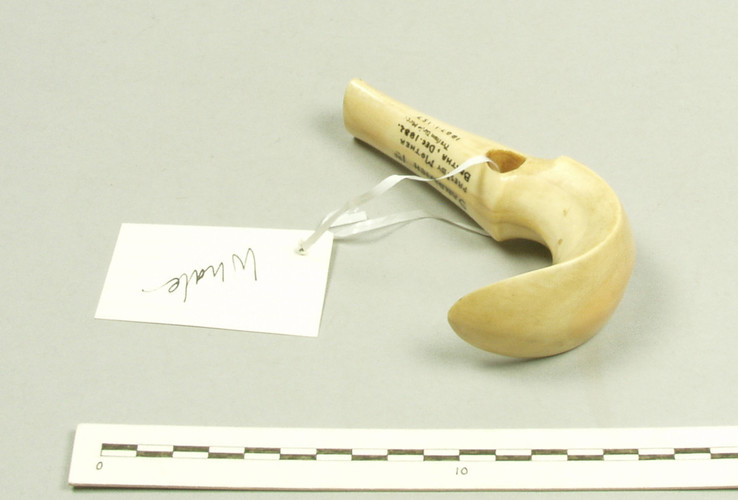 1887.1.157Hook of whale tooth perforated to be worn as ornament. [El.B 'DCF 2004-2006 What's Upstairs?' 12/8/2005]1887.1.157