
- Collection type
- Object
- Description
- Spatulate club decorated with incised scroll work on both sides at the head and grip. [SM 27/03/2007]
- Long description
- Spatulate club decorated with incised scroll work on both sides at the head and grip. The head is decorated with a scroll design. Above the grip is decorated with scroll and zigzag designs. Below the grip is decorated with a zigzag design. The incised designs have been filled in with lime. [SM 27/03/2007]
- Geographical reference
- Milne Bay Province Kiriwina Goodenough District Trobriand Islands
- Date / Period
- Date made: Before 1900
- Date collected
- By 1900
- Acquisition information
- Donated: 1900
- Materials and processes
- Material Lime, Material Wood Plant, Process Carved, Process Incised, Process Decorated
- Dimensions
- Length: max 775 mm
- Object numbers
- Accession number: 1900.55.400
- Research and responses
The following notes are drawn from research compiled by Andy Mills as part of the DCF Cutting Edge project in 2006-2007.
Perhaps the only scholarly work to be specifically directed towards this aspect of the well-documented Trobriands culture, a short 1920 article on weaponry was published by Bronislaw Malinowski (Malinowski, B. (1920) War & Weapons Among the Natives of the Trobriand Islands. Man, 20, pp. 10-12). In this article, Malinowski records that such sword-clubs, although widespread throughout Trobriands society, and carried by men in their everyday business, were never, in fact, used in pitched battles and formally-initiated warfare. Rather, they were weapons of everyday skirmish and brawl – specifically the sort of conflicts which ultimately led to all-out war. Malinowski remarks that the principal motivations of disagreement between Trobriands men of the period in which this sword-club was collected were: arguments over garden boundaries, the ownership and wanderings of pigs, conflicts over the attentions and fidelity of women, breaches of formal etiquette, and the attacker’s suspicion that the defender was a sorceror – a common cause of conflict in many parts of the world (Malinowski, 1920, p. 10). In contrast to this, large-scale battles were fought using spears and shields only, and under a rigid system of military protocols; the number of casualties were generally very small in all-out Trobriands warfare, and flight and homelessness were often the most widely-felt result of such major conflicts. [El.B 27/02/2008]
Further items to explore
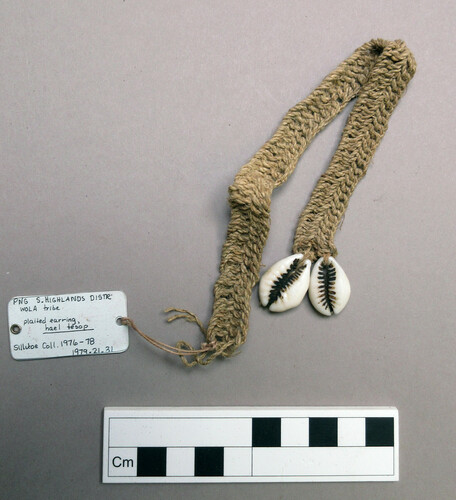 1979.21.31Ear ornament of a plaited band of plant fibre with two cowrie shells. [El.B DDF Body Arts Project 2010/2011 26/11/2010]1979.21.31
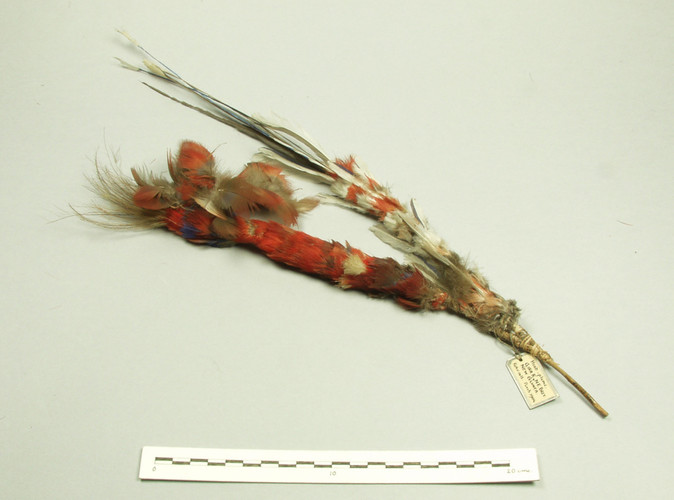 1904.60.126Head ornament; double plume of red, turquoise and white feathers on a wooden stick [EC 'DCF 2004-2006 What's Upstairs?' 13/9/2005]1904.60.126
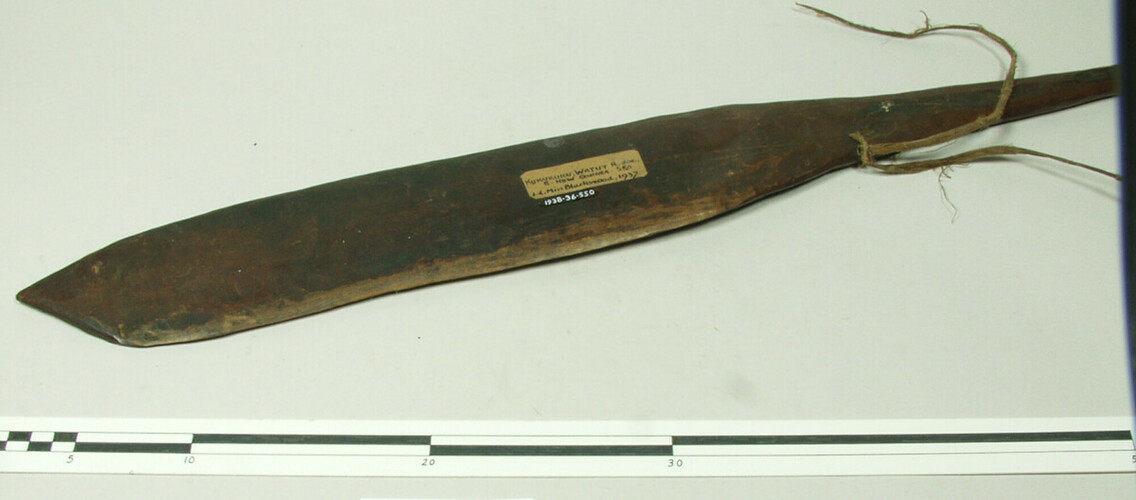 1938.36.550Flat knife-like wooden tool. [E.S-R 'DCF 2004-2006 What's Upstairs?' 17/11/2004]1938.36.550
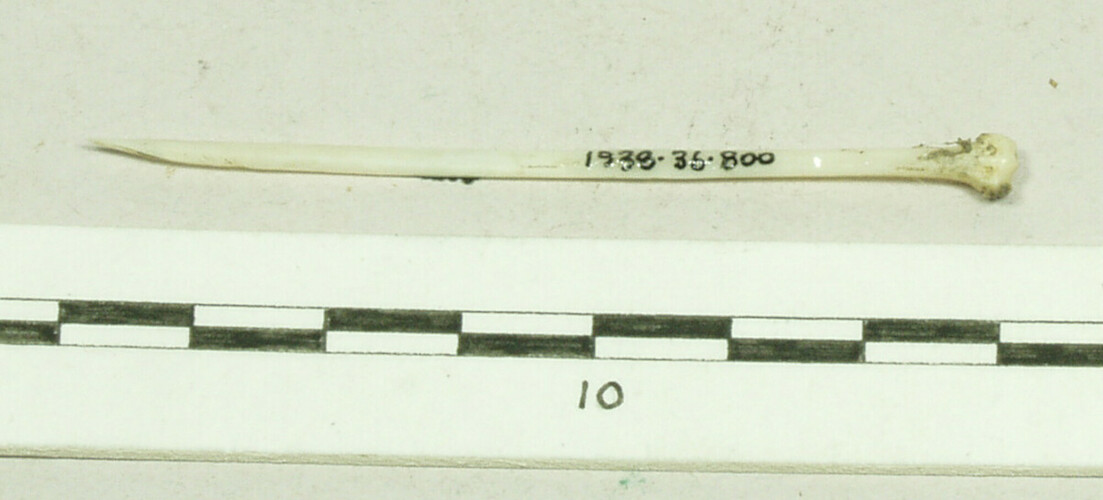 1938.36.800Bone pricker.1938.36.800