
- Collection type
- Object
- Description
- Belt with plaited tie.
- Long description
- For the purposes of this description the belt has been oriented with the fold at the bottom of the belt. The belt has been constructed using raranga whakiro or a close plait in a plain weave pattern using both undyed and black-dyed leaf strips. The spacing of the black strands is irregular and does not continue through the entire surface of the belt. The placement of the strips ranges in frequency between every 2 at the highest and every 6 at the lowest. The right side end of the belt is completely woven in undyed leaf strips. The belt has been sewn shut using a 2-ply thread of brown dyed (?) New Zealand flax fibre. The ties for this belt have been looped through the plaited band and are braided in three-strand plaits. Towards the end of both of these ties the plait transitions into a 2-strand ply. [Emma Schmitt (Conservation Intern) 06/9/2013; JU 06/09/2013; JC 29 11 2013]
- Geographical reference
- Cultural groups
- Māori
- Date / Period
- Date made: Before 03/1770
- Date collected
- Between October 1769 and March 1770
- Acquisition information
- Transferred: 1886, uncertain Loaned: 1886, uncertain
- Materials and processes
- Material Plant Fibre, Process Plaited, Process Woven, Process Stitched, Process Knotted, Process Twisted
- Dimensions
- Width: max 55 mm, Length 1360 mm excluding ties, Length 1982 mm including ties
- Object numbers
- Accession number: 1886.21.3
- Research and responses
See page 130 in Māori Fibre Techniques: A Resource Book for Māori Fibre Arts / Ka tahi: hei tama tū tama, by Mick Pendergrast (Auckland: Reed Books, 2005). [Emma Schmitt (Conservation Intern) 06/9/2013; JU 06/09/2013]
- Associated publications
- For an account of the collection of which this is a part, see 'An Interim Report on a Previously Unknown Collection from Cook's First Voyage: The Christ Church Collection at the Pitt Rivers Museum, University of Oxford', by Jeremy Coote, in Journal of Museum Ethnography, no. 16 (2004), pp. 111-21. This item is listed on page 117. (Copy of article in RDF: Biographies: Banks.) [JC 8 4 2004] Listed on page 23 and illustrated in colour as Figure 8 on page 12 of Curiosities from the Endeavour: A Forgotten Collection—Pacific Artefacts Given by Joseph Banks to Christ Church, Oxford after the First Voyage, by Jeremy Coote (Whitby: Captain Cook Memorial Museum, 2004). (Copies of exhibition leaflets, poster, catalogue, etc. in RDF: Biographies: Banks.) [JC 14 4 2004; JC 25 6 2004] See also 'Forgotten Treasures from Cook's First Voyage', by Jeremy Coote and Sophie Forgan, in Cook's Log, Vol. XXVII, no. 2 (April 2004), pp. 4-6; this item is illustrated in black and white on page 5. (Copy in RDF: Biographies: Banks.) [JC 25 6 2004] See also 'Curiosities from the Endeavour: A Forgotten Collection', by Jeremy Coote, The Friends of the Pitt Rivers Museum Newsletter, no. 49 (July 2004), pp. 6-7. (Copy in RDF: Biographies: Banks.) [JC 1 9 2004] See also 'Uncovered: "Lost" Treasures from the South Seas', by Julie Webb, in Limited Edition [supplement to the Oxford Times], number 215 (December 2004), pp. 31-33. (Copy in RDF: Biographies: Banks.) [JC 15 12 2004] Listed as catalogue number 176 of James Cook and the Exploration of the Pacific, by Adrienne l. Kaeppler et al. (London: Thames & Hudson, 2009) with the caption: '179-181 Three belts tatua | New Zealand, by March 1770 | Flax, dog-skin, 13 x (excluding ties) 180 cm; flax, 5.5 x 136 cm, flax, 7.5 x 125 cm | Christ Church, Oxford (courtesy of Pitt Rivers Museum, University of Oxford, 1886.21.2; 1886.21.3; 1886.21.4, no ill.) | Belts, made in the main of harakeke (New Zealand flax, Phormium tenax), were a standard part of a Maori man's dress and - being open at the top - could also be used to carry things in. These three belts form part of the collection given by Joseph Banks to Christ Church, after the first voyage. The variety in size, colour, and pattern may be seen as illustrating Bank's desire to send a 'structured' collection of types of object to his old Oxford college. The broadest and finest belt also incorporates strips of dog-skin, which have been used to stitch the edge. J[eremy].C[oote].' [FB 09/04/2013] For an account of the history of the collection of which this is part, see 'The Cook-Voyage Collections at Oxford, 1772–1775', by Jeremy Coote, in Jeremy Coote (ed.), Cook-Voyage Collections of 'Artificial Curiosities' in Britain and Ireland, 1771–2015 (MEG Occasional Paper No. 5), Oxford: Museum Ethnographers Group (2015), pp. 74–122. (Copy in RDF: Researchers: Jeremy Coote (Cook-Voyage Collections).) [JC 9 6 2016]
Search terms: Clothing, Ornament, Textile, Belt, Waist Ornament
Further items to explore
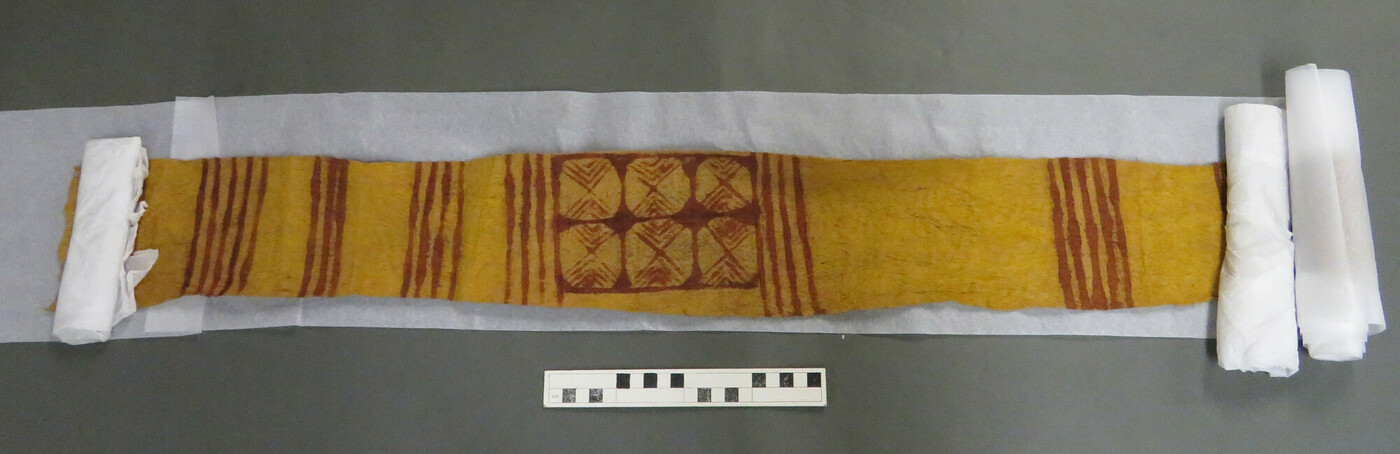 1940.12.517Barkcloth girdle. The cloth is pale in colour, painted with a yellow dye and featuring stripes and diamond designs in red. [AF [OPS move] 20/7/2017]1940.12.517
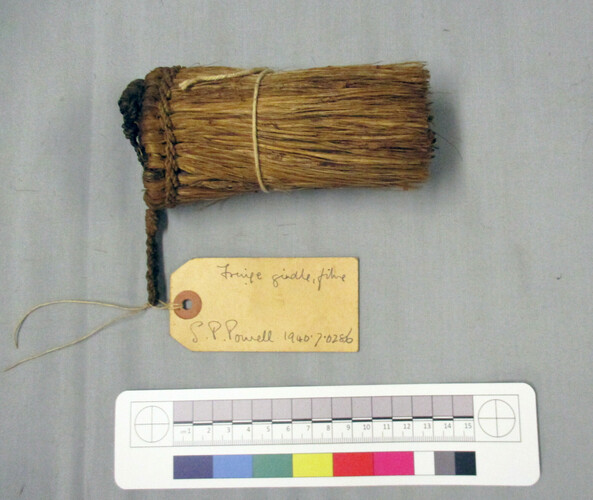 1940.7.0286Fibre waist ornament, belt or skirt. Consisting of shirt fringes made up of dyed red and black plant fibre sections hanging from a plaited plant fibre band. The ties at the end of the belt are plaited and knotted. [ASh [OPS move] 17/08/2016]1940.7.0286
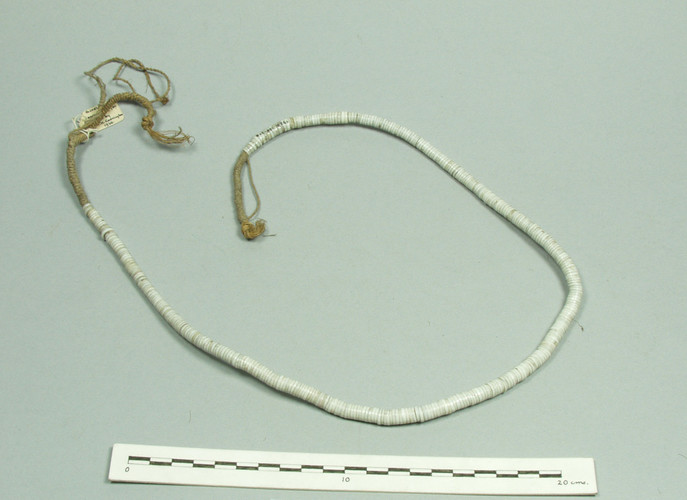 1920.100.378White shell bead girdle. [El.B 'DCF 2004-2006 What's Upstairs?' 10/5/2005]1920.100.378
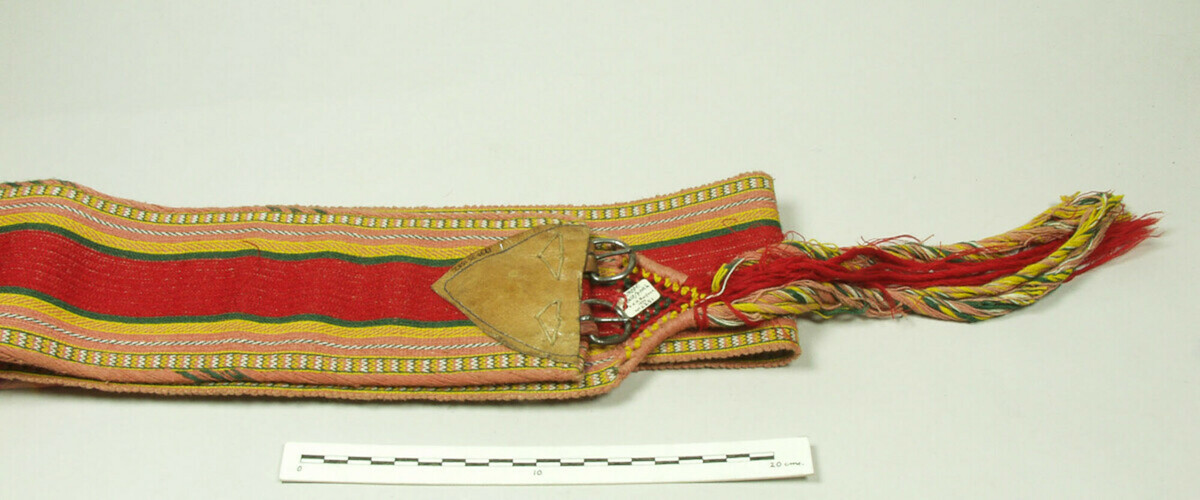 1938.35.1582Belt, woven with leather straps and two metal buckles at one end [L.Ph 'DCF 2004-2006 What's Upstairs?' 25/4/2005]1938.35.1582
 1923.87.210Caterpillar specimen used for making tattoo pigment. (Mounted with 9 others in a glass fronted box) [SM 17/11/2008]1923.87.210
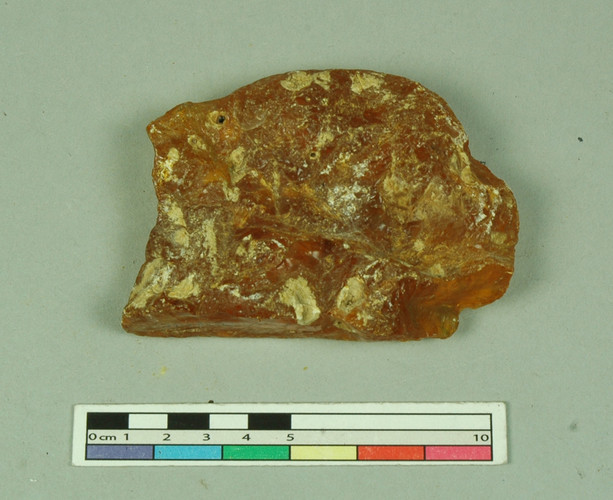 1923.87.204Piece of plant resin used for making tattooing pigment. [El.B DDF Body Arts Project 2010/2011 30/09/2010]1923.87.204
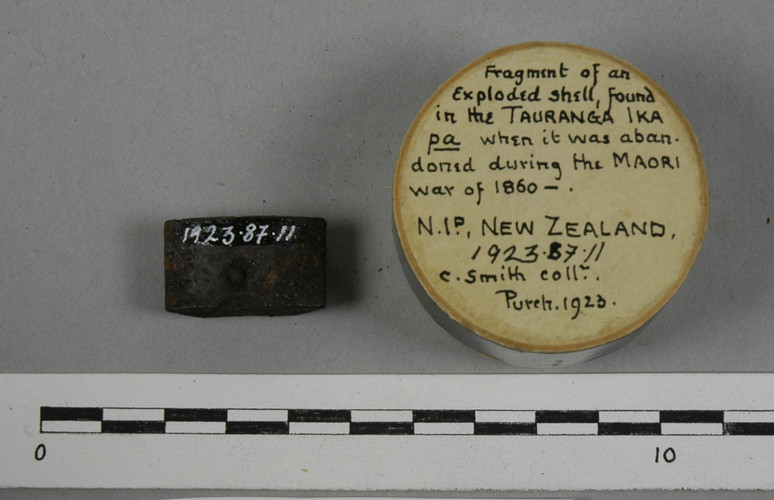 1923.87.11Fragment of exploded shell [SM 23/10/2007]1923.87.11
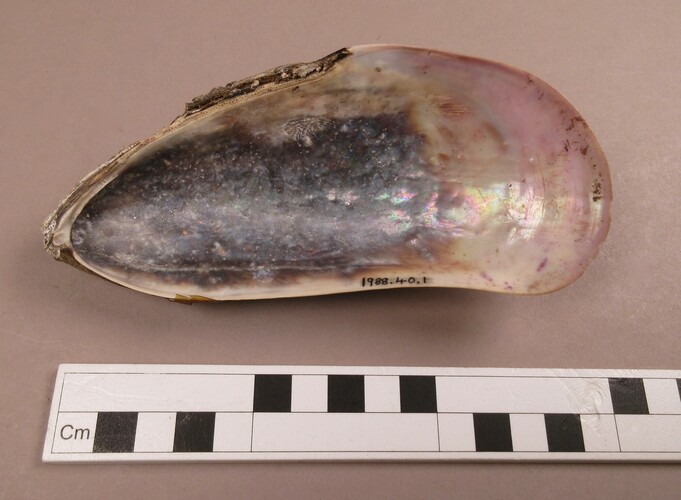 1988.40.1Mussel shell used for stripping flax fibres for weaving.1988.40.1