
- Collection type
- Object
- Description
- Chalk carving of a man's head, with moustache, in armour
- Long description
- Chalk carving of a man's head. Incised lines and crosses. Hole in base for a support. [JW [Excav. PR] 08/02/2013]
- Geographical reference
- England Kent Shepway Folkestone Castle Hill [Caesar's Camp] "Upper rampart" "1 foot beneath turf"
- Person
- Maker Unknown Maker
- Field collector Augustus Henry Lane Fox Pitt-Rivers
- PRM source Augustus Henry Lane Fox Pitt Rivers founding collection
- Date / Period
- Archaeological period: Medieval
- Date collected
- 1878 June 27
- Acquisition information
- Donated: 1884
- Dimensions
- Width: max 68 mm, Length: max 70 mm, Weight 191 g
- Object numbers
- Accession number: 1884.138.23 Other numbers: 23 PR no.: 590/ 12191
- Research and responses
Described by Pitt-Rivers (1883: 463) as "Head in armour, carved in chalk-stone; it has three crosses on the forehead, top and back: found 1 foot (0-306 m.) beneath the turf, and 3 feet 6 inches (1*017 m.) to the rear of the crest of the Upper Rampart, west-end section, June 27th." and illustrated as Figs 21 and 22 on Plate XIX [JW [Excav. PR] 08/02/2013] [Dan Hicks 20/03/2013]
Further described by Pitt-Rivers (1883: 445-446) as follows: "[A] head...rudely cut in chalk and has a hole under the neck to fit into some kind of stick. It evidently represents the head of a man in armour, but whether in a hood of chain mail or in a helm it is difficult to determine. The projection on the forehead may represent a vizor (if so, the vizor was not introduced with the basinet until the end of the thirteenth century), but it is possible it may only represent the coiffe under the hood of mail. Vizor or coiffe, it is ornamented with a cross within a circle, and on each side are marks representing an eye or slit of some kind. The figure has also two other crosses, one on the top of the head and the other at the back. Five incised lines on the side of the head may perhaps be intended to represent the lines of chain mail. The upper lip is provided with large moustachios; it will be remembered that when Harold sent spies into William's camp they returned with the information that the army was composed chiefly of priests, having mistaken the soldiers for priests, on account of their practice of closely shaving the upper lip and chin, the Saxons themselves wearing moustachios. In the reigns of Henry I. and Stephen long moustachios were worn by the Normans. The custom was abandoned again in the reign of Henry II., and they were again worn towards the close of the reign of Richard Coeur de Lion.a Unless, therefore, the figure is of a much later date, it would appear probable that it might be of the reign of Stephen or Henry I. Its position and that of the fragment of padlock about one foot (0*306 m.) beneath the surface, and three feet (0-915 m.) to the rear of the crest of the rampart makes it uncertain whether they belonged to the body of the rampart or the silting, but probably the latter, in which case they might be more recent than the first construction of the Camp. But they are probably of the same date." [Dan Hicks 20/03/2013]
Further information and research notes on this site compiled in the 1970s by Revd. AH Gibson are held at Folkestone Library (see correspondence and copies of Gibson's notes in RDF) [JC 7.11.96]
- Associated publications
- Pitt-Rivers, A.H.L.F. 1883. Excavations at Caesar’s Camp, near Folkestone conducted in 1878. Archaeologia 47: 429-465 - illustrated as Figs 21 and 22 on Plate XIX. [Dan Hicks 20/03/2013]
Search terms: Figure
Further items to explore
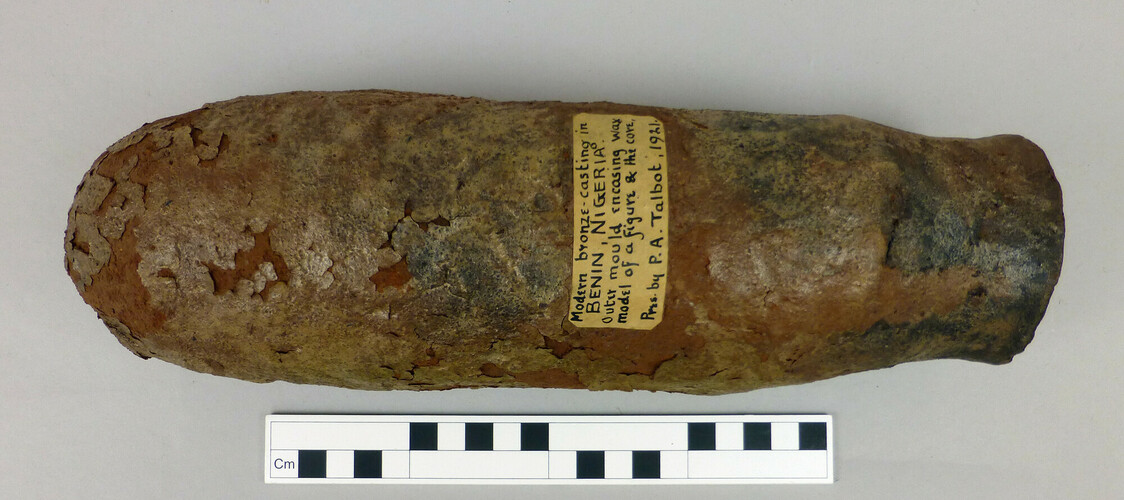 1921.94.10.1Outer clay mould encasing wax model of human figure on clay core. Part of a set illustrating the lost wax method of casting. [SM (Verve) 19/08/2014]1921.94.10.1
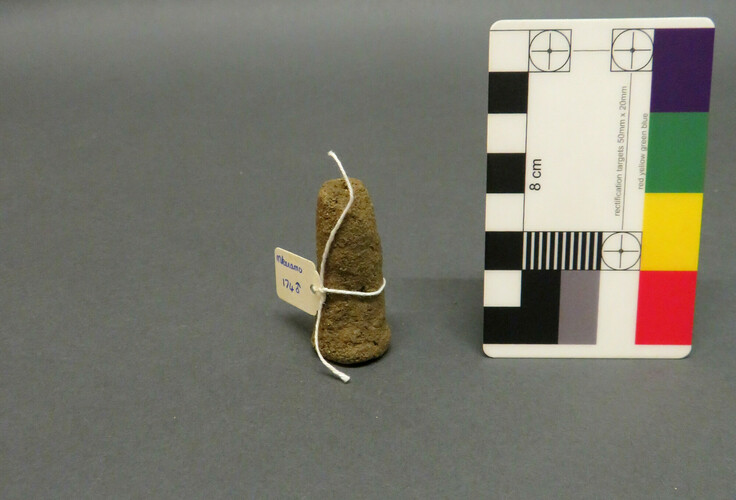 1958.11.3.108Clay Mkaramo figure. A tapering cylinder with a flat, flaring base and rounded head. Probably phallic. There is an indentation in the top and the side. [JC [OPS Move] 7/7/2017]1958.11.3.108
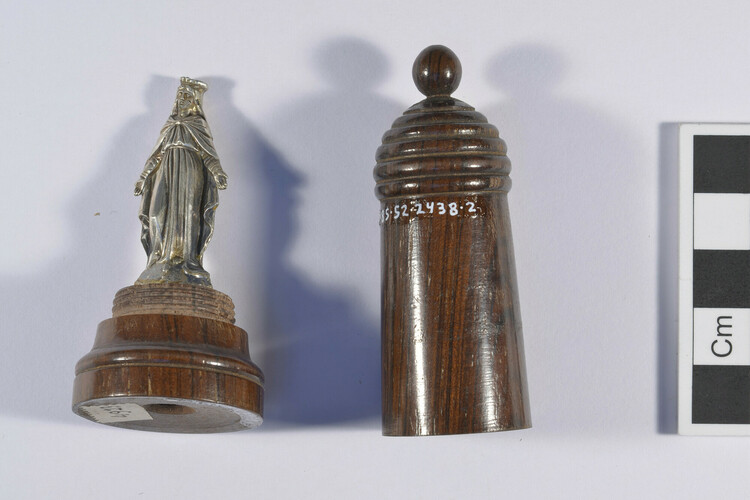 1985.52.2438.1Amulet, silver figure of the Virgin Mary on a wooden base [.1], with wooden lid [.2] which screws onto the base. [El.B 19/07/2012]1985.52.2438.1
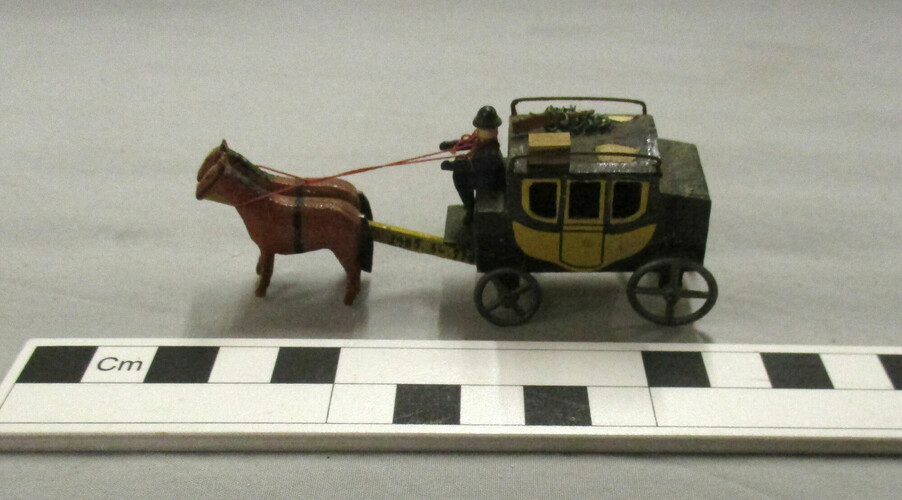 1985.36.220.9Wooden toy/figure of a pair of horses. These horses are meant to be pulling a carriage and have a wooden support down the centre of them that attaches to the carriage [1985.36.220 .10]. The horses are painted brown with the reigns etc. painted black. [1 of] An assortment of miniature wooden and metal pieces, some of which may belong in a dolls house. [ASh [OPS move] 13/06/2016]1985.36.220.9