
- Collection type
- Object
- Description
- Stone or concrete fragment
- Long description
- Fragment of white stone or concrete with a chalky texture and evidence of green staining. [CG [Excav. PR] 06/03/2013]
- Geographical reference
- England East Sussex Lewes Glynde Mount Caburn "Upper rampart; body"
- Person
- Maker Unknown Maker
- Field collector Augustus Henry Lane Fox Pitt-Rivers
- PRM source Augustus Henry Lane Fox Pitt Rivers founding collection
- Date / Period
- Archaeological period: Iron Age
- Date collected
- 1877 Sept 10
- Acquisition information
- Donated: 1884
- Materials and processes
- Material Stone, Material Lime, Material Chalk Stone
- Dimensions
- Thick: max 16 mm, Width: max 18 mm, Length: max 32 mm, Weight 8 g
- Object numbers
- Accession number: 1884.137.1.1 PR no.: ? 250/ 12099 - 285/ 12099
- Research and responses
The Relic Table for Mount Caburn records that the "Body of Upper Rampart" was excavated on 10 Sept 1877 (Lane Fox 1881: 479). I have updated the "when collected" field accordingly. [Dan Hicks 03/09/2013]
See 1884.136.1 for museum documentation of these objects. Pitt Rivers excavated Mt Caburn with between three and five men over two short seasons. A Relic Table was produced for the site [the Relic table was a tabulated record of every feature excavated] [See Bowden, 1991: 85][Thompson, 1977: 55] Note that there are a number of entries in Delivery Catalogue II pages 331 - 334 and 336 - 337 under the title 'Collection from Mount Caburn' which are listed and in many cases given a related fraction number, none of which match fraction numbers given in the accession books. It seems probable that some of the unmatched Mount Caburn objects could be matched to these delivery catalogue entries but until each object is found and given a detailed computerised catalogue entry it will not be possible to match further. Details of the entries on pages 331-4 are listed in PR Catalogue Part II [AP Leverhulme project on founding collection 1995-1998]
Pitt Rivers published his two seasons work at Mount Caburn in the journal Archaeologia in 1881. Full reference: Pitt Rivers, A H L Fox. 1881. Excavations at Mount Caburn Camp, near Lewes, conducted in 1877 and 1878. Archaeologia 46: 423 - 495. [MN 15/06/2009]
The fortifications at Mount Caburn [TQ 4443 0891] are recorded on the English Heritage maintained National Monuments Record under monument no. 405932. The record is accessible online, see http://pastscape.english-heritage.org.uk/hob.aspx?hob_id=405932. [MN 15/06/2009]
- Associated publications
- Lane Fox, A. 1881. Excavations at Mount Caburn camp near Lewes, conducted in 1877 and 1878. Archaeologia 46: 423-495. [Dan Hicks 03/09/2013]
Search terms: Dwelling, Geology, Stone, Building Part
Further items to explore
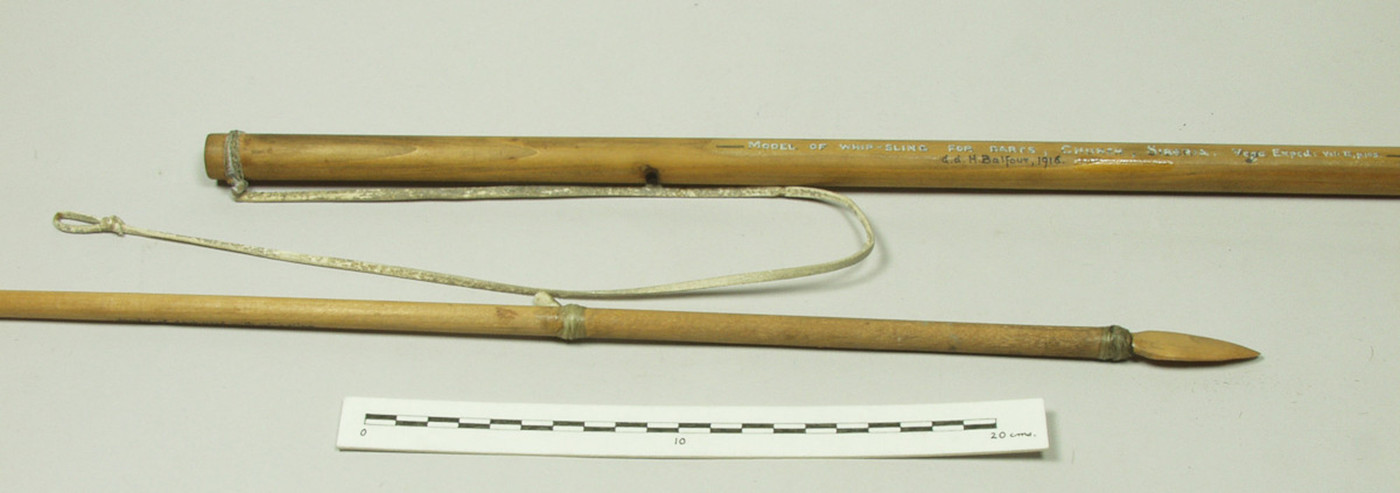 1916.33.35.1Model of sling weapon, consisting of a whip-sling with string [.1], and a dart [.2] [N.B. 'DCF 2004-2006 What's Upstairs?' 22/3/2005]1916.33.35.1
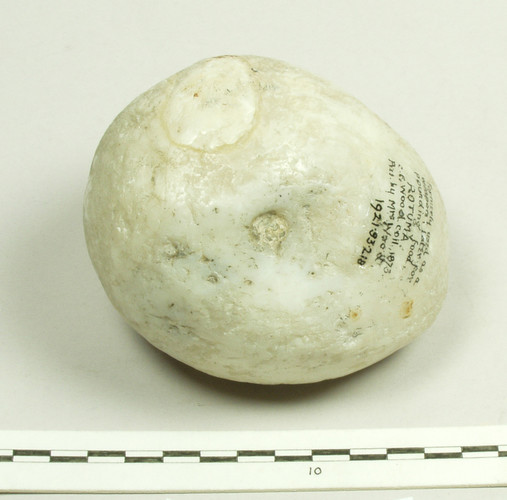 1921.93.218Large shell ball used as a missile and for pounding food [L.Ph 'DCF 2004-2006 What's Upstairs?' 21/4/2005]1921.93.218
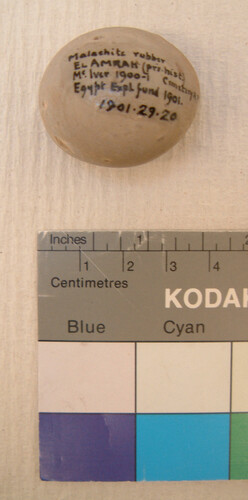 1901.29.20Smooth pebble used as a rubber for use with a palette.1901.29.20
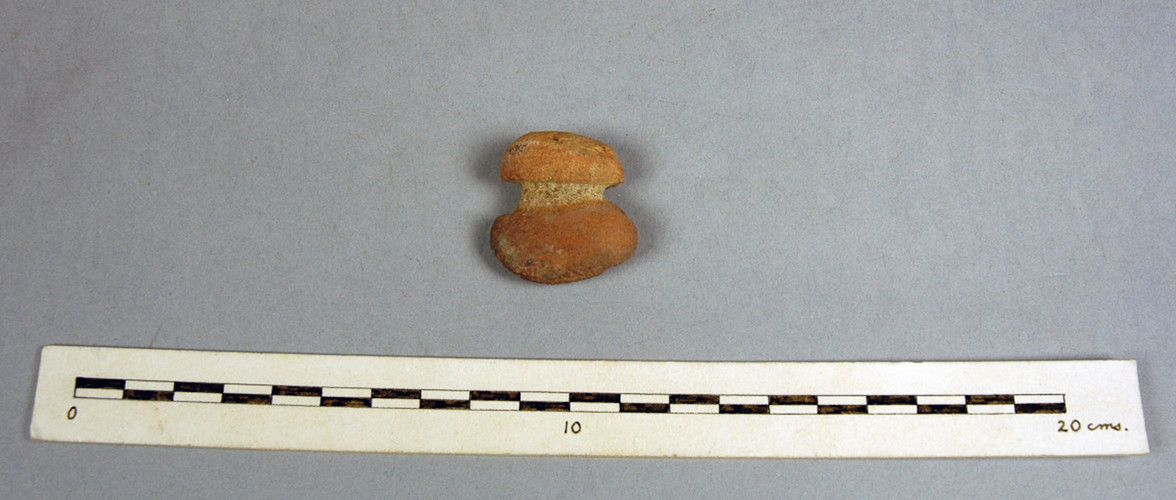 1901.42.26Irregularly shaped stone specimen. [CW 24/11/99]1901.42.26
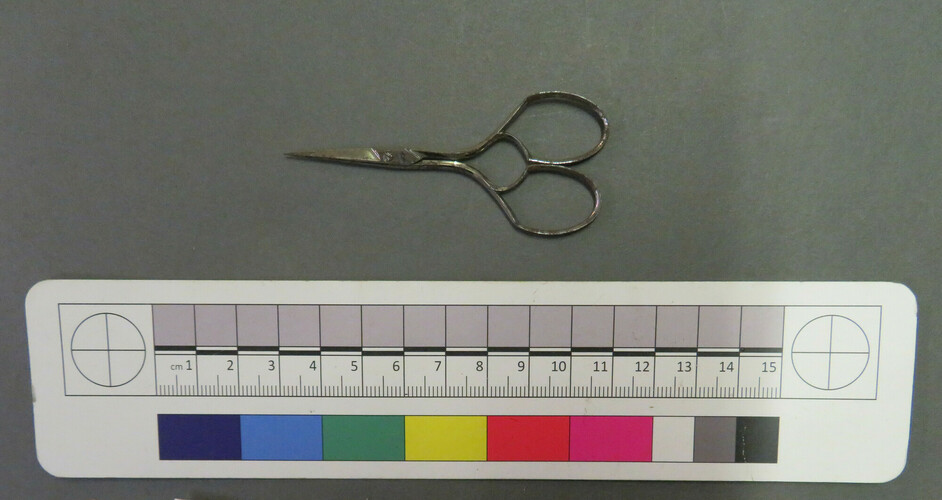 1965.9.122.24Scissors, part of a sewing workbox [1965.9.122 .1 - .2]. For the contents of this box see [1965.9.122 .3 - .34] [BS [OPS Move] 18/5/2017]1965.9.122.24
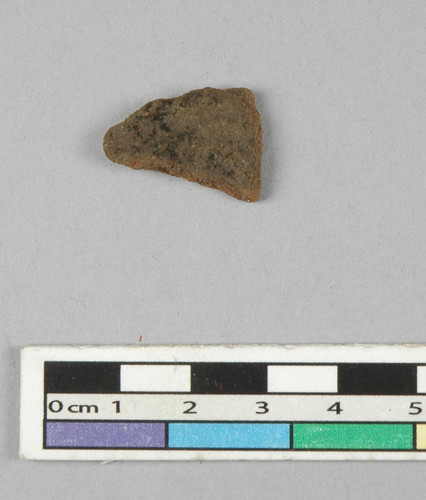 1884.138.8.253Ceramic sherd1884.138.8.253
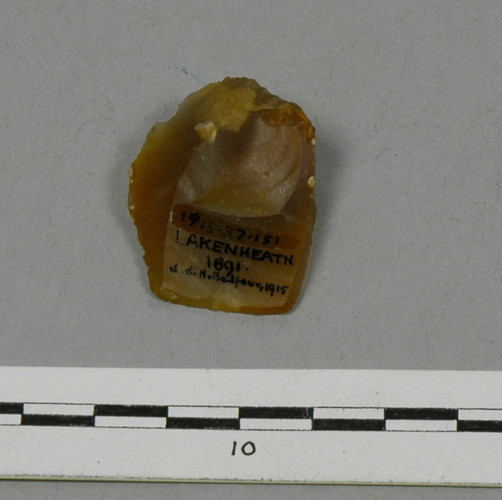 1915.37.151Flint flake, translucent amber colour, worked to a straight transverse edge. [El.B 01/10/2007]1915.37.151
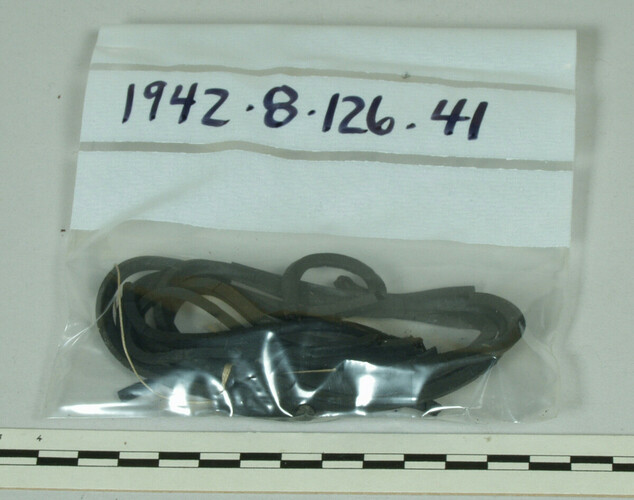 1942.8.126.41Surgical instrument: one of four blades, found in wooden box. [L.Ph 'DCF 2004-2006 What's Upstairs?' 5/10/2004]1942.8.126.41