
- Collection type
- Object
- Description
- Stone arrow-head
- Long description
- Flint leaf-shaped arrow-head with white and light grey patina covering all surfaces, point has broken off. [CC [Excav. PR] 26/09/2013]
- Geographical reference
- England Somerset Bath and North East Somerset Batheaston Little Solsbury Hill Fort [Little Salisbury]
- Person
- Maker Unknown Maker
- Field collector Unknown Collector
- PRM source Augustus Henry Lane Fox Pitt Rivers founding collection
- Date / Period
- Archaeological period: Neolithic
- Date collected
- By 1884
- Acquisition information
- Donated: 1884
- Materials and processes
- Material Flint Stone, Process Flaked
- Dimensions
- Thick: max 4 mm, Width: max 17 mm, Length: max 26 mm, Weight 2 g
- Object numbers
- Accession number: 1884.135.350
- Research and responses
John Evans (1866: 240) described a field visit to Solsbury Hill Fort which he undertook with John Lubbock and Francis Galton in 1864. [Dan Hicks 16/08/2013]
See http://en.wikipedia.org/wiki/Solsbury_Hill: Solsbury Hill (in full, Little Solsbury Hill) is a small flat-topped hill above the village of Batheaston in Somerset, England, near the city of Bath. The top of the hill is ringed by the ramparts of an ancient hill fort. People protesting against the building of an A46 bypass road have recently cut a small maze into the hill. Solsbury Hill is a possible location of the Battle of Mount Badon, which was fought between the Britons (under the legendary King Arthur) and the Saxons c. 496, and which was mentioned by the chroniclers Gildas and Nennius. "Solsbury Hill" is also the title of rock musician Peter Gabriel's first solo single in 1977, which reached the 13th and 68th positions on the UK and US record charts respectively. It is sometimes misspelled as "Salisbury Hill", perhaps because of confusion with Salisbury Plain, a more well known plateau in southern England. [AP 21/08/2006]
The Neolithic stone tools from Solsbury Hill [ST 768 679] are recorded on the English Heritage maintained National Monument Record [NMR] under monument no. 203323. The NMR record is available online, see http://pastscape.english-heritage.org.uk/hob.aspx?hob_id=203323. [MN 25/06/2009]
- Associated publications
- John Evans 1866. On a Discovery of Flint Arrowheads and Other Stone Implements at Little Salisbury Hill, near Bath. Transactions of the Ethnological Society of London 4: 240-243. http://www.jstor.org/stable/3014291 [Dan Hicks 16/08/2013]
Search terms: Tool, Archery Weapon, Arrow-head
Further items to explore
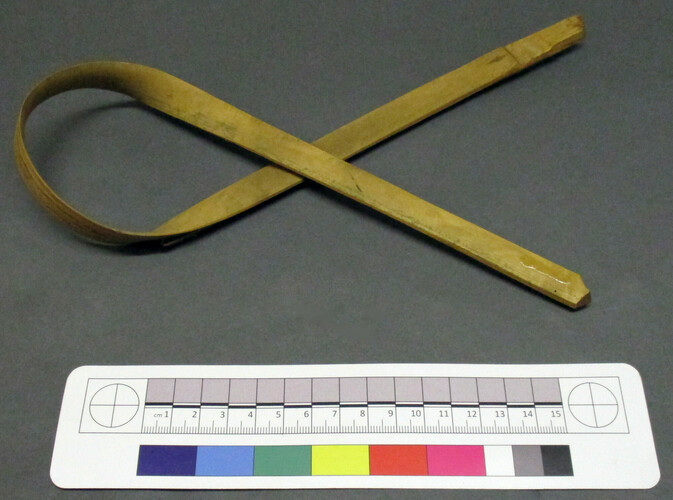 1953.10.114.2Hoe. Made from a single piece of bamboo. The bamboo has been bent in the middle to form a curved blade, the two ends cross over. [AB [OPS Move] 16/12/2016]1953.10.114.2
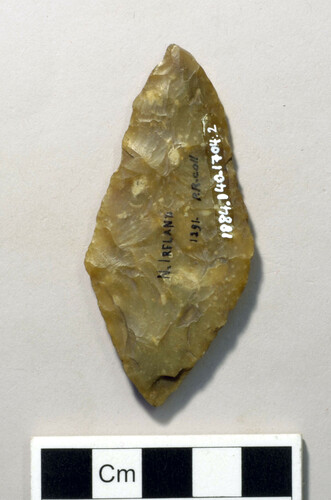 1884.140.1704.2Stone arrow-head1884.140.1704.2
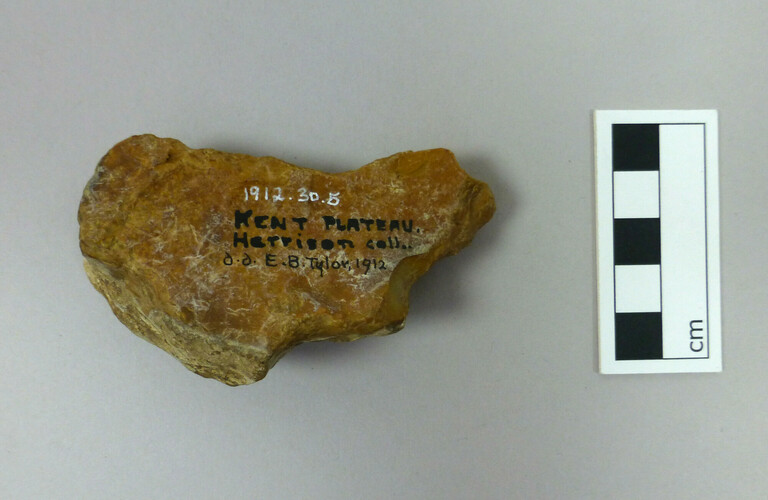 1912.30.5Stone eolith.1912.30.5
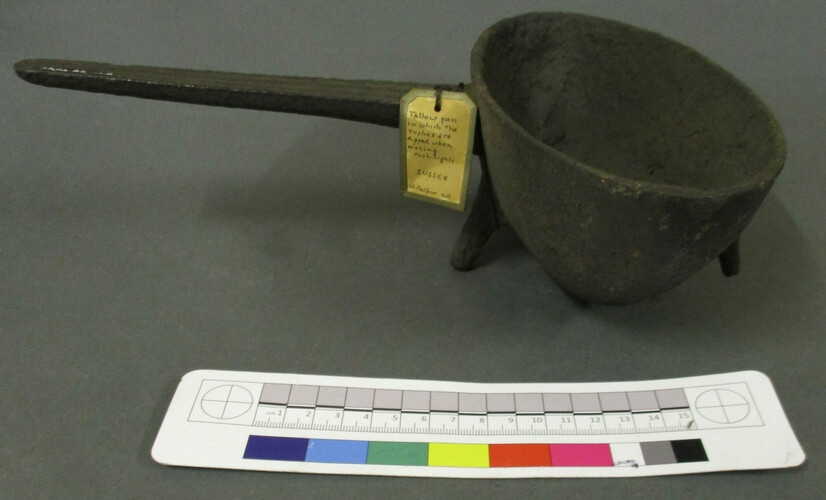 1932.88.185Oval tallow-pan. The pan is made from iron and has three legs extending from the base and a handle extending from one side of the pan. The handle is flat and grooved on the upper side and rounded on the other. [SB [OPS Move] 12/5/2017]1932.88.185
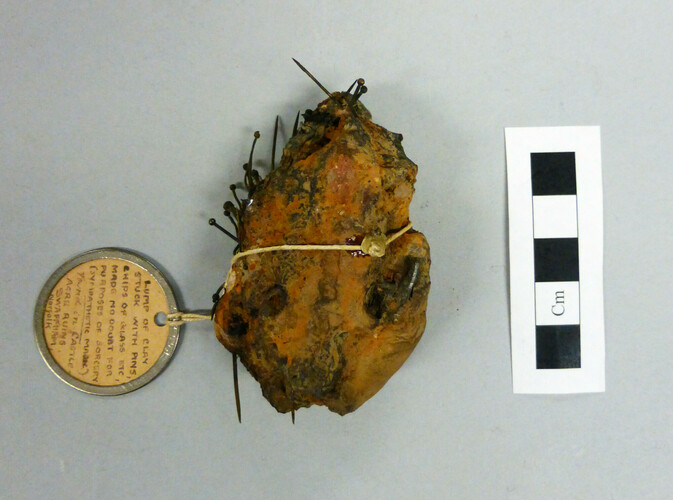 1893.81.3Lump of clay stuck with pins and glass, used in sympathetic magic.1893.81.3
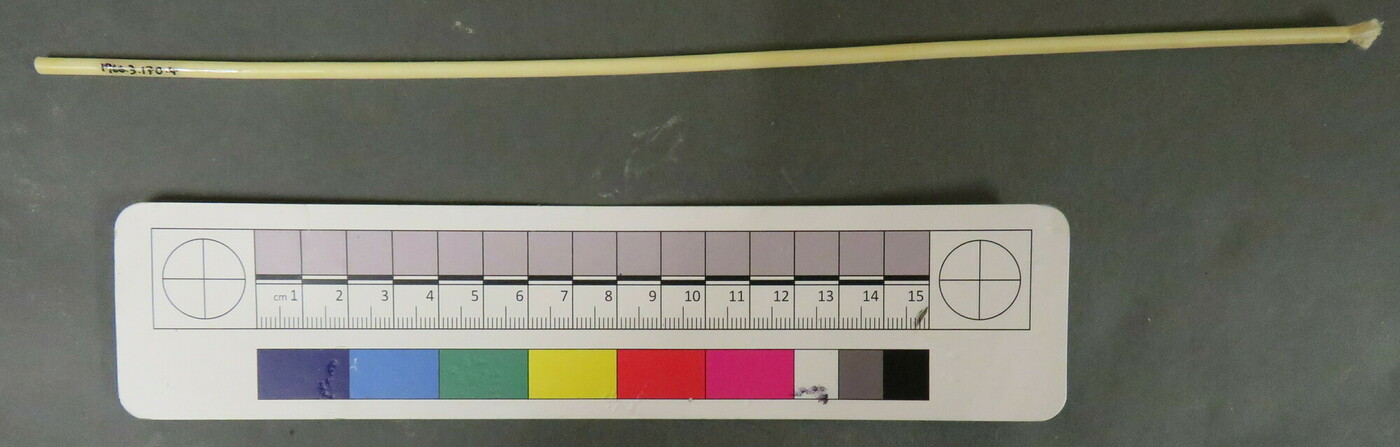 1966.3.170.4Wax taper. It is straight with a circle section, it is white in colour. There is a string wick extending at one end. From a set of eight tapers bound with strips of paper. For the associated objects see 1966.3.170 .1 - .10 [AB [OPS Move] 26/4/2017]1966.3.170.4
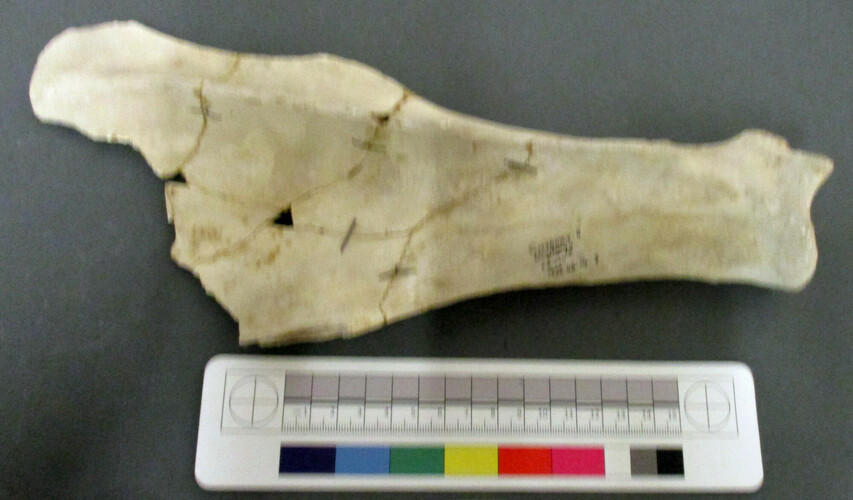 1935.46.14.7Ox scapula, broken in many places and stapled back together. There is a loose broken fragment in a bag packed with the object. [RH [OPS Move] 17/5/2017]1935.46.14.7
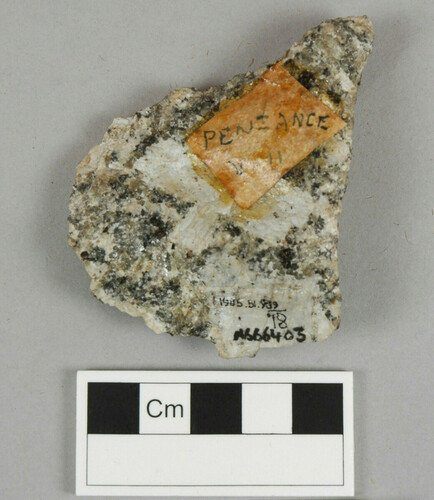 1985.51.989Amulet against sickness. Piece of granite with a natural white cross in it. [SM 18/05/2011]1985.51.989