
- Collection type
- Object
- Description
- Stone core or hammer-stone
- Long description
- Stone core or hammer-stone of mid grey patinated flint. Cortex present on 10% of surfaces. Orange staining.
- Geographical reference
- England East Sussex Brighton Hollingbury Hollingbury Castle Camp Hillfort
- Person
- Maker Unknown Maker
- Field collector Augustus Henry Lane Fox Pitt-Rivers
- PRM source Augustus Henry Lane Fox Pitt Rivers founding collection
- Date / Period
- Archaeological period: Neolithic
- Date collected
- 1868 June 10
- Acquisition information
- Donated: 1884
- Materials and processes
- Material Flint Stone, Process Flaked
- Dimensions
- Width: max 57 mm, Length: max 81 mm, Weight 336 g
- Object numbers
- Accession number: 1884.125.97 Other numbers: 1416 1173 PR Cat other PR nos: 3242
- Research and responses
Pitt-Rivers described Hollingbury in his 1869 paper on Sussex Hillforts as follows: "HOLLINGBURY.—Mr. Horsfield considers Hollingbury to be Roman on account of its being square. Mr. Turner, on the other hand, attributes it to the Druids on account of its being " decidedly circular." From personal inspection I should pronounce it to be of an irregular square form, the corners being rounded, and the sides bulging. Such a configuration appears to have been the best adapted to the faces of the hill on which it stands. There are the remains of a bank 40 Examination of the leading from the south-west corner of this work in the direction of Brighton. A block of Druid sandstone stands at the side of one of the gateways to the west, and another is on the parapet on the south side. [Note: Since writing the above, my attention has been drawn by Mr. Boyd Dawkins to the evidence of an extensive flint manufacture which exists in the neighbourhood of Hollingbury, and which leaves little doubt on my mind that this work, like the others, was of British origin." (Lane Fox 1869: 39-40). [Dan Hicks 16/08/2013]
- Associated publications
- Lane Fox, A.H. 1869. An examination into the character and probable origin of the Hill Forts of Sussex. Archaeologia 42: 27-52. [Dan Hicks 16/08/2013]
Search terms: Tool, Hammer-stone, Core
Further items to explore
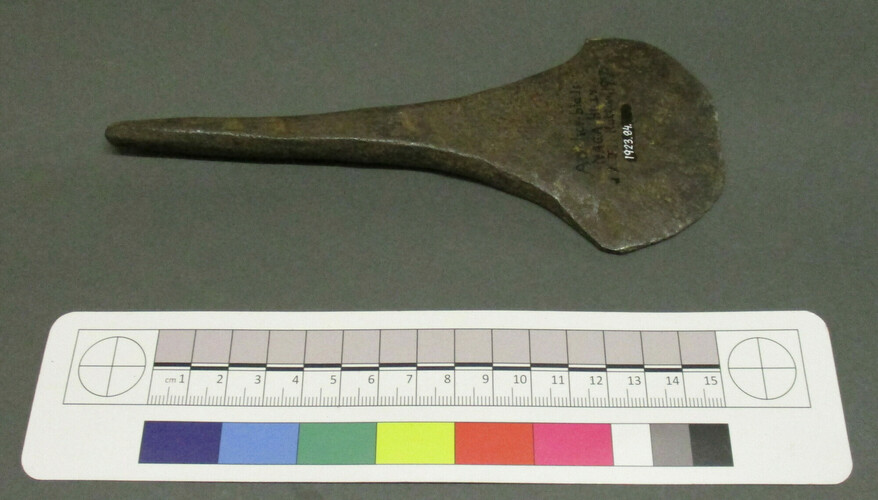 1923.84.286Hoe-blade of iron. [MJD (Verve) 3/1/2017]1923.84.286
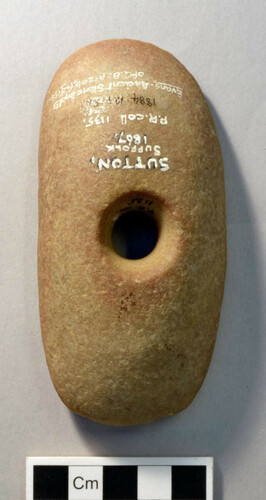 1884.127.64Stone hammer axe-head1884.127.64
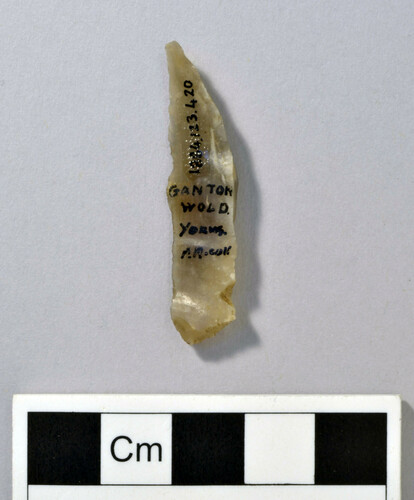 1884.123.420Stone blade flake1884.123.420
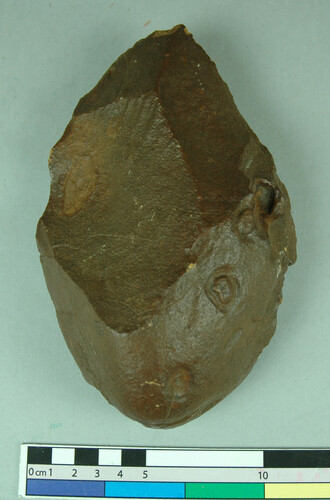 1910.36.30Stone tool; brown in colour, pointed towards distal end. [MJD 01/02/2010]1910.36.30
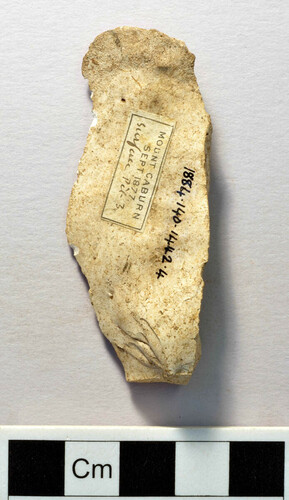 1884.140.1442.4Stone flake1884.140.1442.4
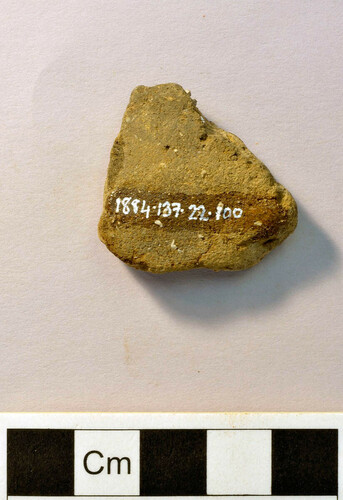 1884.137.22.100Ceramic sherd1884.137.22.100
 1938.35.1171.4Cord tinder with extinguisher. Braided polychrome cord with a metal extinguisher wrapped around near one end. For the other constituent parts see [1938.35.1171 .1 - 3] and [1938.35.1171 .5]. [CW [OPS Move] 29/3/2017]1938.35.1171.4
 1932.88.95Rush light. Consists of a length of rush plant fibre which has been dipped in a waxy substance ?tallow. The rush light is part of a set which are tied together with a piece of paper. For the full set see 1932.88.92 - 96 [SB [OPS Move] 4/5/2017]1932.88.95