
- Collection type
- Object
- Description
- Stone core; fire cracked
- Long description
- Fire cracked core (?) of flint with dark and light grey patina covering all surfaces. [CG [Excav. PR] 02/09/2013]
- Geographical reference
- England Berkshire West Berkshire Combe Walbury Camp
- Person
- Maker Unknown Maker
- Field collector Augustus Henry Lane Fox Pitt-Rivers
- PRM source Augustus Henry Lane Fox Pitt Rivers founding collection
- Date / Period
- Archaeological period: Neolithic
- Date collected
- 1871
- Acquisition information
- Donated: 1884
- Materials and processes
- Material Flint Stone, Process Flaked, Process Fire-Hardened
- Dimensions
- Thick: max 31 mm, Width: max 54 mm, Length: max 61 mm, Weight 129 g
- Object numbers
- Accession number: 1884.125.20
- Research and responses
There is confusion over the location of this site. It is most likely that references to Wallbury/Warlbury/Worlebury in the primary documentation refer to [England West Berkshire Combe Walbury Camp]. However, it is also possible that this site is [England North Somerset Weston-super-Mare Worlebury Worlebury Camp Hillfort], or even [England Essex Uttlesford Little Hallingbury Wallbury Camp]. Pitt-Rivers referred to the discovery of 'deposits of grain' 'at Worlebury, near Weston-super-Mare' in his 1881 paper on Mount Caburn (p.451). This might support the interpretation that the Wallbury/Warlbury/Worlebury records relate to this site - see Pitt-Rivers, A.H.L.F. 1881. Excavations at Mount Caburn camp near Lewes, conducted in 1877 and 1878. Archaeologia 46: 423-495. However, for now the primary documentation in the Blue Book - "near Stockbridge" - means that the Berkshire site is the most probable. [Dan Hicks 13/11/2013]
Location of Worlbury Camp unclear at present, Bowden does not mention it or any archaeological activity in 1871 by Pitt Rivers and neither does Thompson. There is a Worlebury Camp [Iron Age hillfort] in Somerset near Weston-super-Mare which is obviously where the compiler of the Museum's catalogue cards thought this object was from (though they still spelt it incorrectly]. See http://www.megalithic.co.uk/article.php?sid=4976. There is also another Iron Age fort at Walbury Hill which is near to Combe, west of Highclere in Berkshire (near Inkpen), this is presumably the one that the blue book is referring to [it is north of Stockbridge in Hampshire). See http://www.megalithic.co.uk/article.php?sid=4529 I think the former is probably correct but cannot be sure. The journal reference is to Worlebury near Weston-super-Mare [AP 21/08/2006]
Another option is that given for 3 other entries of Warlbury on Cranborne Chase [which cannot be confirmed by map] search for warlbury in region field to find all relevant entries [AP 5/9/2007]
Taking the confusion of the location of this site, it may be that "Dymond, C.W. and Tomkins, H.G. 1886. Worlebury: an ancient stronghold in the county of Somerset. Bristol: Wright and Co." has some relevance. [CB 8/12/2009]
Search terms: Tool, Food and Drink, Fire, Core, Cooking Tool, Food Accessory
Further items to explore
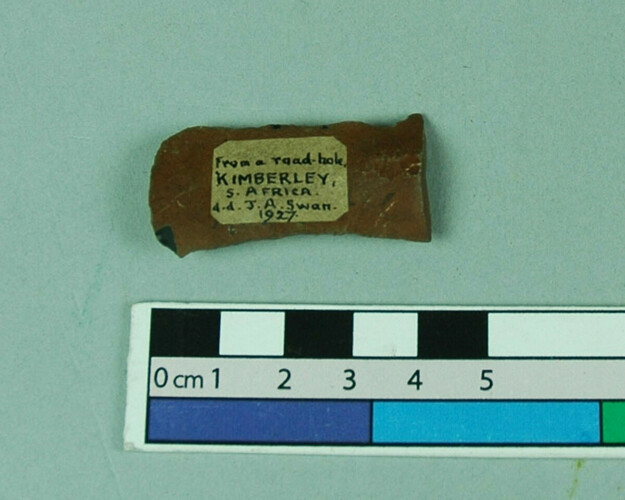 1927.39.30'Duck-bill' scraper. [LKG 10/03/2010]1927.39.30
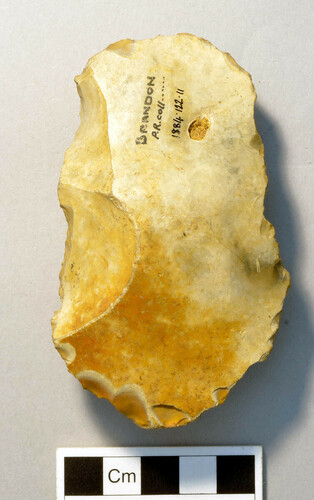 1884.122.11Stone implement1884.122.11
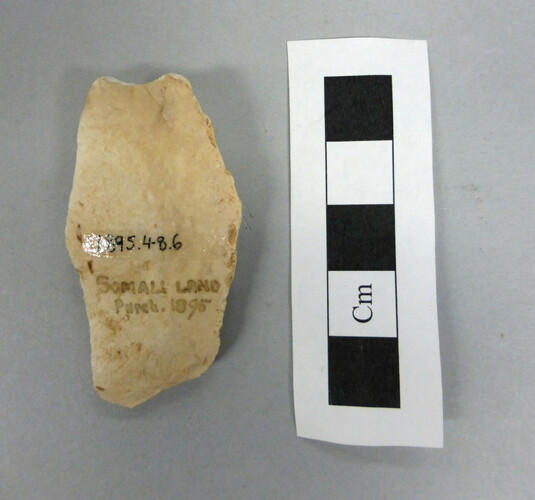 1895.48.6Stone implement.1895.48.6
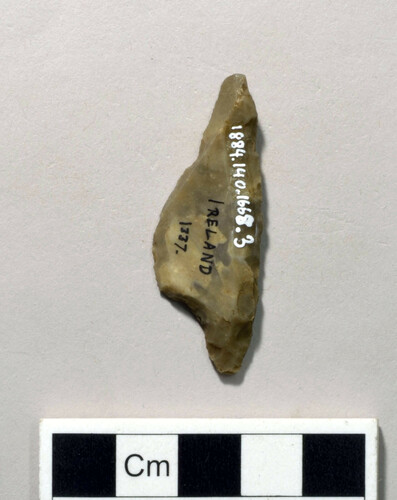 1884.140.1668.3Stone implement1884.140.1668.3
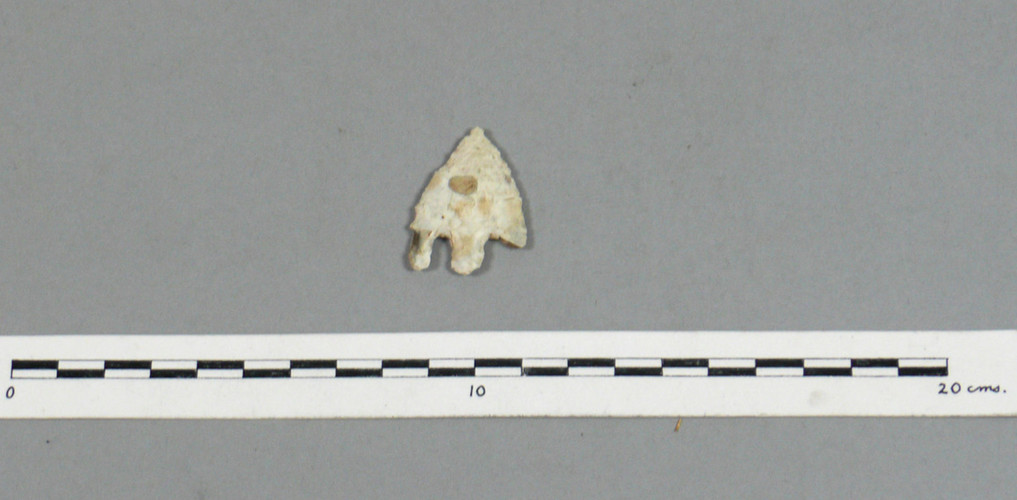 1898.40.1Barbed and tanged flint arrowhead. One barb is partially broken. [MN 20/10/2008]1898.40.1
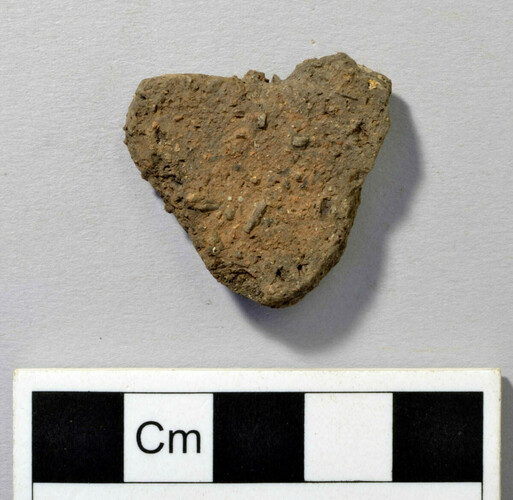 1884.137.58.25Ceramic sherd1884.137.58.25
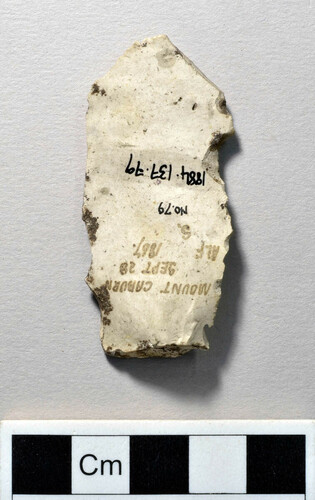 1884.137.79Stone flake1884.137.79
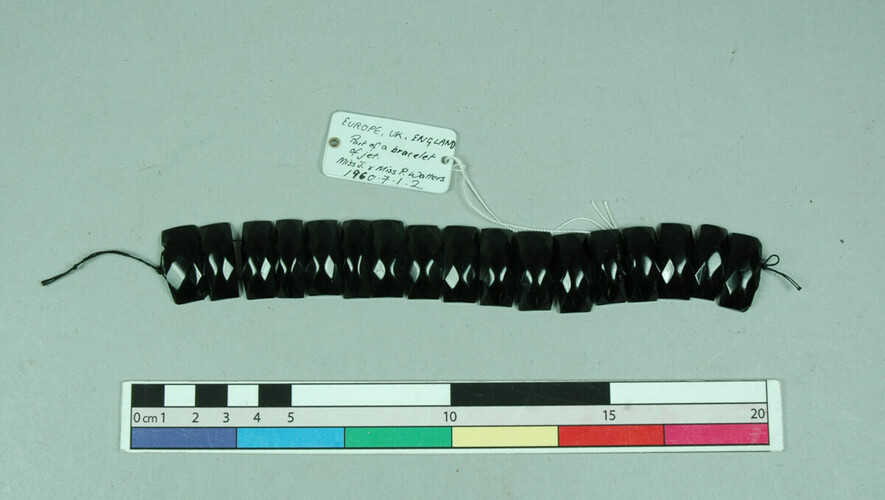 1960.7.1.2String of seventeen beads of polished jet. The beads have a flat rectangular underside and a convex faceted upper side. Each bead is perforated twice across the width. The beads are strung on black cotton yarn. The beads were probably intended to be made up into a bracelet to be worn during mourning.1960.7.1.2