
- Collection type
- Object
- Description
- Stone axe.
- Long description
- Large thick stone axe. It is plano-convex in section and made of polished green Amphibolite stone. [MJD (Verve) 11/8/2016]
- Geographical reference
- Person
- Maker Unknown Maker
- Field collector Frederick K. Porter
- PRM source Augustus Henry Lane Fox Pitt Rivers founding collection
- Date / Period
- Archaeological period: Neolithic, uncertain
- Date collected
- By 1874
- Acquisition information
- Donated: 1884
- Materials and processes
- Material Serpentine Stone, Process Polished
- Dimensions
- Depth: max 34 mm, Width: max 73 mm, Length: max 150 mm
- Object numbers
- Accession number: 1884.123.583 PR Cat other PR nos: 24
- Research and responses
Mark Patton (1987) identifies this object as acquired from Frederick K. Porter. although this is not confirmed by the primary documentation, and it is not impossible possible that Pitt-Rivers collected this item himself. Patton (1987: 466) states that Frederick K. Porter was "Vicar of Yedingham in Yorkshire, a close associate of Canon Greenwell, and for a short time, Chaplain to the Naval College in Jersey". he also indicates that Frank Lukis recorded that Porter sold "a most beautiful fibrolite celt, of great length" from Jersey to Pitt-Rivers, probably in 1870 [Dan Hicks 16/08/2013]
In November 2008 this object is to be subjected to spectroradiometric analysis at the British Museum as part of the international research project 'Projet Jade'. [JC 17 10 2008]
The preliminary results of this analysis are as follows: 'Macroscopic ID (by Pierre Petrequin): Amphibolite with complex structure; bluish mid-green, glaucophanite? Analytical results (Michel Errera): uncertain ID. Specific density suggests a pyroxenite. Will have to await final assessment of results by M Errera before coming to a firmer conclusion as to material and likely source. [JU 16/02/09]
- Associated publications
- Patton, M. 1987. General Pitt-Rivers, Captain Lukis and Channel Island Prehistory. Antiquity 61: 466-468. http://antiquity.ac.uk/ant/061/Ant0610466.htm - illustrated (line drawings) as Figure 2 on page 467 [Dan Hicks 16/08/2013] On page 466 Patton provides a brief account of Rev. Frederick K. Porter and quotes from a letter from Captain Frank Lukis to his brother William, 'That Porter fellow has just sold to Col. Lane-Fox [i.e. Pitt-Rivers] a most beautiful fibrolite celt , of great length, (so I am told),... found by a countryman in Jersey. One from the Tumiac I think was of this form. It is beautifully marked and looks as if grained, such as oak graining is done by painters. This is the description given to me of it.' On page 467, Patton describes it at length, 'The axe of the Lukis letter is not from the Plémont Cromlech. We know only that it was found in Jersey. It is not, as Lukis suggested, of the Tumiac tyle; rather it is a large shoe-last celt very finely polished, and of fibrolite or jadeite, clearly exotic to the island. It is comparable in form to a granite example from Pavilly...; the long edges are not parallel, and the flat lower side has a marked longitudinal convexity, suggesting a relatively late position in the developmental sequence of European shoe-last celts. It has parallels in the Grössgartach-Rössen groups of West-Central Europe..., and it seems reasonable to assign it to a very early stage in the Channel Island Neolithic, probably to the 5th millenium BC (i.e. broadly contemporary with Les Fouaillages and Le Pinacle I). The provenance is at the westernmost limit of the distribution of European shoe-last celts, since only two have previously been recorded W[est] of the Seine.' See RDF: Researchers: Patton for an offprint of this article and for Patton's earlier (1986) unpublished notes. [JN 28/1/2002; JC 14 10 208] Illustrated in colour (two views) as Figure 29 on page 1,072 of 'Les haches alpines et leurs imitations en Grande-Bretagne, dans l’île de Man, en Irlande et dans les îles Anglo-Normandes / Alpine Axeheads and their Imitations in Great Britain, the Isle of Man, Ireland and the Channel Islands', by Alison Sheridan and Yvan Pailler, in Pierre Petréquin et al. (eds), Jade: Grandes haches alpines du Néolithique européen. Ve et IVe millénaires av. J.-C. (2 vols; Collection Les cahiers de la MSHE Ledoux, no. 17; Série Dynamiques territoriales, no. 6.), Besançon: Presses Universitaires de Franche-Comté, pp. 1046–87. Caption (same page): 'Herminette «en forme de bottier», en amphibolite, trouvée à Jersey et acquise par Pitt Rivers'. [JC 29 4 2016]
Further items to explore
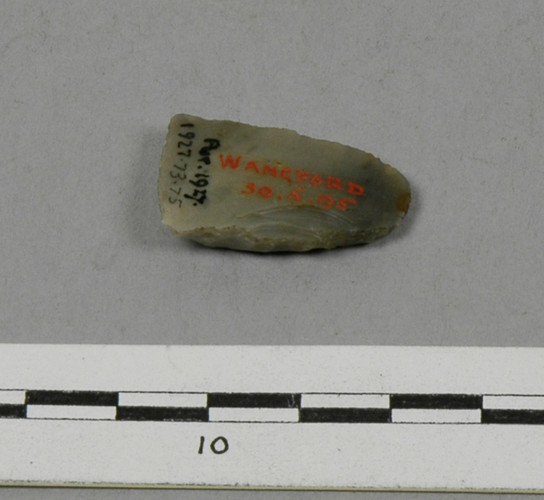 1927.73.75Small flat stone chisel. [El.B 01/10/2007]1927.73.75
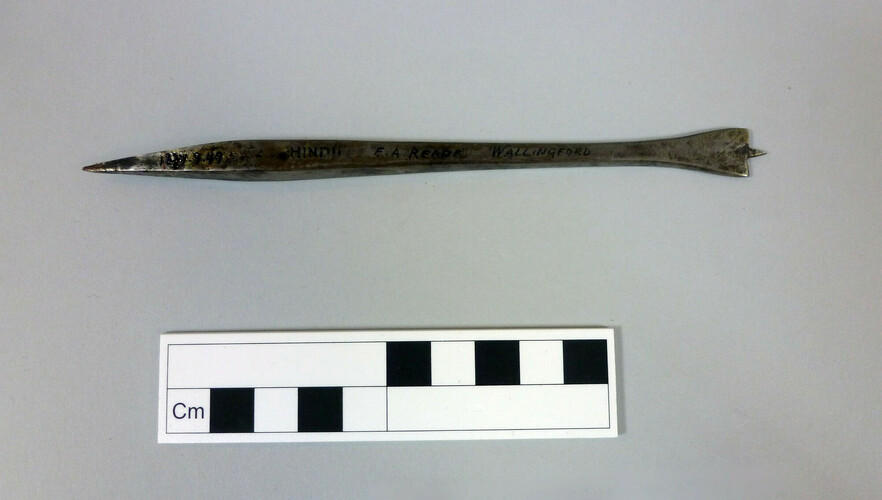 1887.9.49One of set of carpenter's tools, arrow headed centre bit. [FB 22/01/2013]1887.9.49
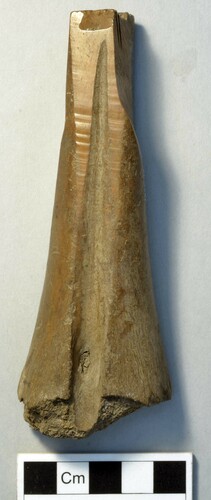 1884.118.215Pinners bone made from distal metatarsal of cattle (Bos). Shaft shaped with 4 flat faces and incised grooves. Distal end not present. [JW [Excav. PR] 03/06/2013]1884.118.215
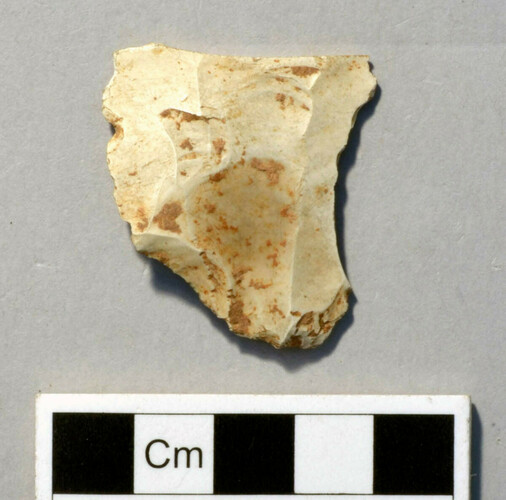 1884.122.531Stone flake1884.122.531
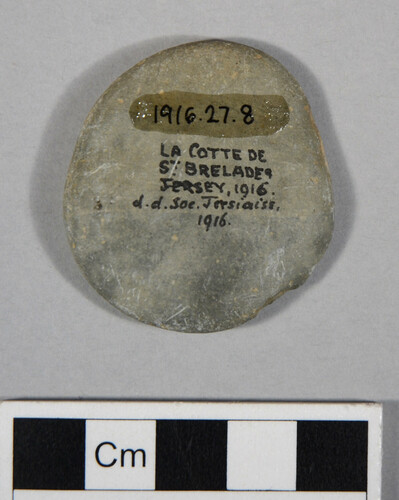 1916.27.8Stone tool; Fractured flat circular pebble.1916.27.8
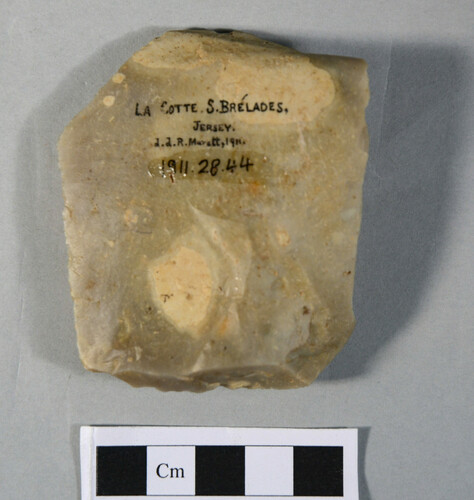 1911.28.44Stone tool; Flake1911.28.44
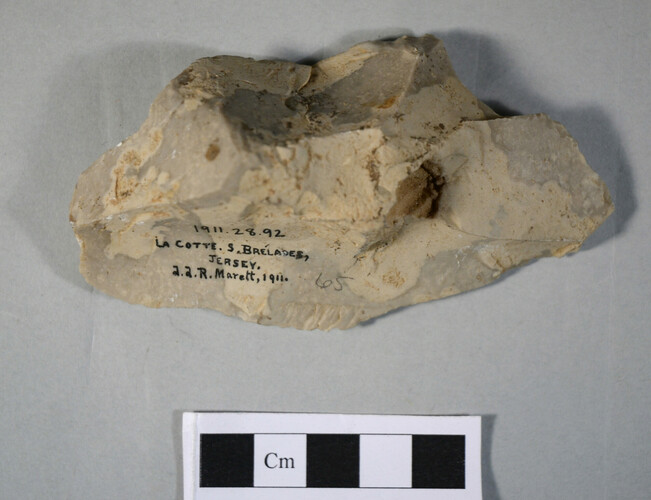 1911.28.92Stone tool; Flake1911.28.92
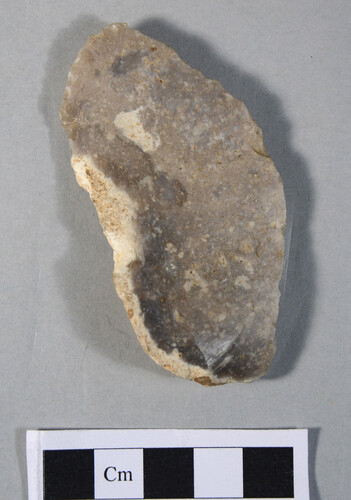 1911.28.15Stone tool; implement1911.28.15