
- Collection type
- Object
- Description
- Stone scraper
- Long description
- Stone scraper of dark grey flint covered in white patina. Strip of cortex on dorsal ridge. [JW [Excav. PR] 23/01/2013]
- Geographical reference
- England Kent Thanet Broadstairs surface collecting at three locations near Broadstairs
- Person
- Maker Unknown Maker
- Field collector Augustus Henry Lane Fox Pitt-Rivers
- PRM source Augustus Henry Lane Fox Pitt Rivers founding collection
- Date / Period
- Archaeological period: Mesolithic, uncertain Archaeological period: Neolithic, uncertain
- Date collected
- 1868 Sept 26
- Acquisition information
- Donated: 1884
- Materials and processes
- Material Flint Stone, Process Flaked, Process Retouched
- Dimensions
- Thick: max 7 mm, Width: max 18 mm, Length: max 51 mm, Weight 7 g
- Object numbers
- Accession number: 1884.123.306 PR Cat other PR nos: 1366 PR Cat other PR nos: 2207
- Research and responses
Note that Pitt Rivers spent some time in east Kent (including the Isle of Thanet and Broadstairs) in 1868 when he examined three flint clusters [Bowden 1991: 72]. Pitt Rivers 'Flint instruments found associated with Roman remains in Oxfordshire and the Isle of Thanet' Journal of the Ethnological Society of London NS1 [1869] 1 - 12: '... The tract of country which I examined in September 1868 extends from about a mile north of Margate to Broadstairs and Ramsgate and to a distance of a mile or two inland from those places ... I found three plots of ground within the area ... upon which the fabrication of flints has been carried on. One near the edge of the cliff between Broadstairs and the North Foreland lighthouse, another about two hundred yards to the west of the lighthouse inland and a third in a field to the west of the churchyard at St Peter's ... [description of flint finds continue] ...' [p8 - 10] [AP Leverhulme project on founding collection 1995-1998]
In his paper on Thanet (Lane Fox 1869: 7), Pitt-Rivers refers to this object as "flint knives: one good specimen of this class is represented in fig. 14; it is an outside flake, two inches long, carefully chipped all round on the convex side" [Dan Hicks 15/03/2013]
- Associated publications
- Lane Fox, A.H. 1869. On some flint implements found found associated with Roman remains in Oxfordshire and the Isle of Thanet. Journal of the Ethnological Society of London 1: 1-12. http://www.jstor.org/stable/3014386 - illustrated as Fig. 14 [Dan Hicks 15/03/2013]
Search terms: Tool, Scraper, Blade Flake
Further items to explore
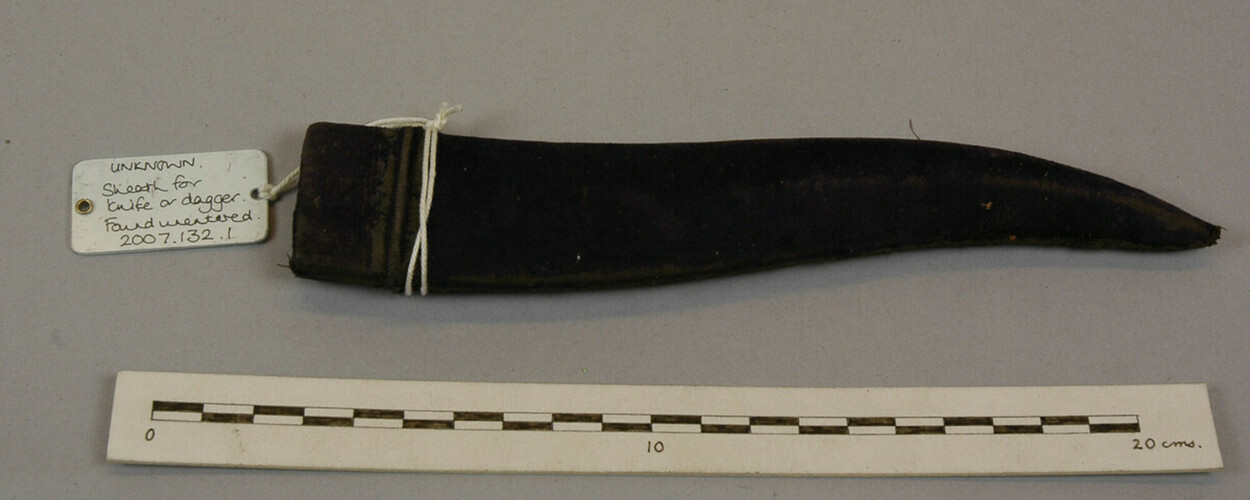 2007.132.1Sheath of wood, covered with purple velvet, for an S-shaped knife or dagger. [SM 04/12/2007]2007.132.1
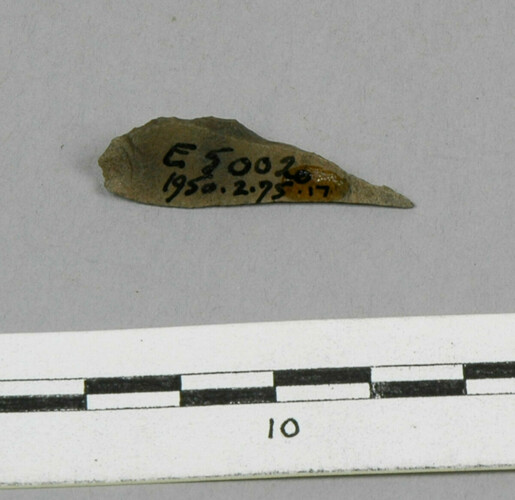 1950.2.75.17Stone tool, small 'Bondi' type point. [El.B 14/08/2007]1950.2.75.17
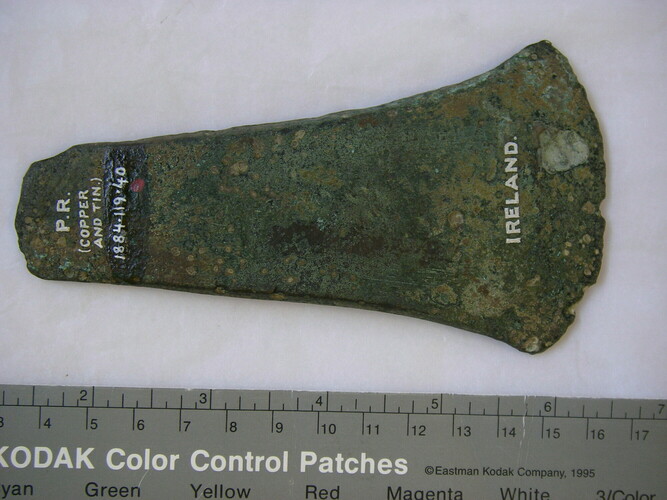 1884.119.40Bronze axe1884.119.40
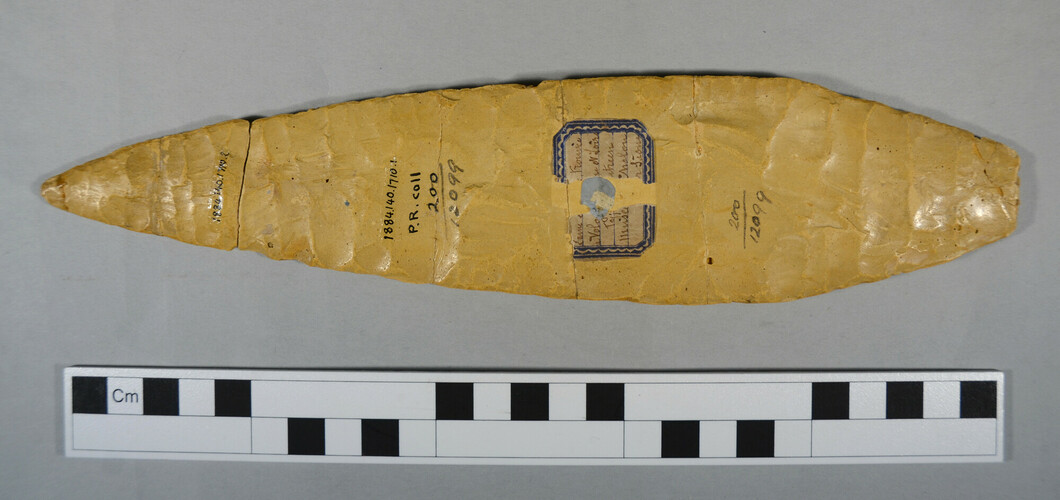 1884.140.1710.1Cast of stone tool, the tip is broken off [.2]. The cast is dark yellow. [MJD 22/01/2014]1884.140.1710.1
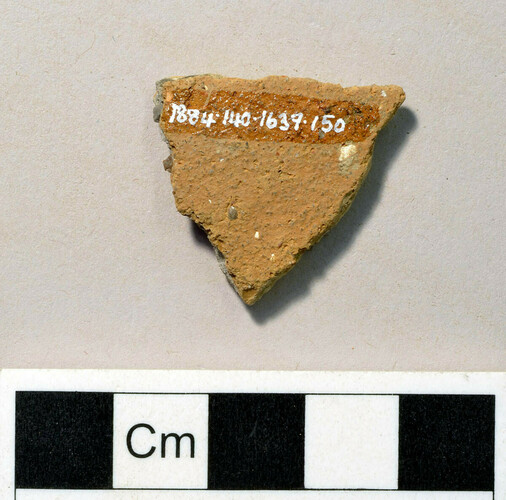 1884.140.1637.150Ceramic sherd1884.140.1637.150
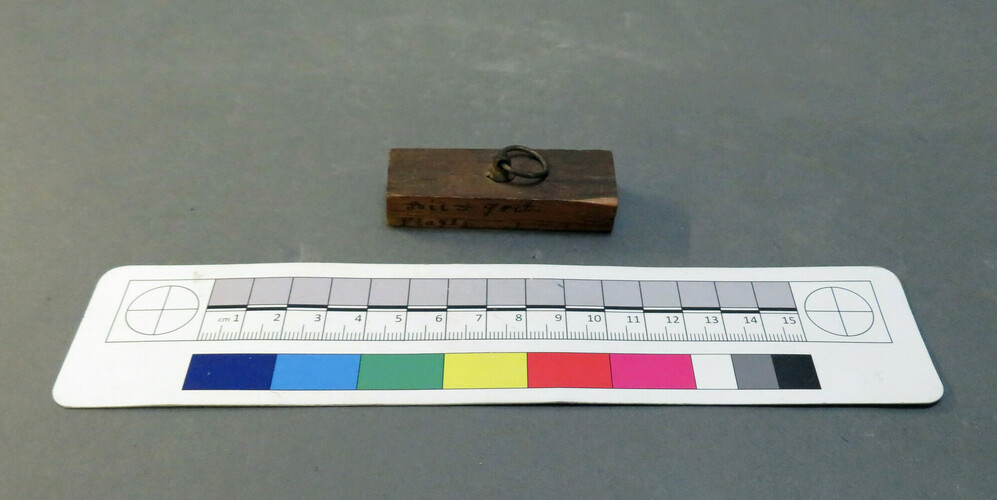 1884.140.85.2Rectangular wooden cover for entrance to model of 'underground structure to Langtoft Wold' [AFS [OPS move] 22/6/2018]1884.140.85.2
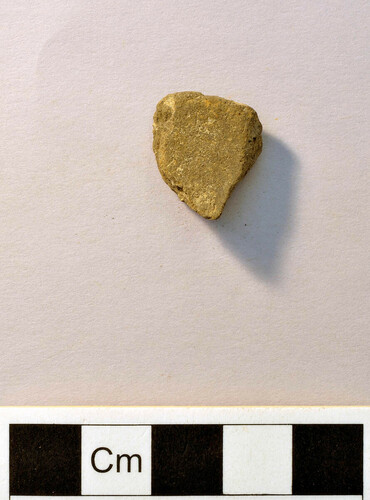 1884.137.22.89Ceramic sherd1884.137.22.89
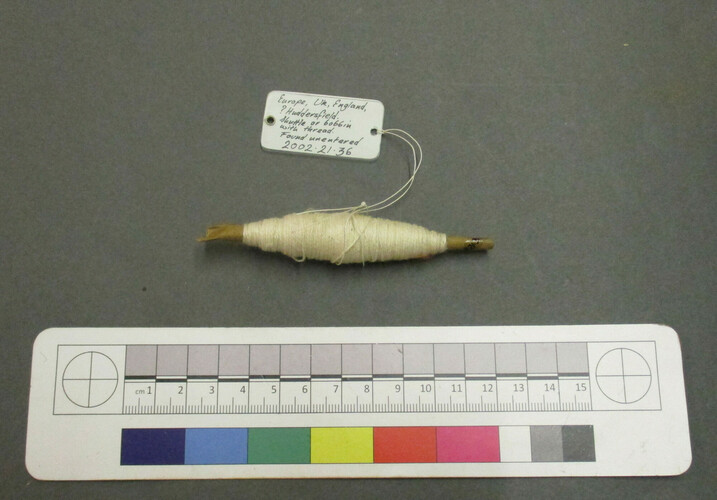 2002.21.36Bobbin or weaving shuttle of brown paper wound with white machine? spun cotton yarn. [EH [OPS Move] 12/6/2017]2002.21.36