
- Collection type
- Object
- Description
- Razor of arsenical copper from Cyprus; Bronze Age (Early-Late Cypriote) in date. [Dan Hicks 01/05/2012]
- Long description
- Tool or weapon. “Razor. Roughly rectangular flat blade with a very slight midrib, rounded shoulders, and a flat tang with one rivet hole, the rivet missing. The blade narrows slightly towards the flat bottom edge, although the original outline of the edges is not preserved. Comparable scrapers or razors date from lat EC-MC II and possibly into LC I.” [Description by Karageorghis, V., 2009, p. 111] [JFK 19/11/2009]
- Person
- Maker Unknown Maker
- Field collector Luigi Palma di Cesnola
- PRM source Augustus Henry Lane Fox Pitt Rivers founding collection
- Date / Period
- Date made: 2500-1450 BC Archaeological period: Bronze Age
- Date collected
- 1868 - 1870
- Acquisition information
- Donated: 1884
- Materials and processes
- Material Copper Metal, Process Riveted
- Dimensions
- Length: max 125 mm
- Object numbers
- Accession number: 1884.119.282 Other numbers: Cypriot Archaeology 136 PR Cat other PR nos: 2604
- Research and responses
Note that there is an entry in the 'Green book' for two 'bronze daggers forgeries'. These cannot be matched at the present time as there is insufficient information but no daggers are currently identified as being reproductions. Any of the bronze daggers in the existing catalogue may therefore be reproductions [AP Leverhulme project on founding collection 1995-1998]
The date given with these objects (1868-1870) suggests that they are probably from the collection of General Luigi Palma di Cesnola, rather than from that of his brother Major Alessandro Palma di Cesnola. Luigi di Cesnola took most of his collection from Cyprus some time after June 1870. Large sales of Luigi di Cesnola's collection were held at Sotheby in 1871. Alessandro di Cesnola's collections were not sold in any great way until 1883 and 1884 when they were sold as the Lawrence-Cesnola collection. [MdeA 5 July 1999]
At a sale at Sotheby's on 1st and 2nd May 1871, Pitt Rivers purchased two lots of metalwork. The sale was of material from the collections of General Luigi di Cesnola. It is possible but by no means certain that this object is from one of these lots. The lots were : Lot 18 'A Spear-Head with its socket ... 10in.' and lot 20 'Two Spear-Heads'. There does not appear to be a metal weapon or blade from Cyprus in the Pitt Rivers Collection which fits the measurements given but it is possible that the measurements were not exact. [MdeA 13 July 1999]
At a sale at Sotheby's on 3rd July 1871 Pitt Rivers purchased three lots of metalwork. The sale was the remainder the General Luigi di Cesnola's collection. It is possible but by no means certain that this object is from one of these lots. The lots were: Lot 62, Lot 63 and Lot 126 and consisted of 22 metal items - ten spear heads, a socketted spear, celts and other unlisted metal items.[MdeA 9 July 1999]
In 1999 samples from the PRM's collection of Cypriot archaeological metalwork were subjected to electron probe microanalysis with wavelength dispersive spectrometry by Peter Northover of the Department of Materials, University of Oxford. The sample from this object was given the sample number 'Cesnola 10' and subjected to two separate analyses, the mean results being as follows: Fe 0.94, Co 0.01, Ni 0.01, Cu 95.42, Zn 0.01, As 2.83, Sb 0.01, Sn 0.52, Ag 0.03, Bi 0.01, Pb 0.05, Au 0.00, S 0.17. For the full results of the analysis, see Peter Northover's unpublished report 'Analysis of Copper Alloy Metalwork in the Cesnola Collection, Pitt-Rivers Museum' (in RDF: Researchers: Northover). [JC 14 11 2008]
Email correspondence today with Peter Northover confirmed that, based on his metallurgical analysis, this object is most accurately described as 'arsenical copper', rather than 'copper alloy'. I have updated the description accordingly [Correspondence now placed on file in RDF: Researchers: Northover] [Dan Hicks 01/05/2012]
- Associated publications
- Published under catalogue number 136 on page 111 in Karageorghis, V., (2009) Cypriote Art in the Pitt Rivers Museum, University of Oxford. A.G. Leventis Foundation. [JFK 09/10/2009]
Further items to explore
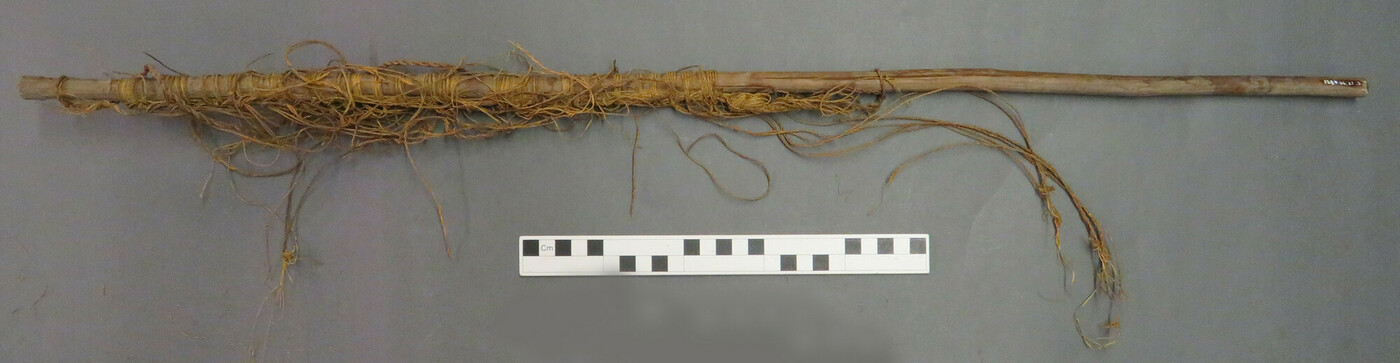 1884.46.21.3Warp beam for loom. Cylindrical rod, split at one end and wrapped with twisted plant fibre. [IL [OPS Move] 3/4/2017]1884.46.21.3
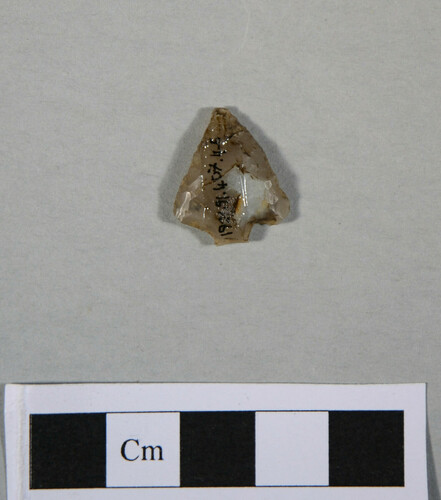 1921.91.407.45Barbed and tanged arrow-head with bifacial retouch extending across both faces. One barb is broken.1921.91.407.45
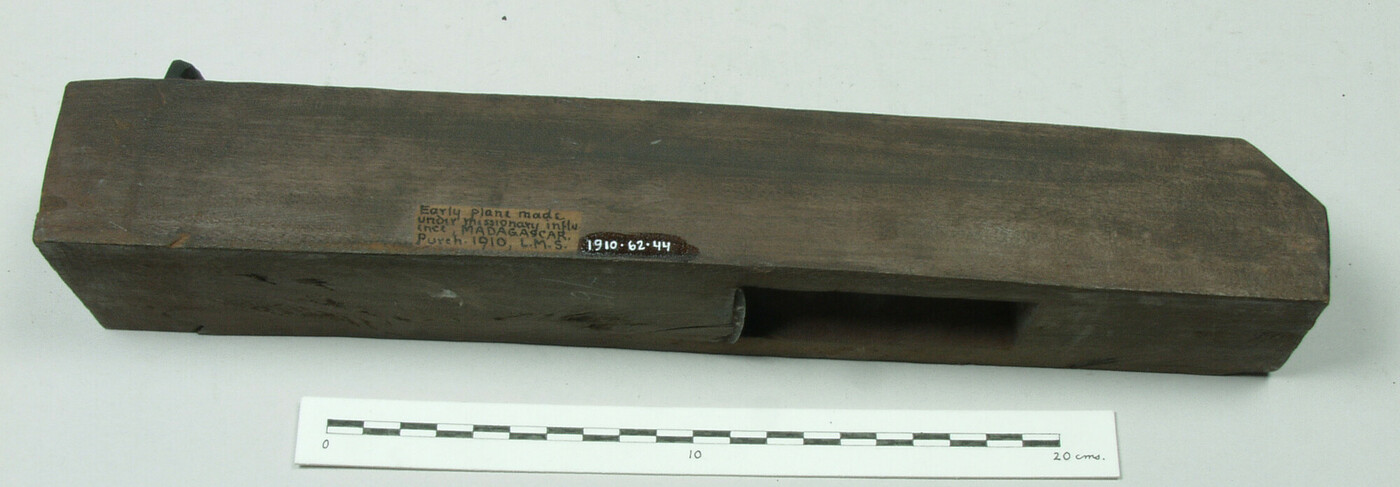 1910.62.44Carpenter's plane. [L.Ph 'DCF 2004-2006 What's Upstairs?' 30/11/2004]1910.62.44
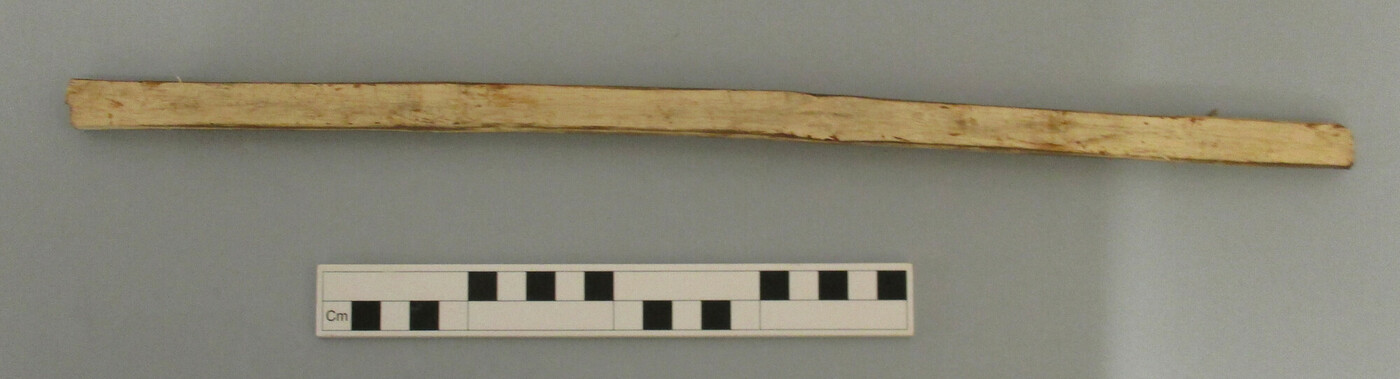 2002.85.86.2Stick, used along with three other sticks bound with string, to hold together a fragile blackboard made from the base of a sago leaf stem. For the blackboard see [2002.85.86 .1] and for the other three sticks see [2002.85.86 .3 - .5]. [RH [OPS Move] 27/6/2017]2002.85.86.2