
- Collection type
- Object
- Description
- Bronze dagger blade
- Long description
- Arsenical copper halberd [dagger] blade with three large rivets. The hafting-plate is asymmetrically arched in outline, with shafts of domed rivets lightly and irregularly faceted. The edges of blade are slightly concave in outline. The midrib is broad and rather flat, starting in an oblique bevel across the hafting-plate and tapering to the tip of the blade. [MN 03/02/2009]
- Geographical reference
- "Ireland": ie Ireland or Northern Ireland (UK)
- Person
- Maker Unknown Maker
- Field collector Unknown Collector
- PRM source Augustus Henry Lane Fox Pitt Rivers founding collection
- Date / Period
- Archaeological period: Early Bronze Age
- Date collected
- By 1874
- Acquisition information
- Donated: 1884
- Materials and processes
- Material Copper Alloy Metal, Process Riveted, Process Cast, Process Forged (Metal)
- Dimensions
- Thick: max 8.5 mm, Width: max 57 mm, Length: max 296 mm, Weight 324 g
- Object numbers
- Accession number: 1884.119.263 Other numbers: 41 187 PR Cat other PR nos: 2610
- Research and responses
Pitt Rivers was in Ireland [serving in the Army] from 1862-66, this object may have been obtained during this period [Bowden, 1991: 60-4] [AP Leverhulme project on founding collection 1995-1998]
In the late 1940s or 1950s, a drilling was taken from this object for elemental analysis and a sample removed for metallographic examination as part of the work of the Ancient Mining and Metallurgy Committee of the Royal Anthropological Institute. For the results of the analysis, see under 'Publications'. [MN 30/03/2009]
- Associated publications
- For description, analysis, and a line drawing, see 'Report 3. Early Bronze Age Halberd' and 'Report 3a: Early Bronze Age Round-Head Rivet from Halberd (P.R. 1488)', including Figure 4, on pages 86-7 of 'A Metallurgical Study of Four Irish Early Bronze Age Ribbed Halberds in the Pitt Rivers Museum, Oxford: A Report to the Ancient Mining and Metallurgy Committee', by T. K. Penniman and I. M. Allen, in Man, Vol. 60, no. 6 (June 1960), art. 120, pp. 85-89. [JC 11 7 2008] Almost certainly that listed as number 187 under category 'B. Halberds', sub-category 'Type Carn' on page 41 of The Daggers and the Halberds of the Early Bronze Age in Ireland (Prähistorische Bronzefunde, VI, 1), by Peter Harbison (Munich: C. H. Beck'sche Verlagsbuchhandlung (Oscar Beck), 1969): '186. Provenance unknown. Pitt-Rivers Mus., Oxford (P. R. 1488 (2)). Penniman, Allen, Man 60, 1960 No. 120 Fig. 4 (Pl. 11, 187).' See also line-drawing in Plate 11 (unpaginated). Photocopy in RDF. [JC 24 7 2008] Published (under catalogue number 41) on pages 107 - 110 of Allen, I.M., Britton, D., and Coghlan, H.H., 1970, 'Metallurgical Reports on British and Irish Bronze Age Implements in the Pitt Rivers Museum', Occasional Papers on Technology 10, Oxford University Press, Oxford: Halberds; Description. Halberd. Hafting-plate asymmetrically arched in outline, now slightly damaged. Shafts of rivets lightly and irregularly faceted, heads domed. Edges of blade slightly concave in outline, originally sharpened, now rather damaged. Midrib broad and rather flat, starting in an oblique bevel across the hafting-plate and tapering to the tip of the blade. Surfaces slightly rough with corrosion. [Drawing] Analysis Chemical: As 2.1% Spectrographic: Pb 0.035%, Sb 1.66%, Ni 0.012%, Fe 0.005% [This is NOT a bronze alloy, but an arsenical copper alloy] Metallographic examination of the blade. Examination showed a highly developed dendritic structure [refers to fig. 41, image 1], typical of an arsenical copper which has been cooled slowly in a heat-insulating mould. The dendrites had grown at right angles to the walls of the mould, reaching almost to the centre of the section. This coarse structure suggests that the stone or clay bivalve mould was pre-heated. Oxygen had been absorbed during casting, producing mixed oxides of arsenic and antimony, but these were sparsely distributed in the section, indicating that the metal was protected by charcoal from atmospheric oxidation during melting. A section taken from the centre [refers to fig. 41, image 1] showed a normal cored structure with interdendritic porosity. Superimposed on this structure were twinned polygonal grains indicating slight working and heat treatment. The dendrites in a second section [refers to fig. 41, image 2] were distorted and the cores elongated in the direction of the forging. Recrystallized twinned grains were again superimposed on the cored structure. Some β phase had been precipitated, accompanied by characteristic cracks. Strain markings at the edge indicated cold-working. a third section taken at the cutting-edge [refers to fig. 41, image 3] showed a spindle-like structure of elongated cores and cracks, indicating severe forging. The forging had increased the hardness of 75 to 153 HB. (spectrographic analysis showed the presence of iron, nickel, antimony, and oxygen, which all tend to increase the hardness.). The three holes in the base of this artefact were of similar diameter and had all been drilled from both sides, probably with a hollow tube drill fed with sand and water. Metallographic examination of a rivet. Examination showed a highly developed dendritic structure [refers to fig 41, image 4], typical of an arsenical copper which has been cooled slowly in a heat-insulating mould. The dendrites had grown at right angles to the walls of the mould, reaching almost to the centre of the section. This coarse structure suggests a pre-heated clay mould. Mixed oxides of arsenic and antimony were distributed throughout the section. The composition of the alloy and its structure were identical with those from the halberd. The dendrites in one head had been elongated into a semi-oval form by forging. Small recrystallized twinned grains were present in the spindle structure, indicating that the rivet had been heated, but this had not been sufficient to eliminate the strain markings [refers to fig. 41, image 5]. The structure of the shank showed recrystallized twinned grains superimposed on a cored structure [refers to fig. 41, image 4]. The structure indicates that the rivet was forged with a round die, from a piece of cast rod. The forging was probably started at red heat and continued until the temperature had fallen below 200°C. Annealing may have partly caused the precipitation of the β phase, producing cracks. The structure of the other head of this rivet [refers to fig. 41, image 6] was similar to the one already described, but did not exhibit twinned grains, and the rivet was therefore closed cold against the haft.' [GB 20/5/2005, MN 29/01/2009, CMP 09/08/2010]
Further items to explore
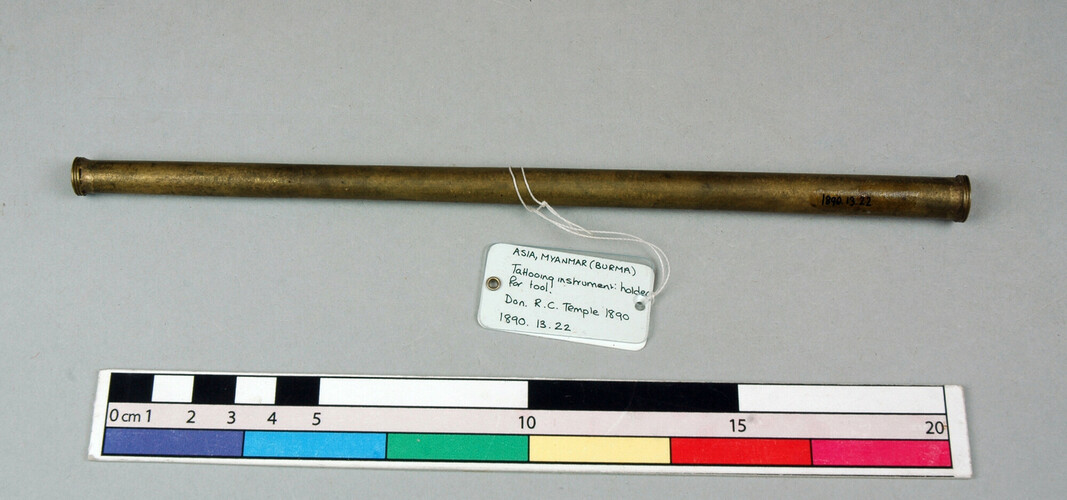 1890.13.22Brass tube, part of a tattooing tool. [El.B DDF Body Arts Project 2010/2011 02/09/2010]1890.13.22
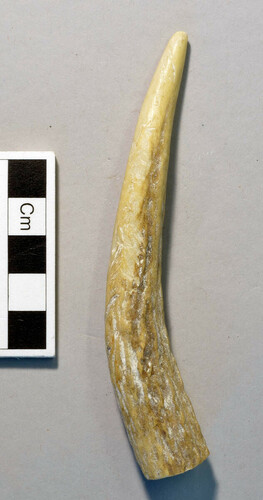 1884.140.1593.4Antler point; experimental1884.140.1593.4
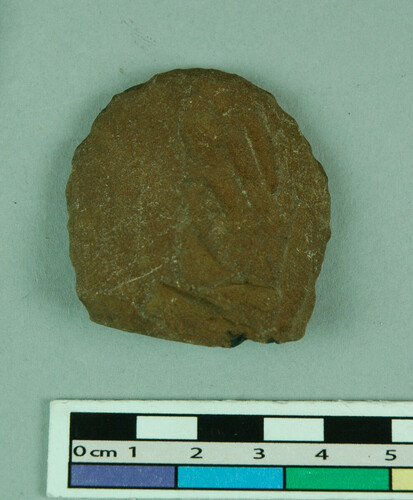 1930.20.67End-scraper, sub discoidal shaped and dark orange in colour. [MJD 18/05/2010].1930.20.67
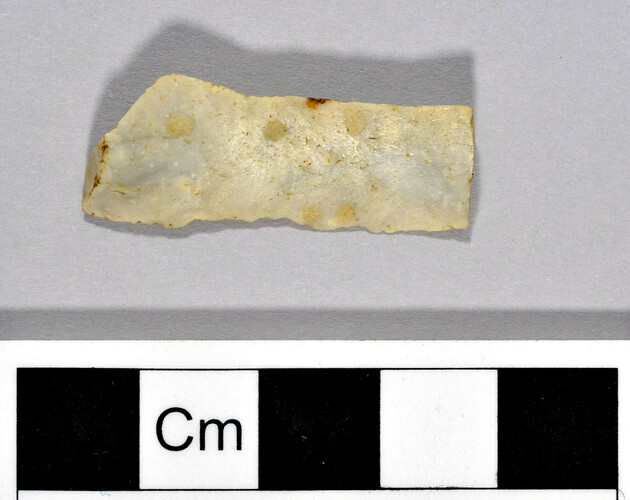 1884.123.469.86Stone blade flake1884.123.469.86
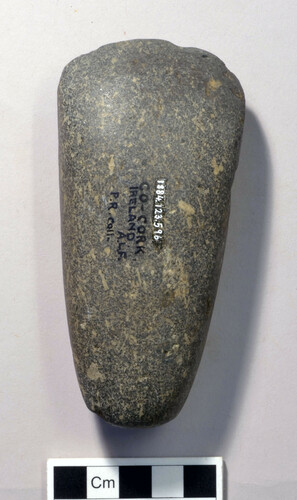 1884.123.596Stone axe1884.123.596
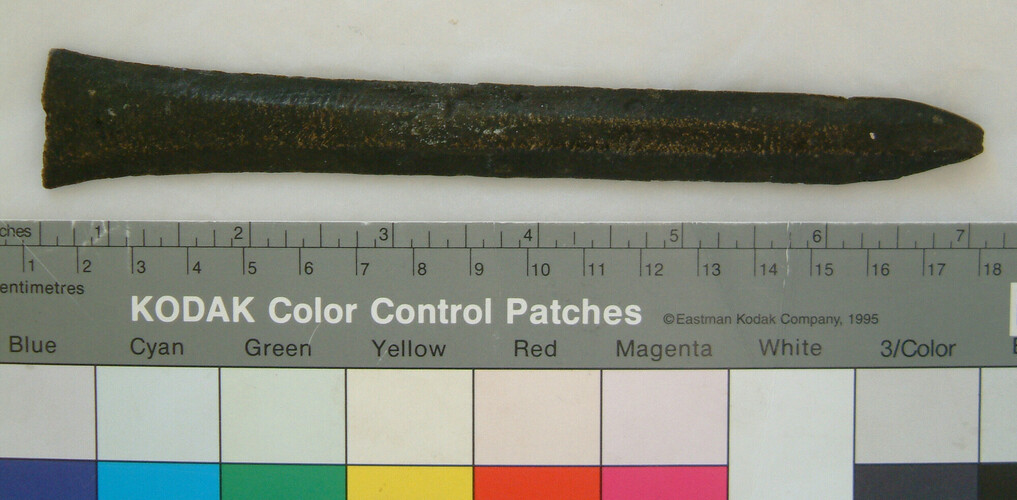 1884.119.271Small dark narrow bronze blade with thick rib.1884.119.271
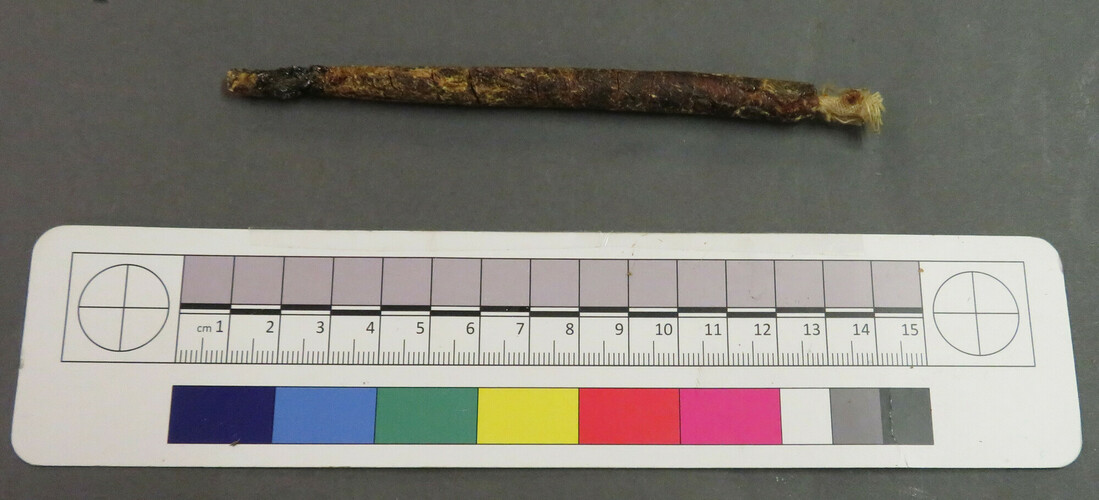 2017.150.2Resin candle. It is straight with a circle section. The wick is made from a textile rag which is extending from the tip. [FB 22/6/2017]2017.150.2
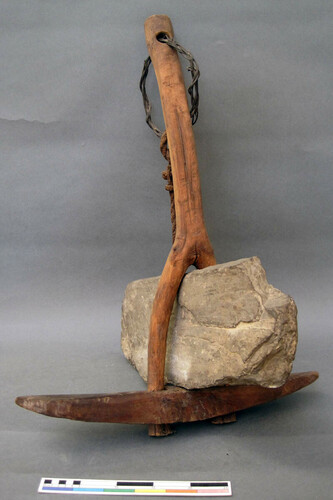 1891.24.1Wood and stone anchor. [DCF Court Team 17/2/2003]1891.24.1