
- Collection type
- Object
- Description
- Fipple Flageolet Duct Flute wrapped in blue and white cloth.
- Geographical reference
- Person
- Maker Unknown Maker
- Field collector Edward Horace Man
- PRM source Augustus Henry Lane Fox Pitt Rivers founding collection
- Date / Period
- Date made: Before 1884
- Date collected
- Prior to 1884
- Acquisition information
- Donated: 1884
- Materials and processes
- Material Bamboo Plant, Material Wax, Material Textile, Process Perforated, Process Bound
- Dimensions
- Diameter: max 25 mm, Length: max 435 mm
- Object numbers
- Accession number: 1884.111.8 PR no.: 4/ 11935
- Research and responses
11935 number would suggest that this is an EH Man object. This object is listed in Accession Book VII but is one of those items listed there which were part of the PRM collections before 1884. [AP Leverhulme project on founding collection 1995-1998]
- Associated publications
- Indian Antiquary, Feb. 1895, 'Catalogue of Nicobarese objects', p. 107 '76 (m) Henhel (Car Nicobar Fa-na) Bamboo flageolet similar to those in use among the Burmese, generally about 18 inches long. A flat circular piece of beeswax about the size of a four-anna piece, but thicker, is inserted in the tube, and is fixed in the middle of the oblong incision marked A in the sketch, where it serves as the block of the instrument. Over the upper half of this incision a piece of leaf (generally of the Amomum Fenzlii) or paper, is loosely wrapped. These measures serve to regulate the tone of the instrument, which is provided with 7 finger holes and one thumb hole, the latter being on the reverse side, and at a level corresponding with the space between the top and second finger holes. The scale is arbitary, and between the Burmese and the European. In construction it resembles the metal flue pipe of an organ. Some four or five tunes only are known, and these are borrowed from the Malays. The tone is liquid and clear. The henhel is not made in Car Nicobar, where only a few, obtained from Chowra, are owned by those who have learnt to play on it. In the long-established villages in the Central Group, where there are cemeteries, this instrument can be played only at the special feast known as Et-kait-fii when it accompanies a danang (vide no 77). It can be played at any time at any village where there is no cemetery, provided no mourners are present: at these villages only can it be played as an accompaniment to dancing and singing. A few persons are able to play this instrument through one or other of the nostrils and more especially is this done on the occasion of the Et-kait-fii festival when the performer usually perches himself on one of the derricks, 20 or 40 feet high (styled henkonsha) which are constructed for the purpose of raising the lofty pole to a vertical position.' [AP Leverhulme project on founding collection 1995-1998]
Search terms: Music, Musical Instrument, Flute
Further items to explore
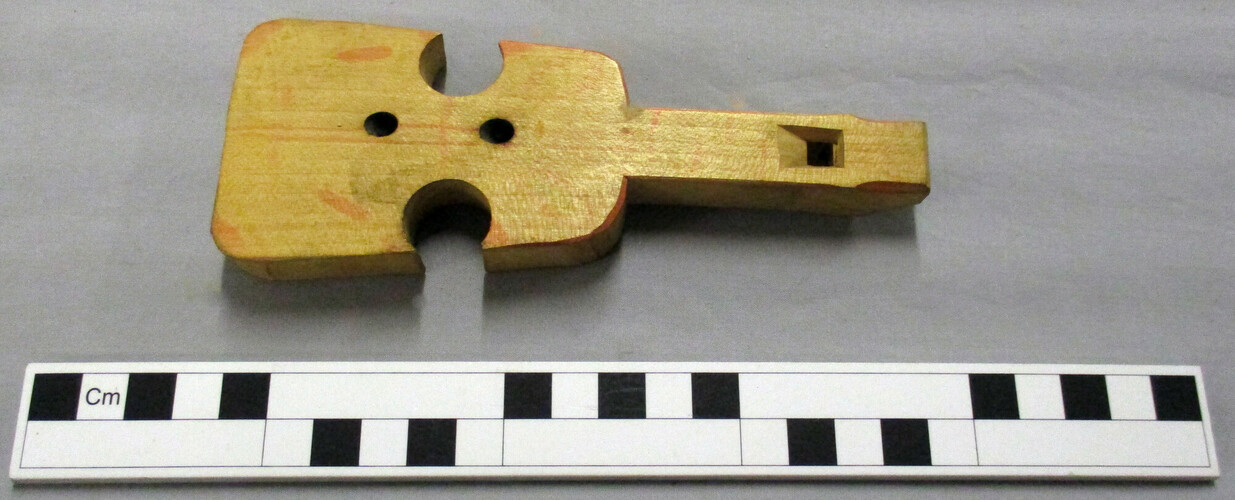 1985.36.174Wooden toy in the shape of a musical instrument, possibly a guitar or violin, hand made by Walter Wilkinson. Painted with red patterns on the upper surface. [ASh [OPS move] 14/06/2016]1985.36.174
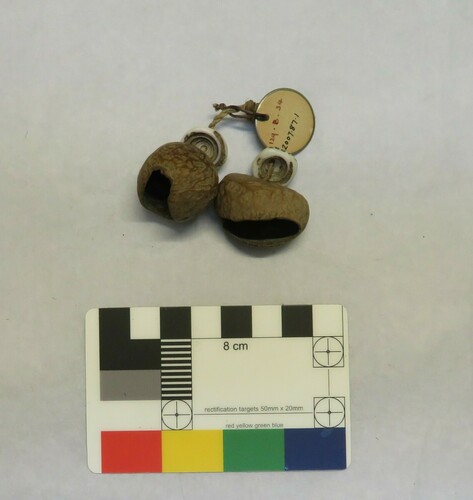 2007.87.1Jingle rattle of two nut shells and two shell beads on plant fibre string.2007.87.1
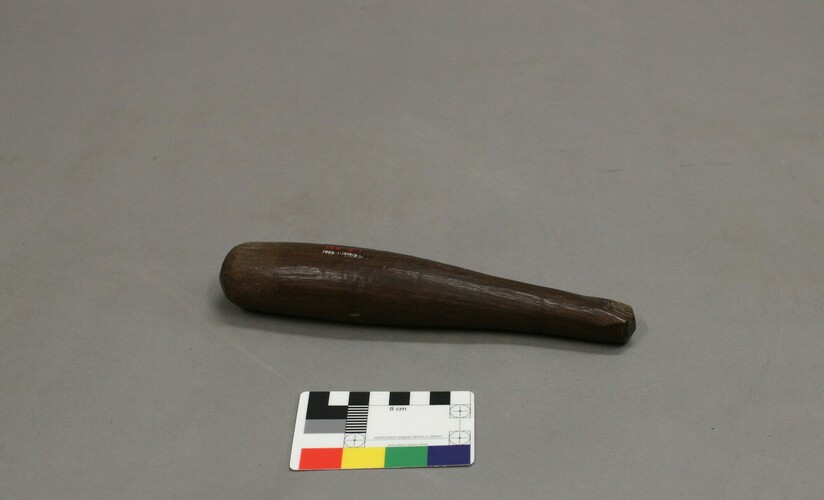 1886.1.1517.3Wooden striker for slit drum [1886.1.1517 .1]1886.1.1517.3
 1965.5.20.2BBridge for fiddle 1965.5.20 .1 B. Tied to fiddle. [MJD 25/09/2008]1965.5.20.2B
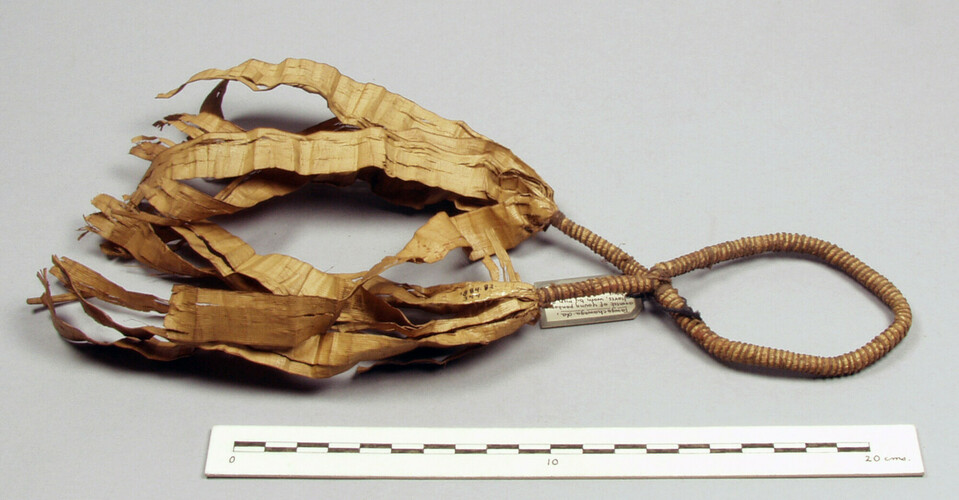 1884.82.344Arm ornament of a loop of tightly bound pandanus leaf with two tassels of pandanus leaf strips on two stalks. [El.B 'DCF 2004-2006 What's Upstairs?' 29/11/2005]1884.82.344
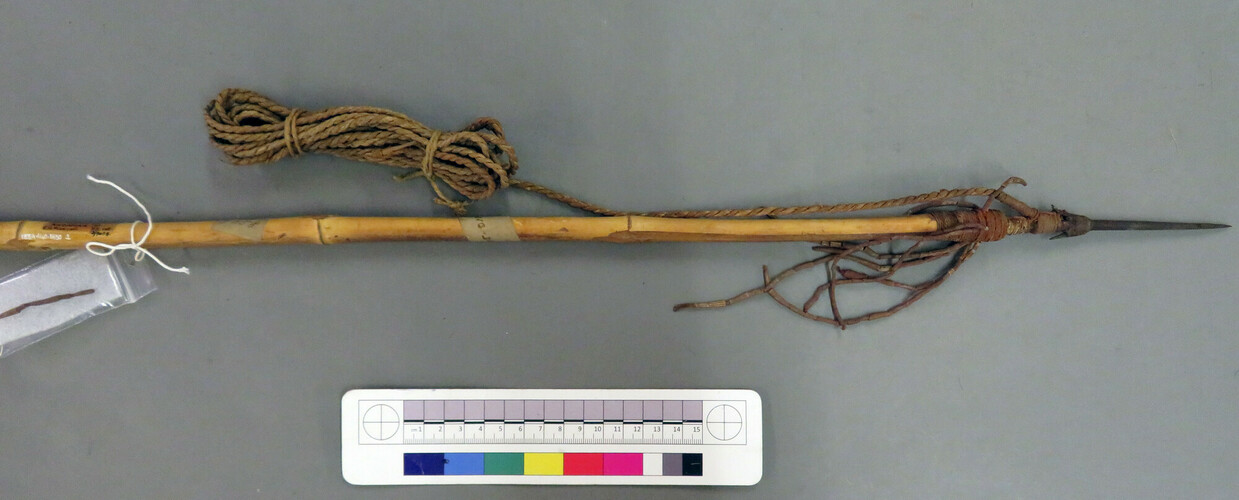 1884.140.1630.1Bamboo harpoon shaft. [FB 12/11/2013]1884.140.1630.1
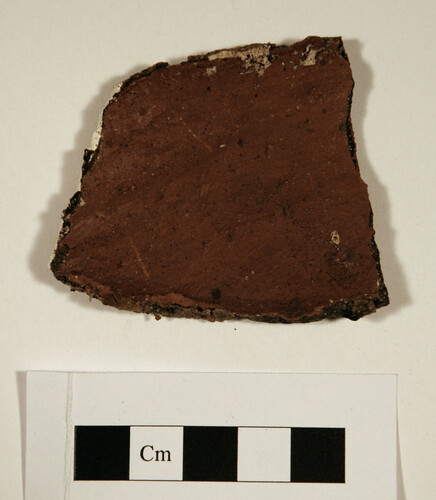 1884.41.53.4Fragment of cooking pot [one of 23 pieces]. [MJD 02/05/2013]1884.41.53.4
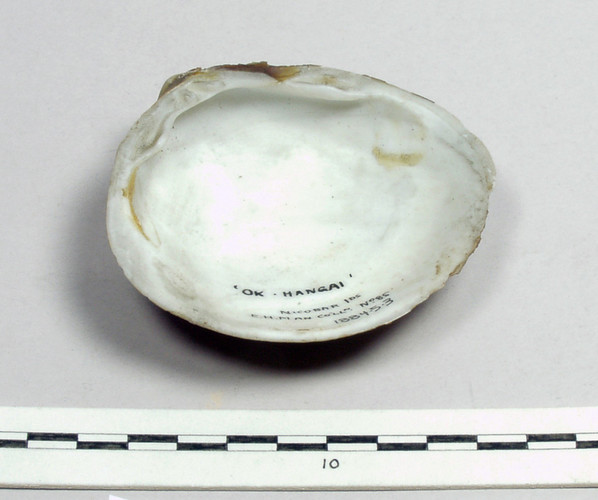 1884.5.3Spoon, of cyrena shell for unripe fruit.1884.5.3