
- Collection type
- Object
- Description
- Wooden drum stick or baton carved at end with head of seal or sea lion.
- Long description
- Wooden drum stick or baton carved at end with head of seal or sea lion. It is carved from a single piece of red cedar wood. The handle is rounded, straight, and tapers inward to one end. The other end is wider, offset at a slight angle from the handle and carved in the form of a seal or sea lion's head. The terminus is carved with a rounded snout, open mouth with the tongue protruding downwards, and lower mandible. Two eyes are carved at the top of the head and the entire face and jaw is outlined. A crack in the wood runs under the chin and there is a circular area with a black residue that may be evidence of a nail or some other material in the past. [CAK 06/05/2009]
- Geographical reference
- Person
- Maker Unknown Maker
- Field collector Unknown Collector
- PRM source Augustus Henry Lane Fox Pitt Rivers founding collection
- Date / Period
- Date made: Before 1874
- Date collected
- By 1874
- Acquisition information
- Donated: 1884
- Materials and processes
- Material Cedar Wood Plant, Process Carved
- Dimensions
- Length: max 350 mm
- Object numbers
- Accession number: 1884.109.16 PR Cat other PR nos: 2186 PR Cat other PR nos: 2170
- Research and responses
The following information comes from Haida delegates who worked with the museum’s collection in September 2009 as part of the project “Haida Material Culture in British Museums: Generating New Forms of Knowledge”:
This object was viewed alongside coppers and musical instruments including rattles and flutes on Thursday Sept 10, 2009. The identification of this object as a 'drum stick' was debated. Candace Weir noted that the drumsticks used today have padded heads and wooden handles; people do not beat their drums with naked wood. It was suggested that it could have been used for beating wood rather than the hide of a drum. (Cara Krmpotich note: Haidas made and used bentwood box drums.) Christian White and Natalie Fournier wondered if this could have been used by a shaman either to beat time on a board or log drum, or alternatively whether it could have been used by a shaman as a baton when dancing rather than as a drum stick, or as gambling sticks.
Kwiiawah Jones identified the material as red cedar.
Diane Brown told us that her husband had produced very similar designs to this one, although he had never seen images of such designs before.
After a day's reflection, Gwaai Edenshaw thought it was unlikely that this was ever used to beat time on wood as it lacked signs of wear you would expect from such activities, and it lacked signs of 'polishing' that comes from repeated use. He thought its designation as a baton or wand more likely. He also cautioned that if this was the possession of a shaman, anyone coming into contact with it needed to take care. [CAK 12/02/2010]
Note that only a tiny fraction of JW Flower items are also marked as being related to the Pitt Rivers founding collection. Whilst it is possible that they did originally form part of the founding collection, were brought from London in 1884 and then placed with the geological collections at Oxford University Museum of Natural History before eventually being transferred to the Pitt Rivers Museum it seems odd that they were not all recorded as being related to the founding collection. Most are attributed to being donated by Flowers to OUMNH and being transferred from there [AP 23/07/2009]
Search terms: Medicine, Figure, Music, Dance, Medical Accessory, Animal Figure, Musical Instrument Accessory, Striker, Dance Accessory
Further items to explore
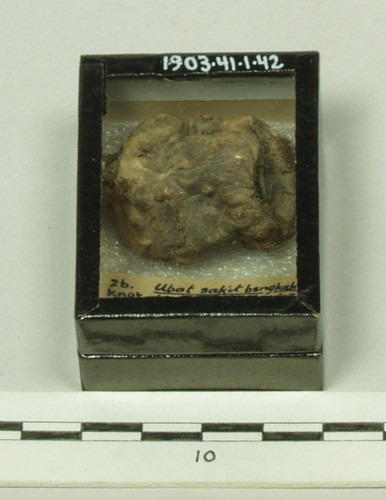 1903.41.1.42Knot of wood, used medicinally [L.Ph 'DCF 2004-2006 What's Upstairs?' 27/1/2005]1903.41.1.42
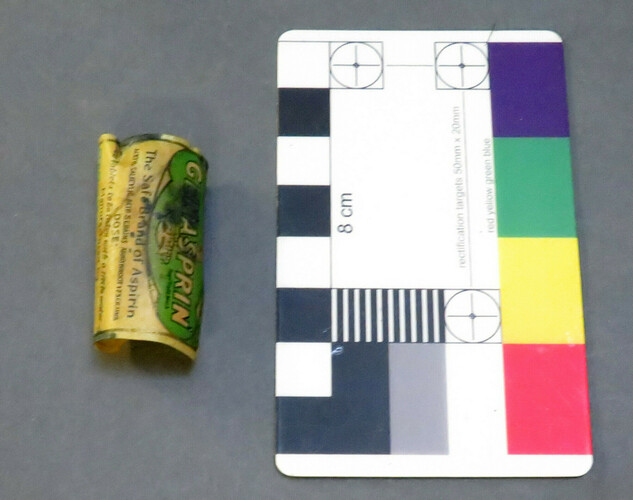 2012.21.43.2Sticker from aspirin bottle, part of a medical kit [See 2012.21.2 - .53]. [FB 26/03/2012]2012.21.43.2
 1898.75.107Carved wooden stick tapered at one end with lines and dots incised to form a pattern.1898.75.107
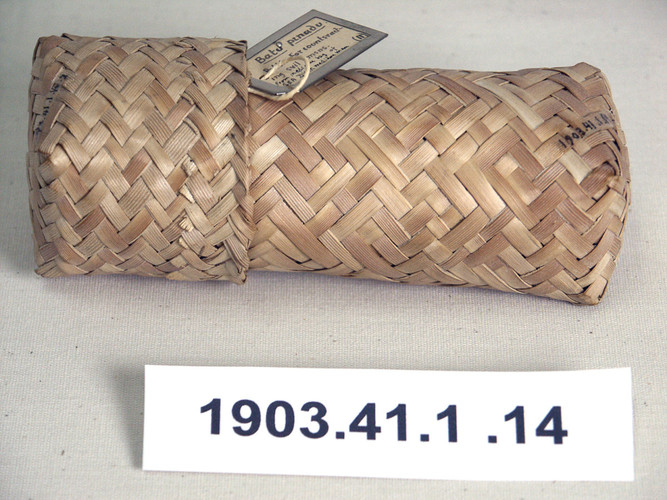 1903.41.1.14.1Small basket [.1] with lid [.2], containing pebble [.3] [L.Ph 'DCF 2004-2006 What's Upstairs?' 27/1/2005]1903.41.1.14.1