
- Collection type
- Object
- Description
- Mancala board. Elaborately carved gaming board with receptacles for pieces at each end. The base is rectangular with straight sides which incline inwards. There is a square cut away on one side of the hollow base. The top has twelve carved round cups with oval handles at each end of the board. The object has floral and geometric carvings. [AB [OPS Move] 22/7/2016]
- Geographical reference
- Person
- Maker Unknown Maker
- Field collector John Myer Harris
- PRM source Augustus Henry Lane Fox Pitt Rivers founding collection
- Date / Period
- Date made: Before 1865?, uncertain
- Date collected
- By 1865?
- Acquisition information
- Donated: 1884
- Materials and processes
- Material Wood Plant, Process Carved
- Dimensions
- Height: max 256 mm, Width: max 211 mm, Length: max 1035 mm
- Object numbers
- Accession number: 1884.100.34 PR no.: 696 or 969
- Research and responses
For an account of mancala boards in the collections of the British Museum, including some comparable examples from Sierra Leone, see Mancala Board Games, by Alexander J. de Voogt (London: British Museum Press, for the Trustees of the Beritish Museum, 1997). [JC 18 8 2010]
In an email to Jeremy Coote dated 16 August 2010, William Hart of the University of Ulster drew attention to the fact that John Myer Harris donated a mancala board made by the 'Gallinas people' of Sierra Leone to the Anthropological Institute in or before 1865 and that it may have been acquired by Pitt-Rivers in 1881 when he acquired the bulk of the Anthropological Institute's collection. In his reply, Jeremy Coote suggested that this board (i.e. 1884.100.34) may well be the board in question. Harris mentions his gift to the Anthropological Institute on page 30 of 'Some Remarks on the Origin, Manners, Customs, and Superstitions of the Gallinas people of Sierra Leone', by J. M. Harris, in Memoirs Read before the Anthropological Society of London, Vol. 2 (1865-6), pp. 25-36: 'As a rule, the Gallinas people are inveterate gamblers; they play various games, the principal one being called by them warri, but it is common to nearly all parts of Africa under different names. It is played with a board having twelve holes, and forty-eight seeds. One of these boards I have the pleasure of presenting to the museum of the Anthropological Society of London, which will show the style of carving executed by the Gallinas people.' (See printout of correspondence in RDF.) [JC 18 8 2010]
- Associated publications
- Listed as number 12 on page 6 of Art from the Guinea Coast (Pitt Rivers Museum, Illustrated Catalogue No. 1), Oxford: Pitt Rivers Museum (1965): 'LIBERIA. 12. Elaborately cared gaming board (poo) with receptacle for gaming pieces at each end, collected before 1884. Probably Kpelle tribe (1884.100.57 [sic; should be 1884.100.34]) (104 cm.)'. Also illustrated in black and white in unnumbered plate IV. (For details of exhibition, see under 'Display History'.) [JC 12 9 2013] Illustrated in black and white on page 110 of African Mythology, by Geoffrey Parrinder (London: Paul Hamlyn, 1967). Caption (same page) reads: 'A favourite African game, known by its Egyptian name of Mancala. This fine board from Sierra Leone shows the twelve holes in each of which four nuts are placed. The two players sit on opposite sides and distribute the nuts all round the board in turn. If a turn ends at holes that already contain one or two nuts the contents are taken by the player. He puts the nuts in one of the containers at each end, and the one who gains most nuts wins.' [JC 18 8 2010]
Search terms: Toy and Game, Game, Gaming Piece, Board Game, Game Accessory
Further items to explore
 2024.20.174Hatu leka, pebble.2024.20.174
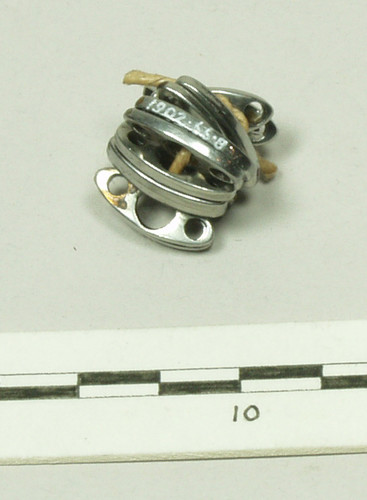 1902.66.8Small loom heddles, strung together into a bunch [L.Ph 'DCF 2004-2006 What's Upstairs?' 4/3/2005]1902.66.8
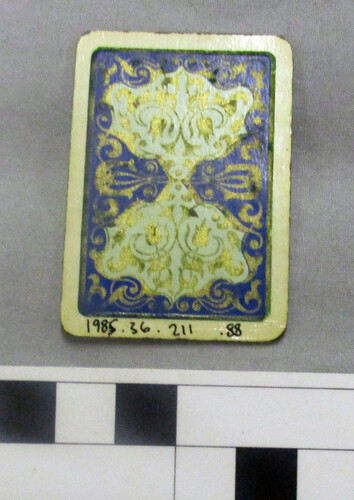 1985.36.211.88Six of Clubs playing card. On the back of the card is an intricate, swirling floral pattern in blue, cream and gold. Part of a set, which includes a box 1985.36.211 .1 and two full sets of playing cards including three Jokers in each set [see 1985.36.211 .2 - 1985.36.211 .56 for the red cards and 1985.36.211 .57 - 111 for the blue cards]. [ASh [OPS move] 23/06/2016]1985.36.211.88
 1917.53.489.25Wooden chess piece with Japanese characters on both sides. For paper chess board see [1917.53.489 .1] and for the other chess pieces see [1917.53.489 .2 - .24] and [1917.53.489 .26 - .42]. [JMC 13/12/2018]1917.53.489.25