- Collection type
- Object
- Description
- Middle fringed skirt of bundles of fine split palm-leaf tied around a plant fibre cord waistband. [FB 06/11/2014]
- Geographical reference
- Nicobar Islands
- Date / Period
- Date made: Before 1886
- Date collected
- Before 1886
- Acquisition information
- Donated: 1884
- Dimensions
- Length: max 320 mm, Width: max 520 mm folded, Depth: max 40 mm
- Object numbers
- Accession number: 1884.87.10
Other numbers: 446
- Associated publications
- Indian Antiquary, Feb. 1895, 'Catalogue of Nicobarese objects', p. 47 '48 (f) Hinong-lama-oal a (lit, inner skirt) Hinong-lam-heam b or Hinong-hen-oal-lama-ok (lit, intermediate skirt) Hinong-lama-ok (lit outer skirt). Skirts made of split cocoanut leaf and worn only by women, at Chowra, Teressa, and Bompoka a. is worn next to the skin both night and day: at night b and c are removed, and re-placed by a cotton skirt. As there is usually sufficient calico among the natives of Teressa and Bompoka the women there are frequently able to dispense with the use of b and c which they don only when working in their gardens, or when fetching firewood, water etc. a is generally about 5 inches deep and is made of plain split leaf. b is usually about a foot deep and consists of fine split leaf-work and c, the outermost skirt is likewise about 12 inches deep and consists of partially split leaf, the unsplit portion being so arranged as to present two parallel bands a few inches apart; which, by means of ornament, are whitened with shell lime and run horizontally throughout its length of about three feet, more or less, according to the size and requirements of the wearer. The upper edge of these leaf-skirts consists of a stout cord to which the ends of the leaves are neatly attached while the lower fringe of the leaves is evenly clipped. For fastening them round the waist, short pieces of cord are provided at the upper ends, and these are tied between the hip and the middle front of the body. They are sometimes made to overlap at the ends by several inches, in which case two additional pieces of twine are provided for fastening purposes.'[AP Leverhulme project on founding collection 1995-1998]

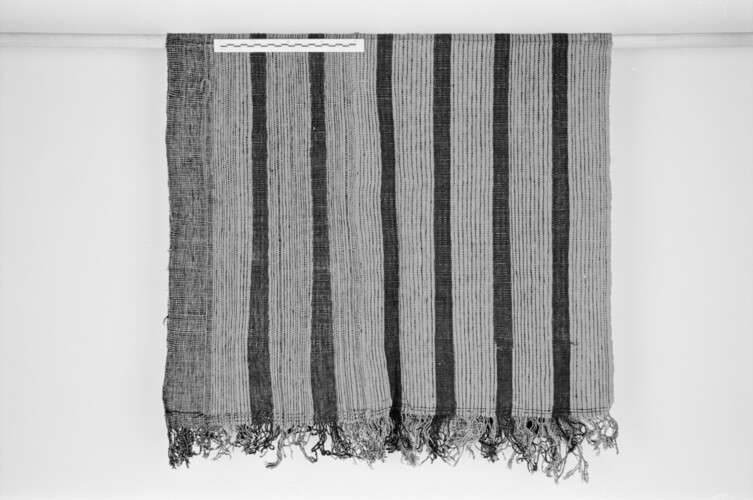 1994.45.20Rectangular red cloth with six blue stripes embroidered with diamond motifs. [ZM 12/5/2005]1994.45.20
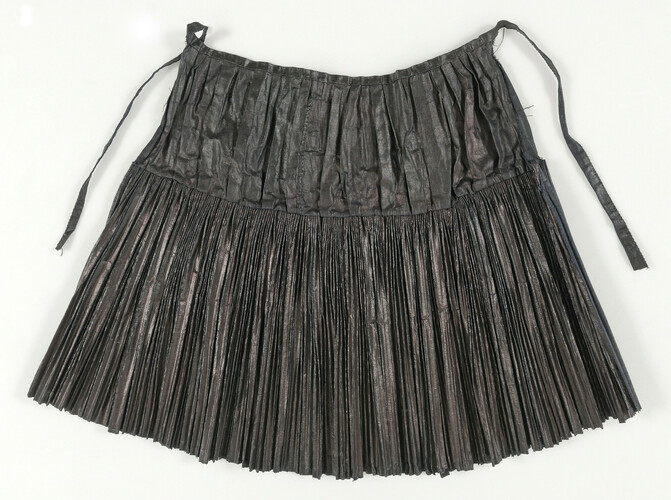 2009.135.75Woman's pleated back skirt. [FB 08/06/2012]2009.135.75
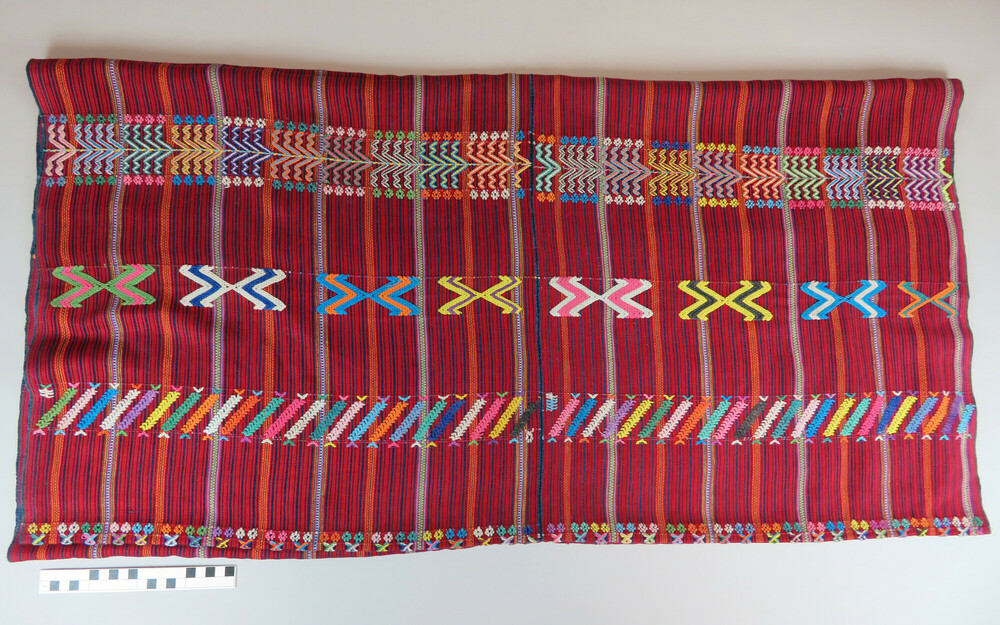 2023.37.13Skirt of woven red and indigo striped fabric, decorated with brocaded geometric motifs in a range of different brightly coloured yarns.2023.37.13
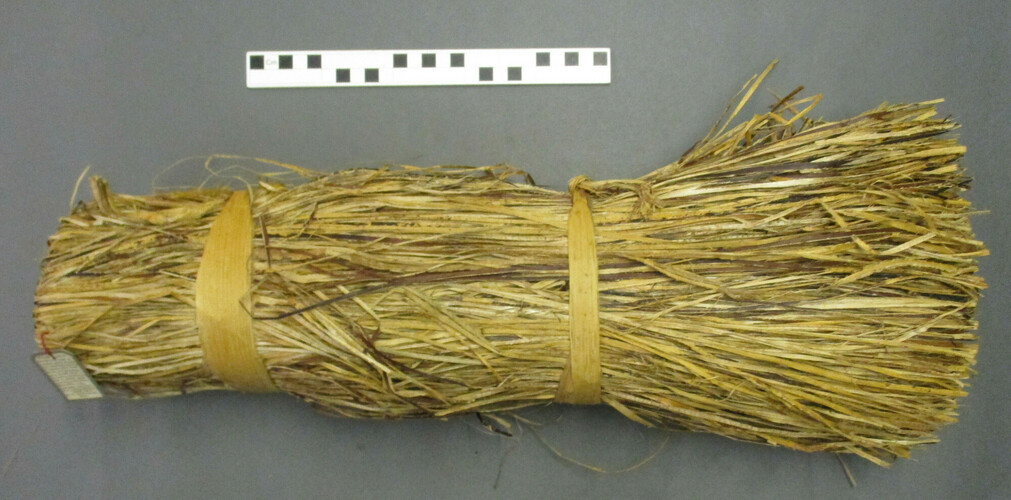 1939.11.3Grass skirt sometimes worn for mourning. Wrapped in two wider horizontal grass bands. [BH [OPS Move] 31/1/2017]1939.11.3
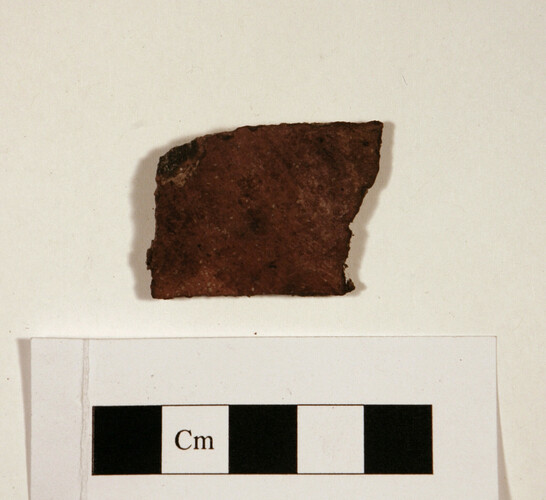 1884.41.53.10Fragment of cooking pot [one of 23 pieces]. [MJD 02/05/2013]1884.41.53.10
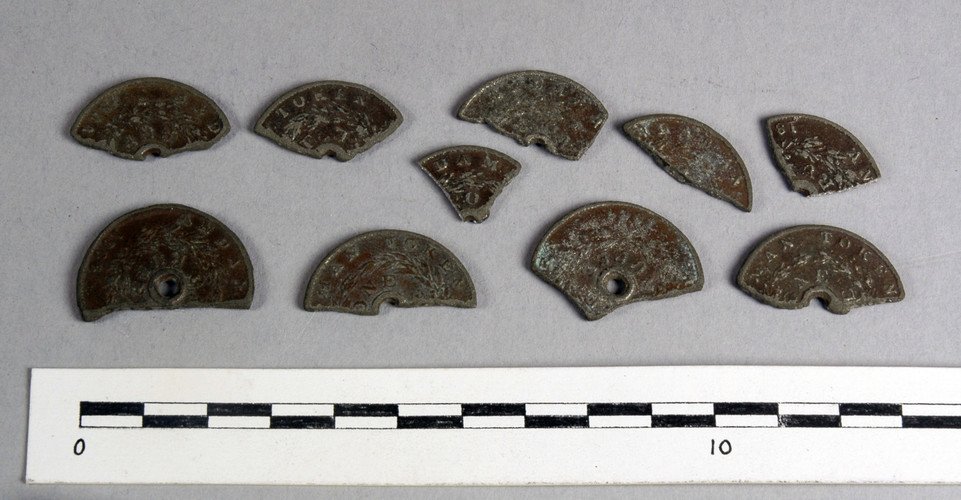 1899.12.70.1Ten pieces of broken and condemned Andaman tokens [CAR 4/9/2008]1899.12.70.1
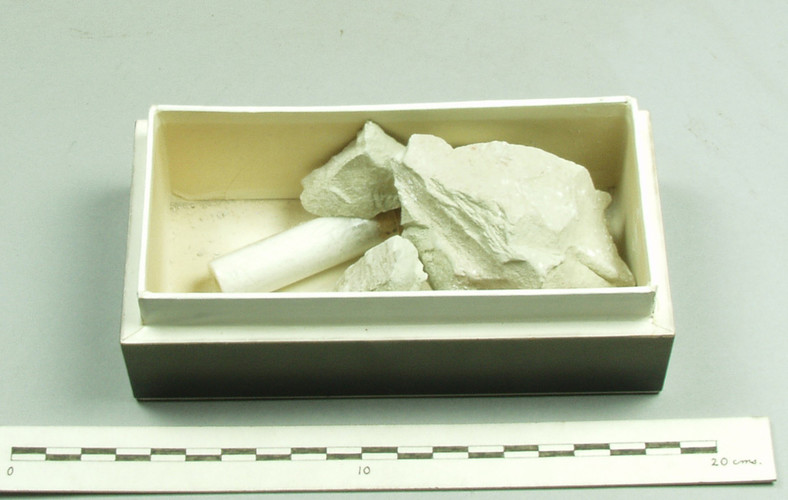 1884.69.6Several pieces of white clay in a box. Also a vial of powdered clay. [El.B 'DCF 2004-2006 What's Upstairs?' 14/2/2006]1884.69.6
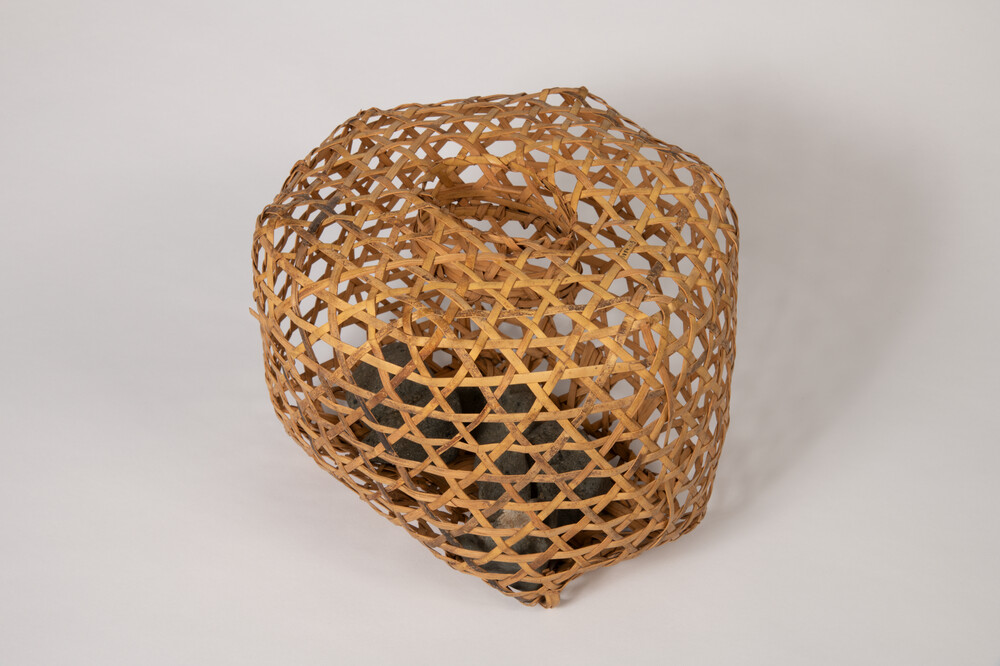 1884.11.5Fish trap of split cane, made in the open hexagonal plaiting technique. Contains coconuts.1884.11.5