
- Collection type
- Object
- Description
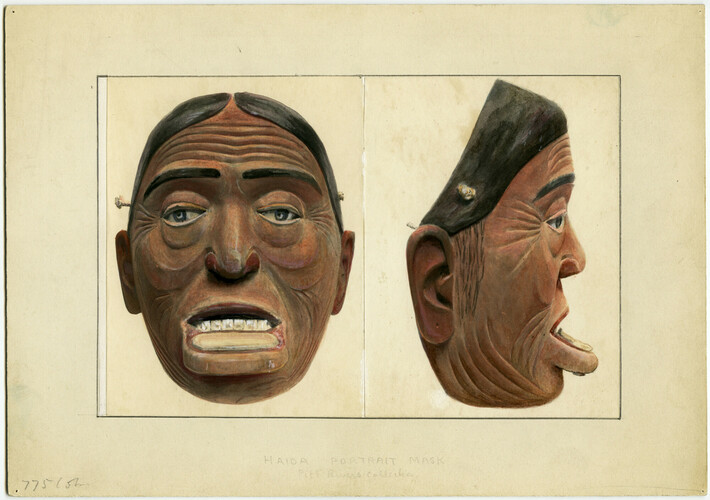
- Wooden mask realistically carved showing wrinkled face of an older female wearing a labret on lower lip. [CAK 26/05/2009]
- Long description
- Wooden mask realistically carved showing wrinkled face of an older female wearing a labret on lower lip. The mask is carved from a single piece of wood and the reverse as been hollowed out. The hair of the woman is smoothly carved, painted black, parted down the centre, and goes behind the ears. Above each ear, the mask is perforated and a length of string knotted through. The strings are knotted together on the reverse to allow the mask to be worn. Wisps of hair have been painted in front of each ear. The forehead shows a series of wrinkles. The eyebrows are carved in relief and painted black. There are wrinkles around the eyes. The eyes are white with black pupils. The pupils have been perforated, presumably so a wearer could see out of them. The area under the eyes is sunken. The nostrils are painted a solid ochre, as are the lips and ears, while the remainder of the face is tinted with ochre with natural hues of the wood showing through. There are wrinkles around the mouth and jaw line. The mouth is open slightly and squared white bottom teeth are visible. The bottom lip extends outward and is carved with a labret. Each ear is perforated at the top, middle section and bottom. The bottom of the jaw is flat and the wood is a bit rougher. Two holes are evident on the edge of the mask along the jaw. There is also an incomplete perforation visible from the reverse of the mask in the nose area. [CAK 07/07/2009]
- Geographical reference
- British Columbia Haida Gwaii (Queen Charlotte Islands) NW Coast
- Cultural groups
- Haida
- Person
- Maker Unknown Maker
- Field collector Frederick Dally
- PRM source Augustus Henry Lane Fox Pitt Rivers founding collection
- Date / Period
- Date made: Possibly before 1868
- Date collected
- 1868 [1862 - 1870]
- Acquisition information
- Donated: 1884
- Materials and processes
- Material Wood Plant, Material Pigment, Material String, Process Carved, Process Painted, Process Perforated
- Dimensions
- Length x Width 220 x 190 mm including ears
- Object numbers
- Accession number: 1884.84.76 PR no.: 103/ 12099
- Research and responses
This object was viewed and confirmed as Haida by tribal members Vincent Collison, Lucille Bell, and Kwiiawah Jones on 7 September 2007 in preparation for a planned Haida community visit to PRM in 2009 [L Peers, 24/01/2008]
The following passages can be found in Charles Harrison's manuscript, sent to E.B. Tylor at the Pitt Rivers Museum, and later expanded and published as Ancient Warriors of the North Pacific. On page 16, he writes: "When her time [first menstruation] was over her uncle made a feast, then her lower lip was pierced, and a piece of whalebone inserted about the size of an ordinary shirt stud. On her marriage this was enlarged to the size of a cuff button. The size increased according to the social position of her marriage, and the number of children she bears, so that in reality this bone insertion is a mark of caste. I have seen some very large ones, on which the lip lay distended exposing the teeth. The fact is the Haida women have more lip than any other we know of, and to see a group of the quarrelling, the lip shaking with anger, is a sight not to be forgotten. The old women who have their lips pierced are generally at the bottom of all the rows, and act afterwards as peacemakers, looking as innocent as lambs They are great diplomats and generally contrive to have their own way, and it is a mistake to imagine them treated as slaves, for though they do much drudgery, an offer of assistance from a man would be laughed at. They also pierced their noses, and suspended shells, bone, teeth of animals and other bijouterie from them when at a state of puberty, and during each successive month at the customary period: and it is not a bad idea either, for what is jewellery and other ornaments for if not to be conspicuous and admired." And on page 34, he writes: "Chin Stones or Bones. A girl formerly, as soon as she arrived at the years of puberty, had her chin or lower lip slit, and a piece of whalebone inserted. Very rarely silver was used. I have however seen this article made of silver, as well as of bones, and of stone. It is increased according to the rank she takes when married, and to the number of children she bears." On the topic of earrings, Harrison writes on page 34, "I have noticed some old men and women who have had their ears pierced two and three times and pieces of black slate carved with their crests about one and half inches in length, and three sixteenths in diameter dangling therefrom." This description accords with the holes pierced in the mask's ears. [CAK 27/05/2009]
Note that in Collectors Miscellaneous this entry is linked by a mark to the entry for 1884.84.77 (a lip stud). It seems likely that for some reason two separate entries have been prepared, one for the mask and one for the lip stud [AP Leverhulme project on founding collection 1995-1998]
The labret numbered 1884.84.77 is the same size and general shape as the one depicted in the mask. The labret may have been owned by the woman depicted by the mask, or carved to show the design of labrets more generally. [CAK 26/05/2009]
The following information comes from Haida delegates who worked with the museum’s collection in September 2009 as part of the project “Haida Material Culture in British Museums: Generating New Forms of Knowledge”:
This mask was viewed alongside other masks on Thursday Sept 10, 2009. Natalie Fournier pointed out that labrets were worn only by woman of status on Haida Gwaii. Candace Weir added that normally, only people of high status would be carved. She pointed out the clan markings painted on the face around the nose and the holes in the ears that at one time probably had earrings. Delegates thought the face of the woman was similar to that of a woman shown in a historic photograph weaving a basket. [CAK 22/03/2010]
Labrets were worn by Haida females as a sign of their status. [CAK 26/05/2009]
Given the small perforations in the ears of the mask, it is possible that earrings were once affixed to the mask. Haliotis shell earrings were a common adornment for Haida women of high status. [CAK 26/05/2009]
- Associated publications
- Object: EMPOWERING ART: Indigenous Creativity and Activism from North America's Northwest Coast, Editor: Jack Davy; Additional author: Haa'Yups; Additional author: Ishmael Khaagwaask' Hope; Additional author: Kaitlin McCormick; Additional author: Jordan Wilson; Norwich, 2023, Page: 72, Page illustrated: 72, Notes: Unknown artist, Haida, Mask of an older woman wearing a labret on lower lip 1868, painted wood. Pitt Rivers Museum, University of Oxford
- Illustrated in black and white as figure 1.3 on page 10 of 'This is our life: Haida material heritage and changing museum practice' by Cara Krmpotich and Laura Peers, UBC Press 2013 with the caption 'Portrait mask of Haida woman (PRM 1884.84.76)' with the paragraph above the image '...Cara Krmpotich In 1907 Henry Balfour, the curator of the museum, described one portrait mask (PRM 1884.84.76, Figure 1.3) in the journal of the Royal Anthropological Society as "one of the most successful examples of realistic carving which I have hitherto seen from the hands of a savage sculptor... the carving is life-sized and has been executed with very considerable skill, and the close attention manifestly given to detail affords evidence of an unusual appreciation of the surface modelling of the human face. The general contour is excellently rendered, and the eyes and other features are skilfully treated. The facial wrinkles have been represented with care and give considerable character to the face." What seems to matter most to Balfour is not the meanings of the mask to Haida, but, rather, its relationship to Western traditions of realism in art' [FB 07/01/2014] Related Documents File - Illustrated (from front and in profile) as Plate A and discussed in detail in 'Haida Portrait Mask' by Henry Balfour, in Man vol vii no 1 (1907) pp 1-2 (photocopy in RDF) [JC 21.8.96] This article is a description of the how the mask looks only, not on its purpose or use. Balfour states 'The carving is life-sized and has been executed with very considerable skill, and the close attention manifestly given to detail affords evidence of an unusual appreciation of the surface modelling of the human face. The general contour is excellently rendered, and the eyes and other features are skilfully treated. The facial wrinkles have been represented with care and give considerable character to the face. An interesting feature is the representation of the fashionably large wooden plug or stud inserted in the lower lip, distending the latter to a remarkable extent.' [MOB 3/9/2001] Colour photograph on page 72 of the exhibition catalogue 'Empowering art: indigenous creativity and activism from North Americas Northwest Coast' with the caption 'Unknown artist, Haida, Mask of an older woman wearing a labret on lower lip, 1868, painted wood. Pitt Rivers Museum, University of Oxford'
Search terms: Mask, Figure, Ornament, Status, Lip Ornament, Status Object

Further items to explore
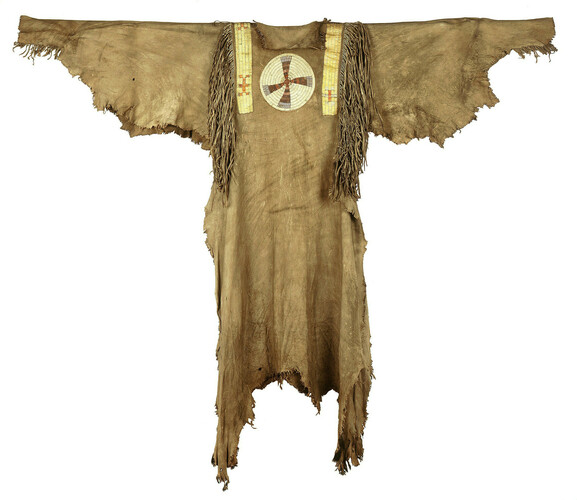 1893.67.3Shirt with leather arm fringes, arms without quilled bands, round chest ornament.1893.67.3
 1994.15.700Drawing by child of a figure. [MJD 27/01/2015]1994.15.700
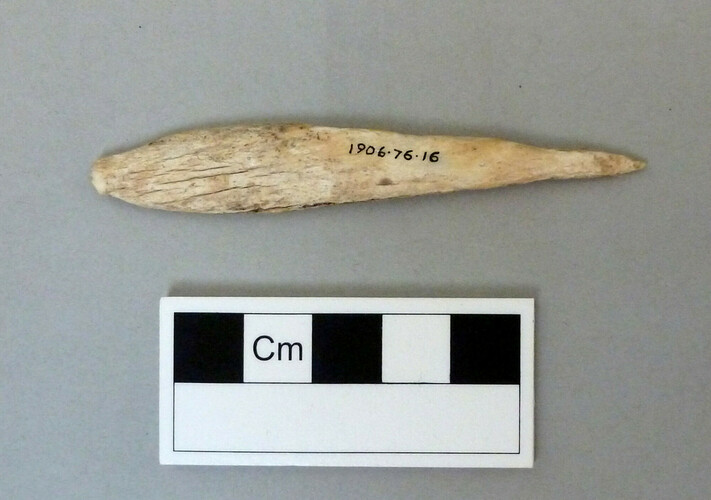 1906.76.16Bone arrow-head1906.76.16
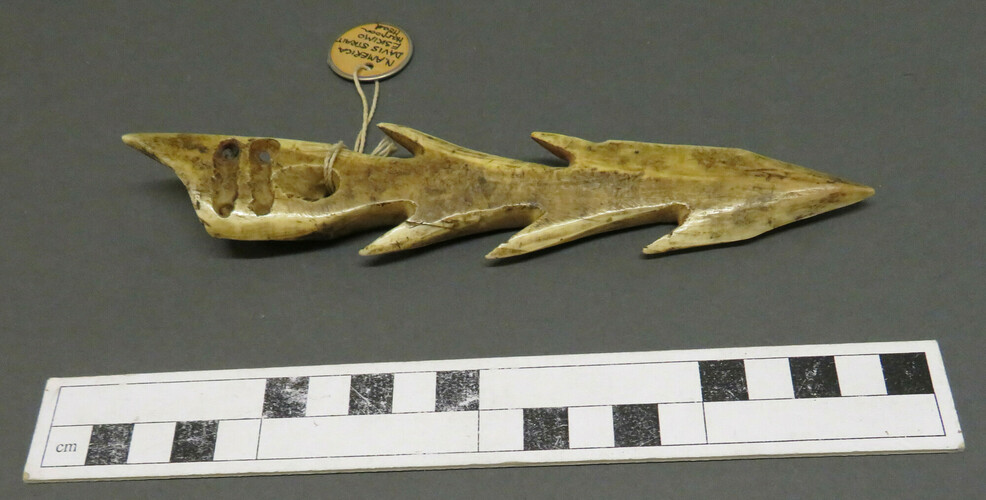 1951.7.2Ivory harpoon-head with five barbs on the sides and an incised line down the centre of the blade. [ASh [OPS move] 20/6/2017]1951.7.2