
- Collection type
- Object
- Description
- Small bowl in the form of a seabird made from elk horn.
- Long description
- Small bowl in the form of a seabird made from elk horn. The bowl is made from a single piece of horn. At one end, the horn has been carved into the three dimensional shape of a seabird's head with eyes and beak clearly visible. The sides of the bowl have been steamed and moulded to form the body of the bird. The exterior is incised with formline designs. The other end of the bowl has been steamed and moulded to form the tip of the wings and tail of the bird. There is a small hole in the centre of the tail. The interior of the bowl is smooth and undecorated. [CAK 15/03/2010]
- Geographical reference
- British Columbia Haida Gwaii (Queen Charlotte Islands) NW Coast
- Cultural groups
- Haida
- Person
- Maker Unknown Maker
- Field collector Unknown Collector
- PRM source Augustus Henry Lane Fox Pitt Rivers founding collection
- Date / Period
- Date made: Before 1874
- Date collected
- By 1874
- Acquisition information
- Donated: 1884
- Materials and processes
- Material Elk Horn Animal, Process Carved, Process Steamed, Process Moulded, Process Perforated
- Dimensions
- Length: max 140 mm
- Object numbers
- Accession number: 1884.68.60 PR Cat other PR nos: 2156? PR Cat other PR nos: 2158
- Research and responses
The following information comes from Haida delegates who worked with the museum’s collection in September 2009 as part of the project “Haida Material Culture in British Museums: Generating New Forms of Knowledge”:
This small bowl was viewed alongside other horn and wood vessels on Wednesday Sept 9, 2009. In response to the material - elk horn - delegates noted that elk were introduced to Haida Gwaii in the late 1800s. There were also caribou. The form was identified as a seabird more generally, rather than a duck specifically. Rather than a bowl, Nadine Wilson proposed this tiny vessel could have been used as a scoop. Christian White commented on design similarities between the U-shape and bevelled ovoid line carved in this vessel and that carved on 1891.49.96. [Cara Krmpotich note: it should also be noted that a unique bevelled ovoid was identified on bowl 1884.68.59.] Jaalen Edenshaw drew a comparison between this vessel and a duck amulet made of ivory featured in Robin Wright's book "Northern Haida Master Carvers" [see Fig 2.2, page 28, "Ivory bird, a woman's neck ornament, collected by Juan Perez near k'yuust'aa, July 1774, 6.9 by 4.3 cm. Museo de America, Madrid, Spain, cat. no. 13.042"]. Diane Brown provided the Haida term for horn duck and mallard duck: xaa. Lucille Bell wondered if the little hole in its tail allowed it to be hung on a wall. [CAK 15/03/2010]
- Associated publications
- Reproduced in colour on page 81 of the exhibition catalogue 'From the Forest to the Sea: Emily Carr in British Columbia' edited by Sarah Milroy and Ian Dejardin, published 2014 by Art Gallery Ontario and Dulwich Picture Gallery. With the caption 'Duck Bowl, Northern Northwest Coast (Haida), 19th century. Elk horn'. [FB 29/10/2014]
Search terms: Figure, Vessel, Food and Drink, Bowl, Bird Figure, Food Accessory
Further items to explore
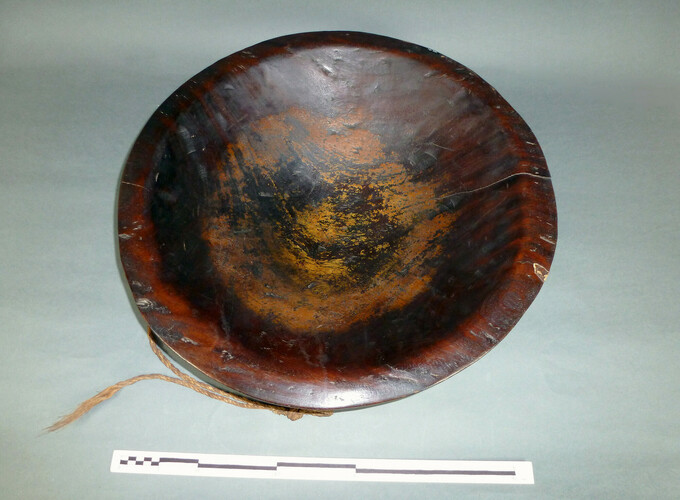 2012.75.1Circular wooden bowl, Tanoa, used for Kava. [FB 27/06/2012]2012.75.1
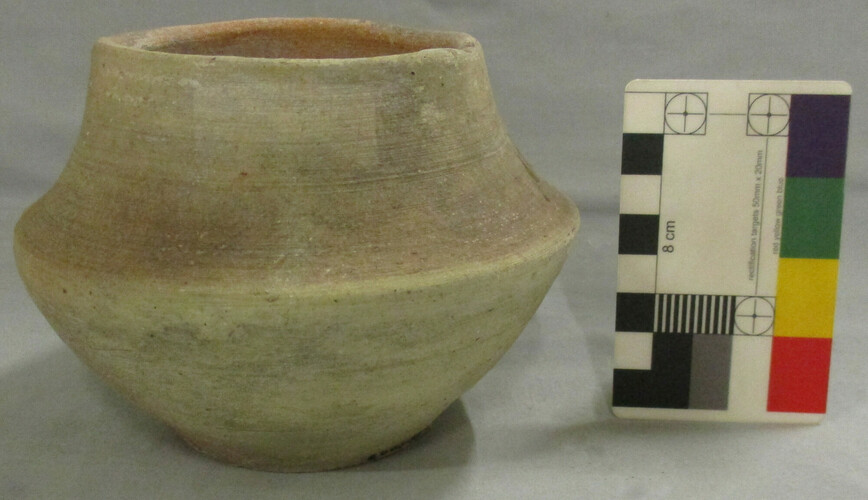 2005.88.1Pottery vessel, pinkish buff in colour.2005.88.1
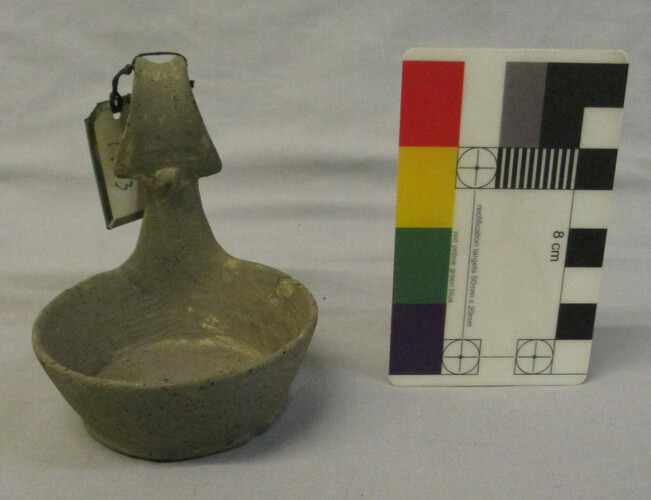 1884.140.25Pottery lamp of grey ware. Saucer shape with straight expanding sides. Vertical strap handle with an expanded section on the bowl side. The strap ends in two small feet under the base of the lamp. [MOBB [OPS move] 07/06/2016]1884.140.25
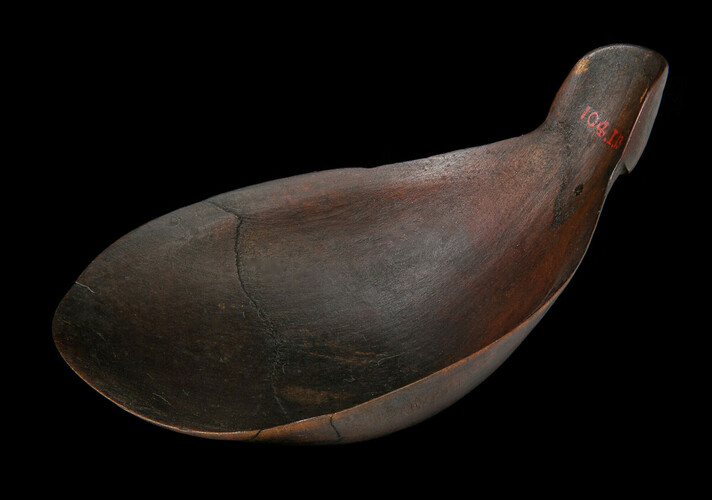 1891.49.66Horn scoop, wide at one end and narrowing at the other, with small perforation by the handle. [CAK 19/04/2010]1891.49.66
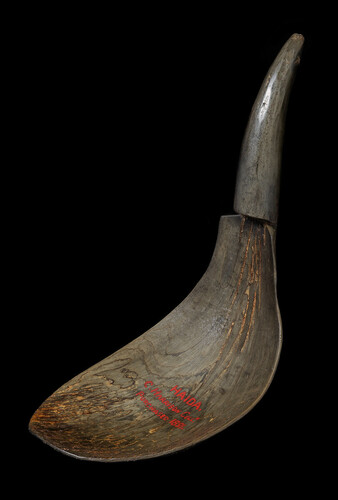 1891.49.53Brown horn spoon with pointed handle, the 'graininess' in the horn is visible. [EC 'DCF 2004-2006 What's Upstairs?' 13/3/2006]1891.49.53
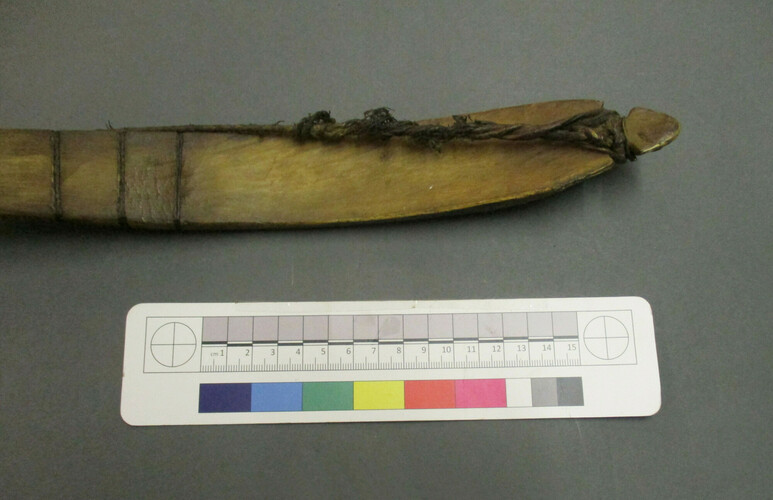 1954.4.25Bow, made from two pieces of Mountain Sheep horn which have been fastened together with iron nails. The tips of the bow have been notched, onto which is attached the bowstring, made from twisted sinew. The bow is also backed with twisted sinew. [SB [OPS move] 25/7/2017]1954.4.25
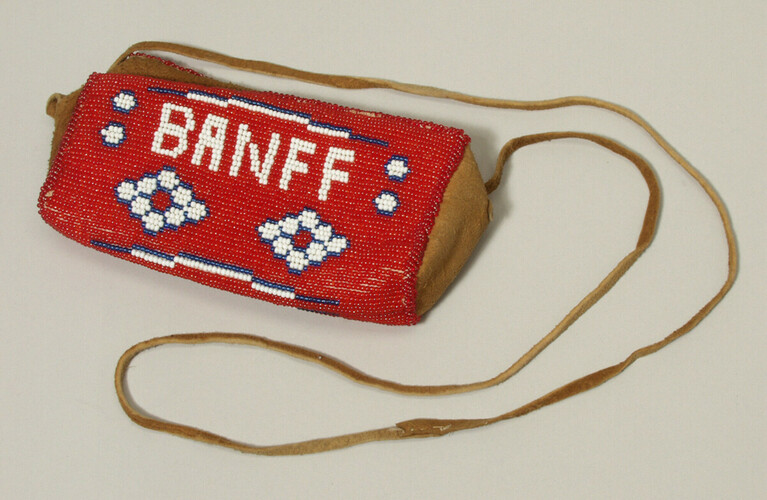 2003.63.8Hide purse covered with beadwork and with a thin hide string for carrying. Beaded with blue and white hexagonal motifs and lines, and BANFF in white, against a red background. [JP 19/2/2003]2003.63.8
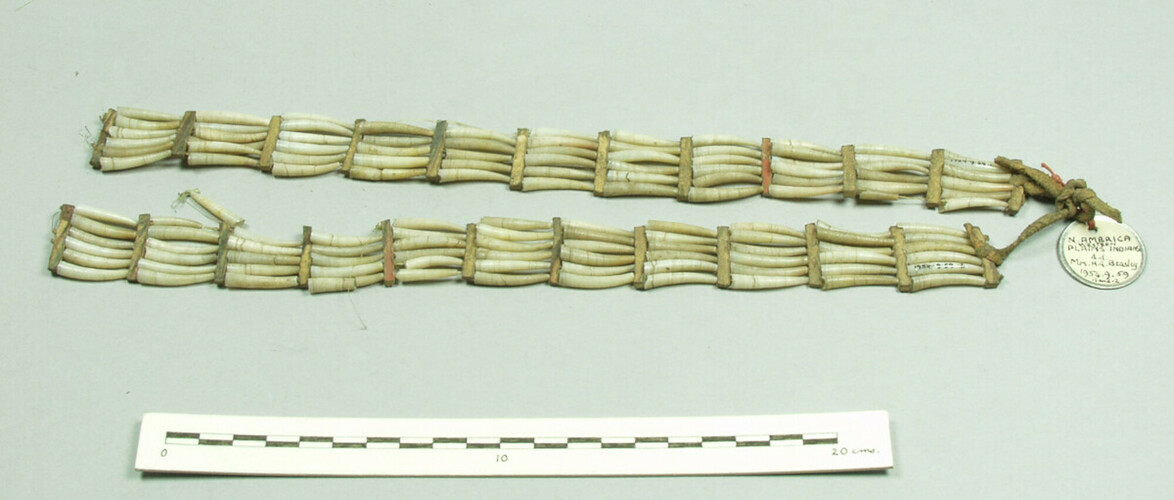 1954.9.59.12 bands [.1 and .2] of Dentalium shell ornament with hide spacers. The two bands are tied together by hide strips. [EC 'DCF 2004-2006 What's Upstairs?' 28/9/2005]1954.9.59.1