
- Collection type
- Object
- Description
- Carved yellow ivory figure of woman kneeling and holding breasts. [DCF Court Team 28/1/2003]
- Cultural groups
- Yoruba
- Person
- Maker Unknown Maker
- Field collector Unknown Collector
- PRM source Augustus Henry Lane Fox Pitt Rivers founding collection
- Date / Period
- Date made: Before 1881
- Date collected
- (Before May 1881)
- Acquisition information
- Donated: 1884
- Materials and processes
- Material Animal Ivory Tooth, Process Carved
- Dimensions
- Height: max 285 mm, Diameter: max 100 mm
- Object numbers
- Accession number: 1884.65.21 PR no.: 970/ 12394
- Research and responses
According to the accession book the number 12394 suggests that this object was obtained via Anthropological Institute [AP Leverhulme project on founding collection 1995-1998]
On a visit in May 1996, John Pemberton III of Amherst College, Massachusetts, expressed doubt about Bernard Fagg's identification of the figure as 'probably used in divination ceremonies'. The fact that Bassani and W. B. Fagg did not mention this function in their caption to the figure when they reproduced it in 1988 (see above) may suggest they also doubted the identification. [JC 11 6 1996]
- Associated publications
- Listed as number 23 on page 7 of Art from the Guinea Coast (Pitt Rivers Museum, Illustrated Catalogue No. 1), Oxford: Pitt Rivers Museum (1965): 'NIGERIA Western Region ... 23. Ivory figure in the style of Owo, probably used in divination ceremonies by priests of the Yoruba cult of Ifa. Eastern Yoruba (1884.65.20) [sic] (28.5 cm.)'. Also illustrated in black and white in unnumbered plate VIII. (For details of exhibition, see under 'Display History'.) [JC 12 9 2013] Illustrated in black and white on page 19 of African Mythology, by Geoffrey Parrinder (London: Paul Hamlyn, 1967). Caption (same page) reads: 'Ivory carving is much practised in tropical Africa. This fine example from Benin, Nigeria, may be a goddess or a simple symbol of fertility. Sculptures of African womanhood emphasize the mystery and power of life in the firmly moulded body and the calm, accepting face.' [JC 18 8 2010] Illustrated in black and white on page 72 of The Cult of Ifá among the Yoruba, Volume 1: Folk Practice and the Art (Ethnographic Arts and Culture Series, 2), by E. McClelland (London: Ethnographica, 1982). Caption (same page) reads: 'An ivory figure, in the style of Owo, used in Ifá ceremonies'. [JC 14 3 2000] Illustrated as Figure 66 on page 338 of 'The Afro-Portuguese Ivories: Classification and Stylistic Analysis of a Hybrid Art Form' (2 vols), by Kathy Curnow (Bloomington, Indiana: Indiana University Press, Ph.D. thesis, 1983). Caption (same page): 'This ivory depicts a kneeling female figure. It is consistent with the works attributed to Owo and dating from the late eighteenth and nineteenth centuries. Pitt-Rivers Museum. Oxford.' (The image is reproduced from Parrinder; see above.) The object is also mentioned on passing on pages 194-196. (Printouts from PDF in RDF.) [JC 2 12 2016] Illustrated as fig 264 on page 195 of Africa and the Renaissance: Art in Ivory, by Ezio Bassani and William B Fagg (New York: The Center for African Art / Munich: Prestel, 1988), where it is captioned: 'Kneeling female figure. Yoruba, Owo, Nigeria. The style and details of the hair and scarification are those seen on the Owo-Portuguese vessel [see book]. The kneeling caryatid is also similar and it is a frequent theme in African art. Like much African art made for African use, this small figure has great presence and seems to express contained power. Ivory, 28.5 cm'. [JC, undated]
Search terms: Figure, Religion, Ritual and Ceremonial, Divination Religion, Ceremonial Object, Religious Object
Further items to explore
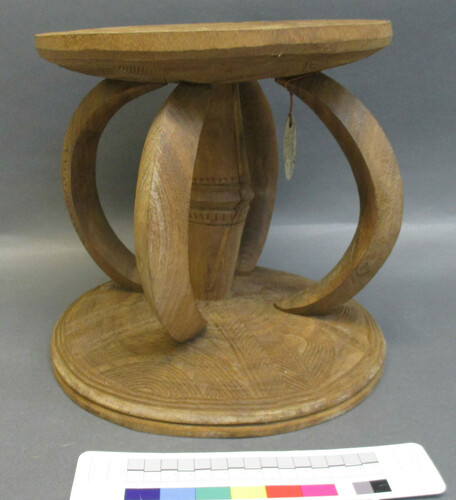 1942.13.19Carved wooden stool. Both the seat and the base are circular and the two are connected by a central pillar and four curved supports. [JC [OPS move] 5/5/2017]1942.13.19
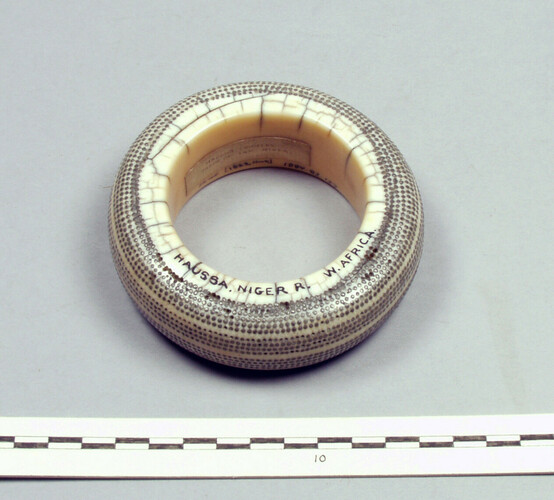 1884.82.127Ivory armlet, ornamented with 4 bands of inlaid silver pins. [El.B 'DCF 2004-2006 What's Upstairs?' 3/8/2005]1884.82.127
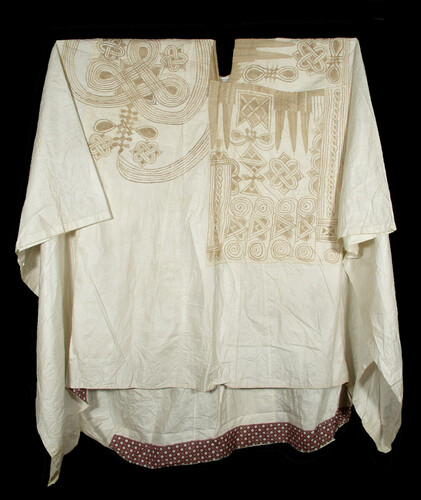 2001.26.1Embroidered robe or overshirt. Part of whole costume 2001.26.1 - 2001.26.4. This robe is worn over the shirt and trousers of this collection. The robe is made of pale cream coloured fine brocade woven cotton. The robe has been ornately embroidered in asymmetrical geometric designs with undyed cotton thread (beige in colour) around the shoulders and front and back. On the left side of the front of the robe there is a large rectangular pocket, embroidered all over. The embroidery has been done by hand but the robe has been stitched together by machine. The robe is hemmed on the inside with a printed cotton textile, mainly dark red in colour. The hem at the front of the robe is shorter than at the back. [MdeA 1/11/2001]2001.26.1
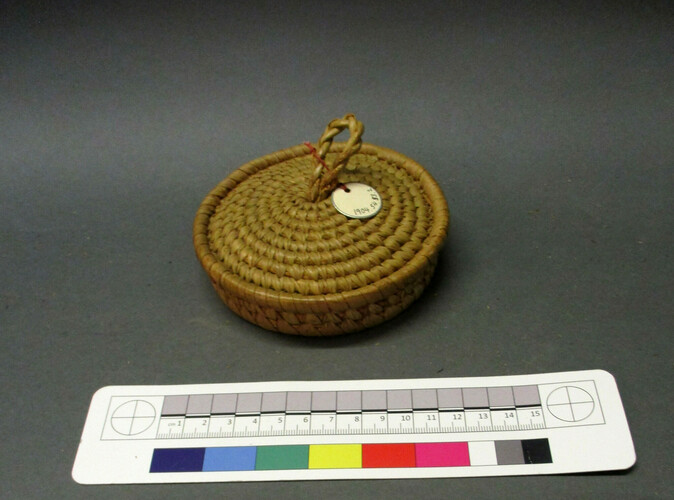 1904.54.53.2Circular coiled basketry lid with twisted plant fibre loop threaded through the top. For the coiled basketry base decorated with vertical strips of dyed plant fibre see 1904.54.53 .1. [CW [OPS Move] 7/12/2016]1904.54.53.2