
- Collection type
- Object
- Description
- Ball-headed club, the ball carved into a face, incised shaft and leather strap decorated with quillwork. [ZM 16/11/2007]
- Long description
- Ball-headed club, the ball carved into a face, incised shaft and leather strap decorated with quillwork. [ZM 16/11/2007] Ball-headed club. The ball is carved into a face. The shaft is decorated with red and black incised designs. A leather strap is tied to a perforation in the club handle. This strap is decorated with quill work stitching, claws which have been cut and shaped, and strings of animal hair covered in quill work and tin cones. [LM]
- Geographical reference
- Great Lakes Region
- Cultural groups
- Native American
- Person
- Maker Unknown Maker
- Field collector Unknown Collector
- PRM source Augustus Henry Lane Fox Pitt Rivers founding collection
- Date / Period
- Date made: Before 1874
- Date collected
- By 1874
- Acquisition information
- Donated: 1884
- Materials and processes
- Material Wood Plant, Material Animal Leather Skin, Material Porcupine Quill Animal, Material Animal Claw, Material Hair, Material Tin Metal, Process Carved, Process Quillwork, Process Incised, Process Perforated
- Dimensions
- Length 510 mm including head
- Object numbers
- Accession number: 1884.65.14 PR Cat other PR nos: 2115
- Research and responses
In Salisbury and South Wiltshire Museum Pitt Rivers ms collections there is a handwritten list [P141] headed 'A catalogue of M.General [sic - Major General] Pitt Rivers' Anthropological Collection Objects illustrating Animal Form conventionalised in Ornamentation from different countries' which seems to be a list of all items which were associated with the display entitled 'Illustrations of Human and Animal form Cases 92 - 93' in Bethnal Green and South Kensington Museums. A photocopy of this list is held by Alison Petch [AP 23/03/2005]
Examined by the GRASAC research team on 13 December 2007 as part of a research project to create a digital database. This will incorporate information about collections of indigenous material culture from the Great Lakes region of North America that are housed in a number of museums on several continents; see https://icslac.carleton.ca/grasac/ [see researchers file GRASAC]. The team noted the materials used to make this club include hard wood, untanned deer hide, porcupine quill, saw tooth dewclaws, red dyed deer hair, and metal tin. During construction there was a carving burning technique applied to the ball head, along the spine of the stern. The motifs look like the fields of a mide scroll (pictographic mnemonic device). Ruth Phillips thought the leather strap could be older than the club (RP). From Great Lakes with date of manufacture between 1815-1860. [ZM 15/05/2008]
Final GRASAC entry: 'Description/Summary: Ball-headed club, the ball carved into a face, with a strap that appears to have the fields of a pictographic mnemonic device called a "mide scroll." Made before 1874, in the Great Lakes region. Materials: The club is made of a hard wood. It's strap is made of untanned deer hide, decorated with porcupine quills, animal claws, red dyed deer hair, and metal (tin) cones.
Format/Techniques: The club is decorated with carvings and a burning technique, applied to both the ball head and along the club's spine. Quillwork embellishes the strap.
Motifs and Images: On the club Side A: The front of the ball is carved and painted with a representational face encircled with a scalloped edge. Images on the stem include a ground bird, possibly grouse, six- and three-petalled flowers, a flower motif with two elongated double curves on right angles, four leaves and four quarters, with a bottom panel of cross-hatching with dots in squares. Side B: Starting near ball, there is a turtle, owl, a gun stock club, a six-petalled flower, with floral and cross-hatching motifs identical to those found on the other side. Strap: At the bottom, there are three vertical rows of zig-zag lines, with a straight line on one side, ending with a cross shape and additional u-shapes. There is also an hour glass with the inside of a thunderbird. An orange zig zag goes up one edge and a white zig zag is on the other edge. A broader zig zag crosses into the design fields in which there are eight thunder birds on one strap side. On other side there are three thunderbirds in orange, alternating with ovals dissected by lines and crosses. If this was worn as a strap across shoulder the thunderbirds would be arranged as ascending.
Symbolism and Interpretation: Its strap's decorations look like the the fields of a pictographic mnemonic device called a mide scroll.
Condition: Good.
Other Notes: The stap may be older than the club (RP).' [L Peers, 28/04/2009]
This object was examined on a research visit by Nikolaus Stolle, Goethe University, Frankfurt am Main, Germany, on 19 June 2013. He noted the strap might not originally belong to the club. The length does not fit with the handle for a club. It may be the handle for a bag. Nikolaus found a small piece of leather wrapped with string tucked into a recess in the edge seam of the strap. [MJD 19/06/2013]
Further items to explore
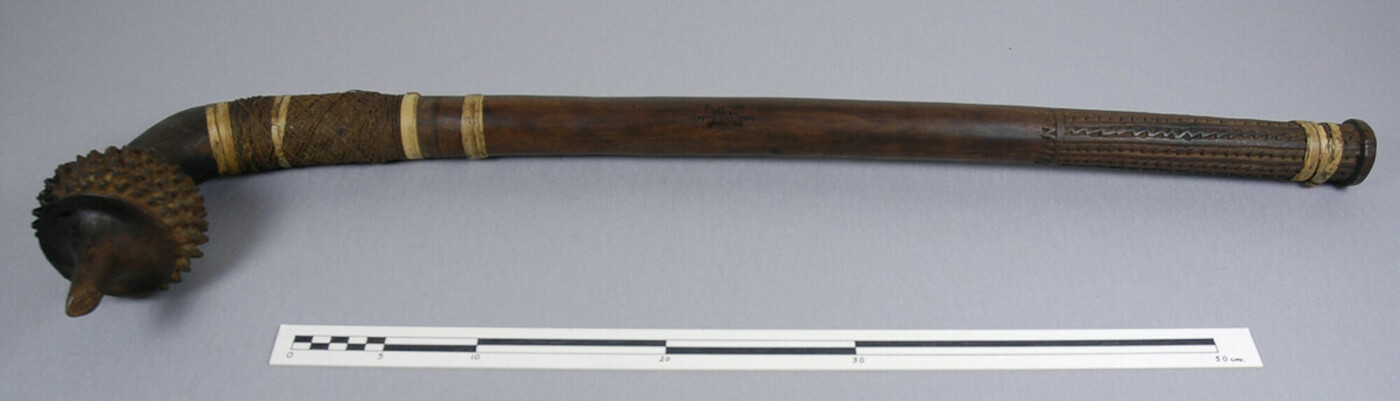 1906.20.24Club with spiked 'pineapple' head of carved wood with decorated handle. [SM 21/03/2007]1906.20.24
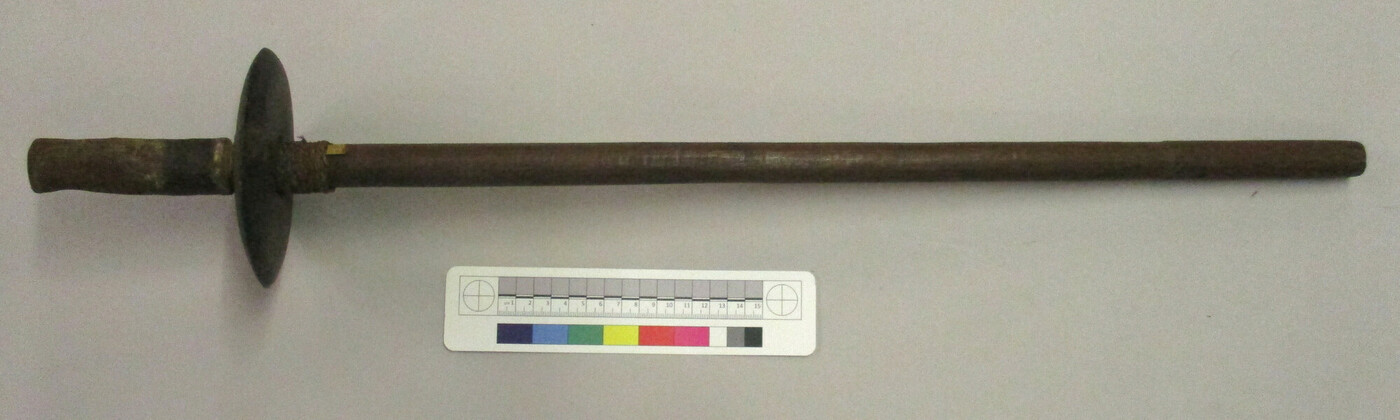 1900.55.392Club with perforated discoidal stone head and cylindrical wooden shaft. [BS [OPS Move] 03/08/2016]1900.55.392
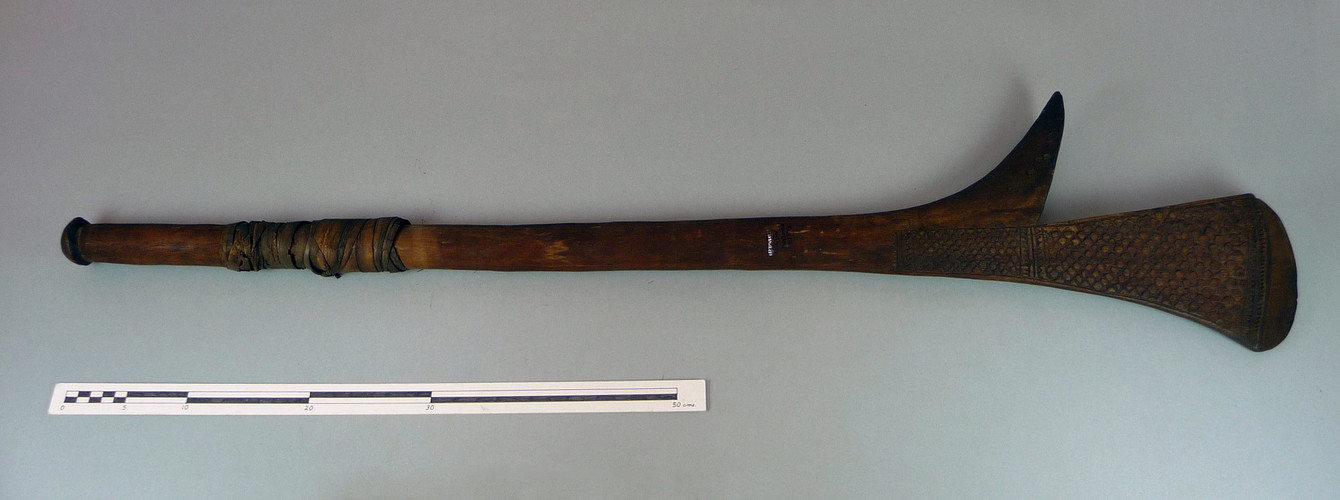 1884.12.137Wooden club with broad flattened blade and extremely pronounced spur (Sali).1884.12.137
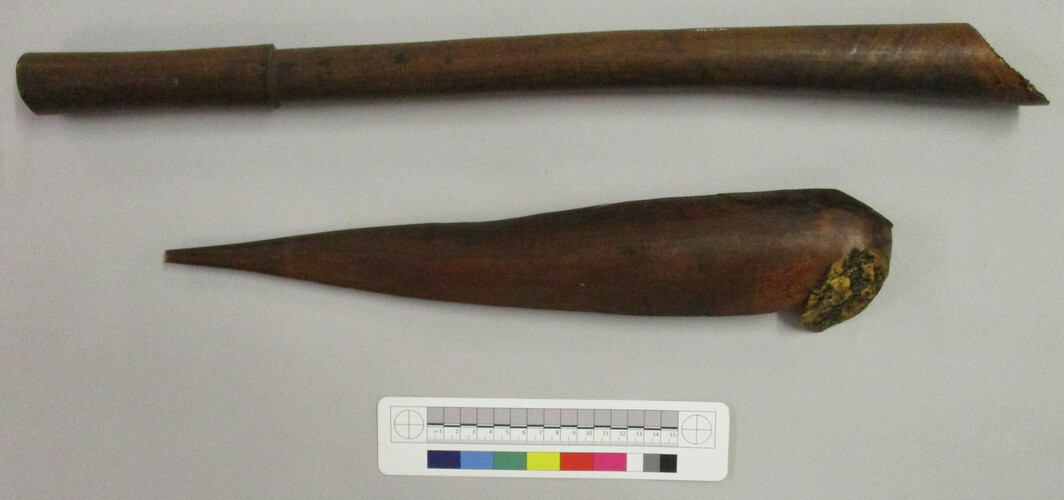 1884.12.185Wood club with blade head made to resemble a duck's. [BS [OPS Move] 28/07/2016]1884.12.185
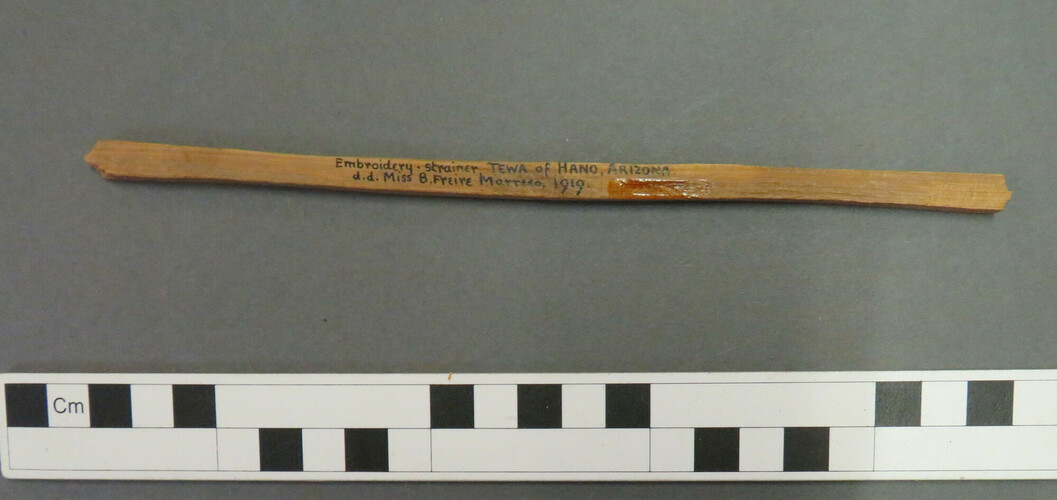 1919.40.5Small stick with pointed ends, used in embroidery. [MJD (Verve) 9/5/2017]1919.40.5
 1985.36.212.47Seven of Spades playing card. [1 of a] Complete set of playing cards. Each card has the image of a woman holding a parasol with the phrase 'LA MODE ILLUSTREE Bureaux du journal 56 rue Jacob Paris' on it. Part of a pack of cards consisting of a box and 54 playing cards. [ASh [OPS move] 14/06/2016]1985.36.212.47
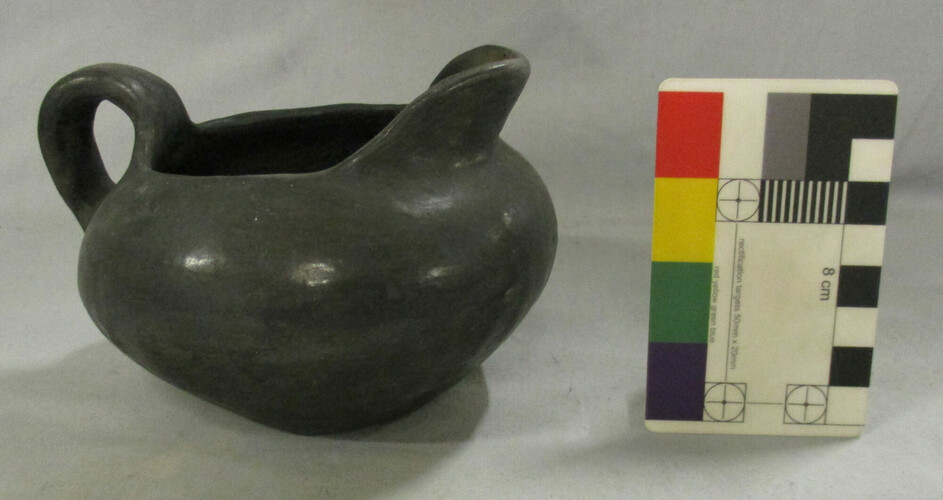 1911.86.68Ceramic jug of burnished blackware. [MOBB [OPS move] 07/04/2016]1911.86.68
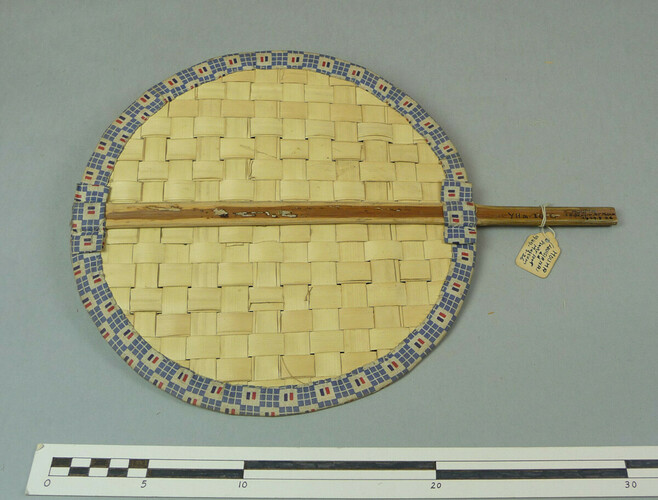 1949.3.26Circular fan of plain checker 'cane' or reed, bound with European cloth, with handle of split cane.1949.3.26