
- Collection type
- Object
- Description
- Paddle with oval blade and straight crutch handle, painted with eagle designs in black. [E.S-R 'DCF 2004-2006 What's Upstairs?' 17/12/2004]
- Long description
- Paddle with oval blade and straight crutch handle painted with eagle designs in black. [CAK 25/05/2010]
- Geographical reference
- British Colubmia Haida Gwaii (Queen Charlotte Islands) NW Coast
- Cultural groups
- Haida
- Person
- Maker Unknown Maker
- Field collector Unknown Collector
- PRM source Augustus Henry Lane Fox Pitt Rivers founding collection
- Date / Period
- Date made: Before 1874
- Date collected
- By 1874
- Acquisition information
- Donated: 1884
- Materials and processes
- Material Cedar Wood Plant, Material Pigment, Process Carved, Process Painted
- Dimensions
- Length: max 1640 mm, Width: max 141 mm
- Object numbers
- Accession number: 1884.61.42.4
- Research and responses
The following information comes from Haida delegates who worked with the museum’s collection in September 2009 as part of the project “Haida Material Culture in British Museums: Generating New Forms of Knowledge” :
This paddle was viewed alongside other paddles and model canoes on Tuesday Sept 15, 2009. The observations about this paddle pertain equally to the others within this set [1884.61.42 .1-.7]. The identification of the figures on these paddles as 'thunderbirds' was met with skepticism. Delegates noted that thunderbirds usually have beaks that curve all the way under and the beaks on these paddles do not. They thought the birds depicted on the paddles were more eagle like. One delegate wondered if the bird was in a state of transformation. Two distinguishing features of the paddles were that the birds' eyes do not pinch before the ovoid (someone else phrased it as the centre of the eye 'bleeding' into the surrounding oval), and that the artist used single cross-hatching. Christian White thought the eye style could be an artist's signature, or alternatively could be a town's fashion. Jaalen Edenshaw thought the formline design related to the owner of the canoe. The design on the paddles were likened to waves, which is a representation Jaalen has used on some of the paddles he has made. Billy Yovanovich also thought there were elements of Kuugin Jaad (Mouse Woman) in the paddles. One delegate suggested that the designs were left intentionally abstract so that any Haida (regardless of clan and crest ownership) could buy or use them. Another delegate proposed that the artist could have made the designs slightly different on each side just to 'switch it up' and keep things interesting. A relationship between the eye designs on these paddles and the large bentwood chest (1884.57.25 .1-.2) and the blanket (1891.49.15) was observed by Gwaai Edenshaw, Nika Collison and Jaalen Edenshaw.
Delegates had different opinions on the kind of wood used to make these paddles, and paddles in general. Jaalen Edenshaw and Christian White thought the paddles were made from red cedar. Vern Williams noted that spruce wood is a good material because it is light and durable, while yew wood is good but heavier and can warp. Another delegate believed the paddles were mostly made from yew wood, while yet another person thought most of them were made from cedar. With yew wood paddles, it was said that the edge could be burned to harden it and allow for the edge to be sharpened, turning the paddle into a weapon. Christian White said that two sets of paddles would be carried in canoes: normal paddles and 'attack' paddles which were similar to the normal ones except that the blade widened out more and then tapered to a more pronounced point.
Vern Williams and Jaalen Edenshaw described the parts of Haida paddles as the blade, shaft (or reach), grip and rib (the ridge running down the middle). It was noted that a paddle should fit under one's chin if stood upright on the ground. Given this, it was thought these paddles would be used by people about 6 feet tall. In terms of its manufacture, it was noted that ideally, a paddle should lay flat and that you should be able to lay a ruler along its length and have it touch continuously. During the carving of a paddle, it was best of the carver could work the paddle in 'one motion', i.e. do one long plane sweep. Vern Williams observed that older paddles have smaller handles than new paddles being made. In terms of current paddle making, Kwiaawah Jones said that contemporary carver Reg Davidson in Old Massett was noted for making paddles that were much thinner than these 'thunderbird' paddles. By and large, however, delegates were impressed with the thinness of the historic paddles. It was further noted that paddles would not be repaired if broken as the weakness would continue to make the wood vulnerable.
In response to the paddles, Nika Collison teased Jaalen Edenshaw about where the paddles he is supposed to make for her daughters were. Another delegate (Kwiaawah Jones?) sang the paddle song while Kristy Alsop danced. [CAK 04/03/2010]
Search terms: Navigation, Figure, Paddle, Bird Figure
Further items to explore
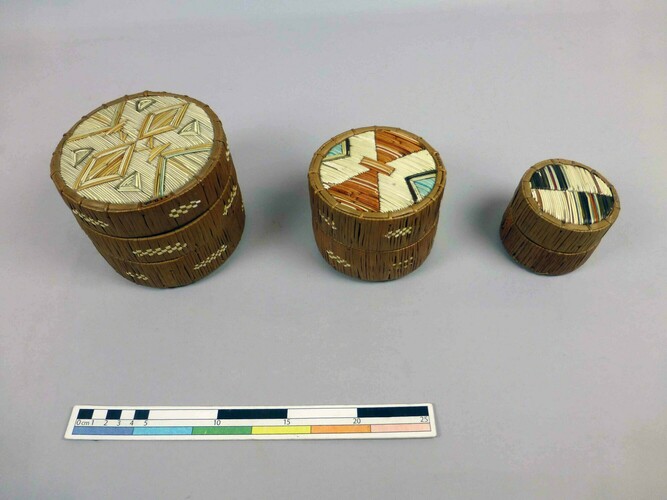 2014.43.3.2Birch bark lid with quillwork decoration. The lid is constructed of birch bark with a band of vertical cane strips with the same quill decoration as the body of the box. The lid is decorated with a geometric design of white, yellow and green dyed quills consisting of linear designs and triangles. For the decorated quillwork birch bark box see 2014.43.3 .1 [CW [OPS move] 15/07/2016].2014.43.3.2
 1994.15.669Drawing by child of three figures. [MJD 26/01/2015]1994.15.669
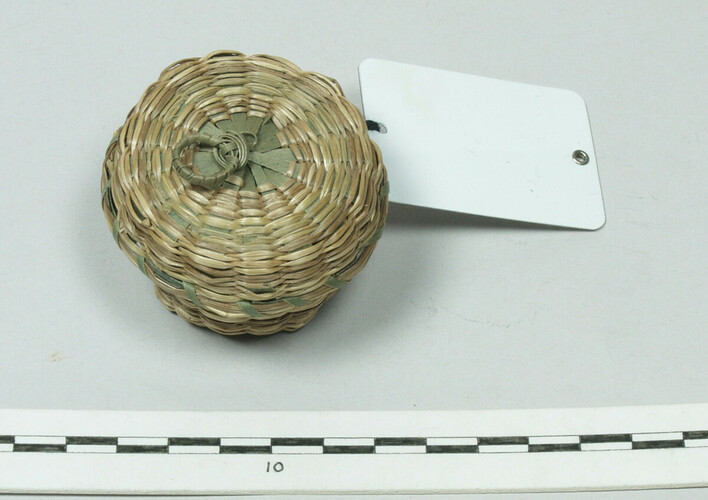 1993.40.6.1Small round basket [.1] with lid [.2]. Warp of ash, weft of sweetgrass. Lid has small central loop. [El.B 'DCF 2004-2006 What's Upstairs?' 21/3/2005]1993.40.6.1
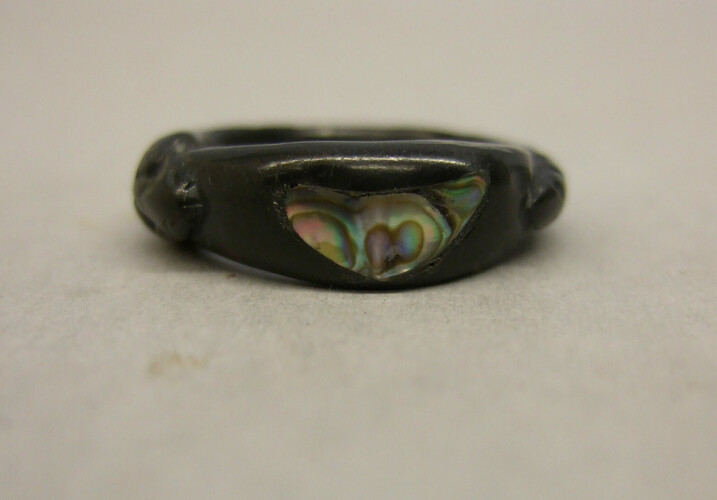 1938.36.1728Argillite ring with the band carved as a snake and inlaid with a crescent-shaped piece of haliotis shell.1938.36.1728