
- Collection type
- Object
- Description
- Paddle.
- Person
- Maker Unknown Maker
- Field collector Unknown Collector
- PRM source Augustus Henry Lane Fox Pitt Rivers founding collection
- Date / Period
- Date made: Before 1872
- Date collected
- Between 1865 and 1872
- Acquisition information
- Donated: 1884
- Materials and processes
- Material Wood Plant, Material Pigment, Process Carved, Process Painted
- Dimensions
- Length: max 1420 mm, Width: max 160 mm
- Object numbers
- Accession number: 1884.61.39
- Research and responses
This paddle illustration is first discussed publically in 1872 by Lane Fox at a BAAS meeting in Brighton, where he addressed the Anthropological Dept and said 'I determined to collect New-Ireland paddles, and see whether a connexion would be found to exist between the peculiar patterns with which they are ornamented. The result is the series now before you, which I have obtained at different times during the last seven years as they turned up in curiosity-shops or were brought over by travellers from the South Seas' hence the years given in the date made and date collected fields. [AP 25/10/2010]
See Plate IV 'The Evolution of Culture' (1875)[1906] which shows this series of clubs [this one is Fig 5]. The textual reference to this illustration is as follows [p 41]:
'Having noticed one or two allied varieties of design in specimens that came into my possession, I determined to collect all that I could find as they came to this country. In the course of several years I succeeded in obtaining the series represented upon Plate IV. The first figure [Fig 1] you will see clearly represents the head of a Papuan: the hair or wig is stuffed out, and the ears elongated by means of an ear ornament, after the manner of these people; the eyes are represented by two black dots, and the red line of the nose spreads over the forehead. This is the most realistic figure in the series [1884.61.29]. In the second figure [Fig 2] the face is somewhat conventionalised: the line of the nose passes in a coil round the eyes; there is a lozenge pattern on the forehead, representing probably a tattoo mark; the body is represented as sitting in full [1884.61.30]. In the third figure [Fig 3] the man is represented sitting sideways, simply by lopping off an arm and a leg on one side [1884.61.32]. In the fourth figure [Fig 4] the legs have disappeared [1884.61.33]. In the fifth figure [Fig 5] the whole body has disappeared [one side of the paddle blade 1884.61.35]. In the sixth figure [Fig 6] the nose has expanded at the base and the sides of the face are made to conform to the line of the nose; the elongated ears are there, but the ear ornament has gone: the nose of this figure is becoming the principal feature [the other side of the paddle blade 1884.61.35]. In the seventh figure [Fig 7] nothing but the nose is left: the sides of the face and mouth are gone; the ears are drawn along the side of the nose; the head is gone, but the lozenge pattern on the forehead still remains; the coil round the eyes has also disappeared and is replaced by a kind of leaf form, suggested by the upper lobe of the ear in the previous figures; the eyes are brought down into the nose [1884.61.36]. In the eighth figure [Fig 8] the ears are drawn at right angles to the nose [1884.61.37]. In the ninth figure [Fig 9] the nose has expanded at the base; all the rest is the same as in the last figure [1884.61.38]. In the tenth figure [Fig 10] lozenge pattern and the ears have disappeared, and a vestige of them only remains in the form of five points; the base of the nose is still further expanded into a half moon [1884.61.39]. In the last figure [Fig 11], nothing but a half moon remains [1884.61.40]. No one who compared this figure with the first of the series, without an explanation afforded by the intermediate links, would believe that it represented the nose of a human face. Unfortunately we do not know as yet the exact meaning of these designs, but when further information is obtained about them it will throw considerable light on similar transformations in prehistoric times.' [AP Leverhulme project on founding collection 1995-1998]
Search terms: Navigation, Paddle
Further items to explore
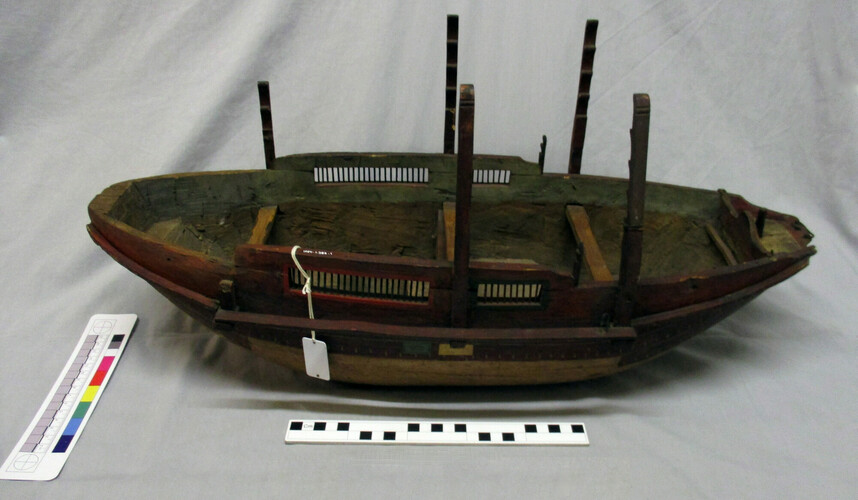 1886.1.386.1Model of boat with hull painted in beige and painted pale blue inside. Frets have been cut into the side of the boat with metal rods inserted to create railings. Five upright lengths of wood are attached to the side of the boat each with four notches carved into the surface. There were two sections of broken pieces of wood that were found with the object and have been placed in a sample bag along with the boat. Metal hooks along the side of the boat. Painted red and yellow on the exterior. In the interior of the boat is a carved section of stone that is secured by the mast. Part of a model boat [1886.1.386 .1] with associated parts including separate back to the boat [1886.1.386 .2], parts of boat [1886.1.386 .3 & .4], paddle [1886.1.386 .5], long stick [1886.1.386 .6], round section [1886.1.386 .7] and a rudder [1886.1.386 .8] [ASh [OPS move] 19/09/2016]1886.1.386.1
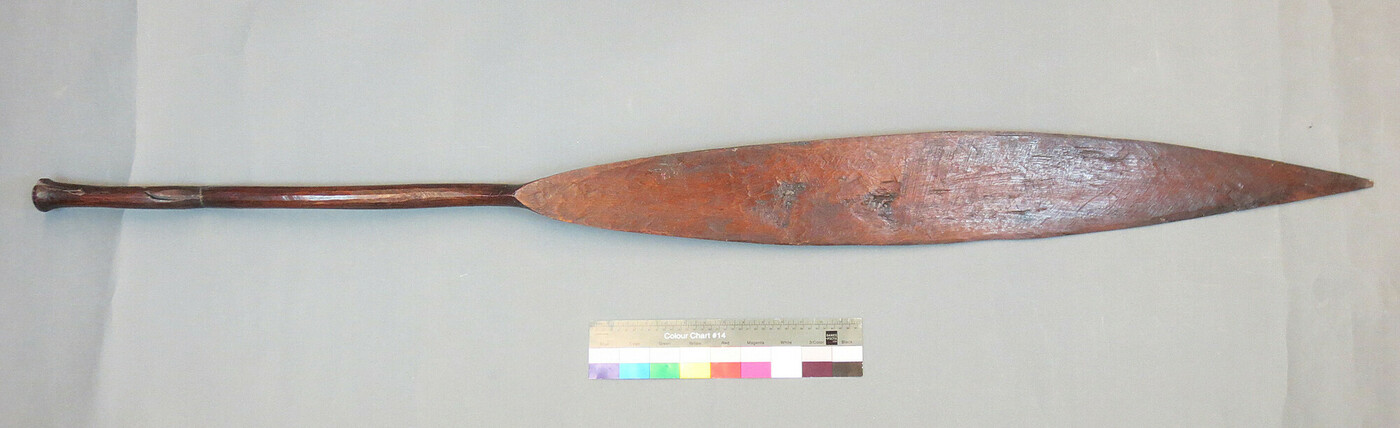 1884.55.22Paddle with curiously-shaped loom, curving to a cusped angle, with very large long leaf blade.1884.55.22
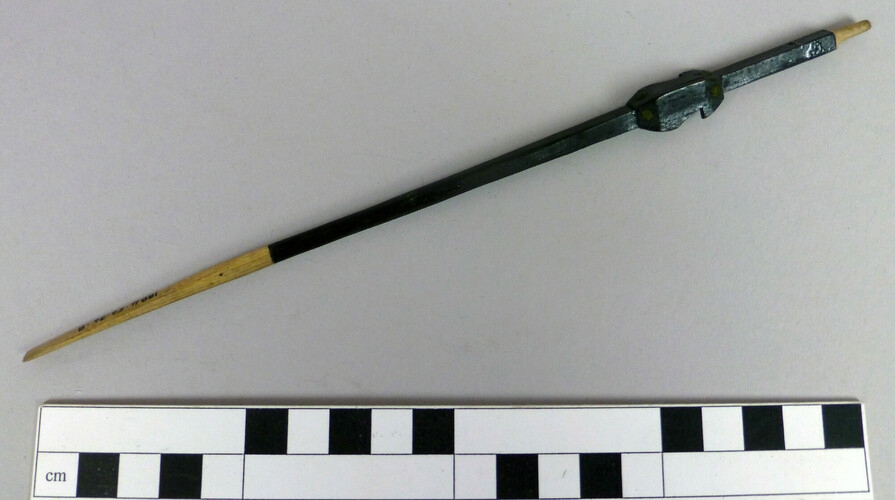 1884.54.34.8One of eight painted wooden oars, part of boat model 1884.54.34. [ZM 11/3/2016]1884.54.34.8
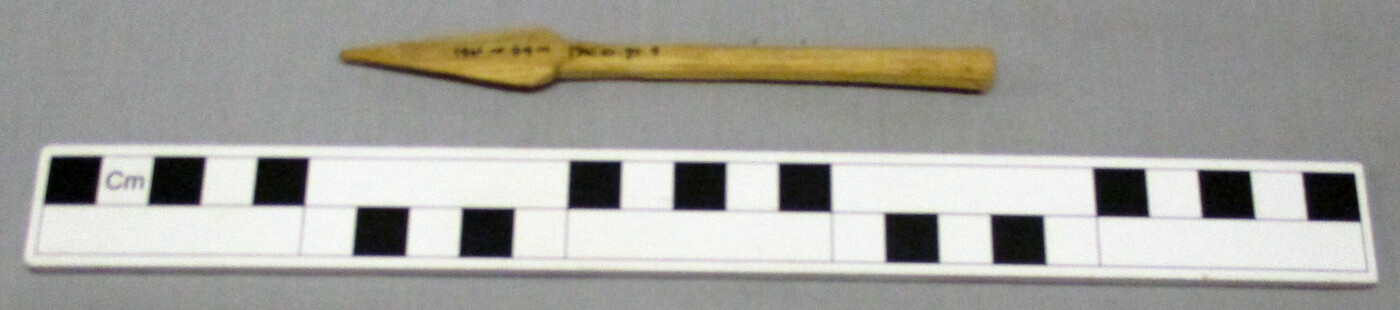 1941.10.89.9Paddle, carved from a single piece of wood. The paddle has a pointed blade with a short, rounded shaft. There is a triangular projection on the blade where it meets the handle. See records 1941.10.49 .1-.3 for the boat and two compartments, 1941.10.49 .4 - .7 for the associated parts and 1941.10.49 .8 - .24 for the paddles. [ASh [OPS move] 27/09/2016]1941.10.89.9
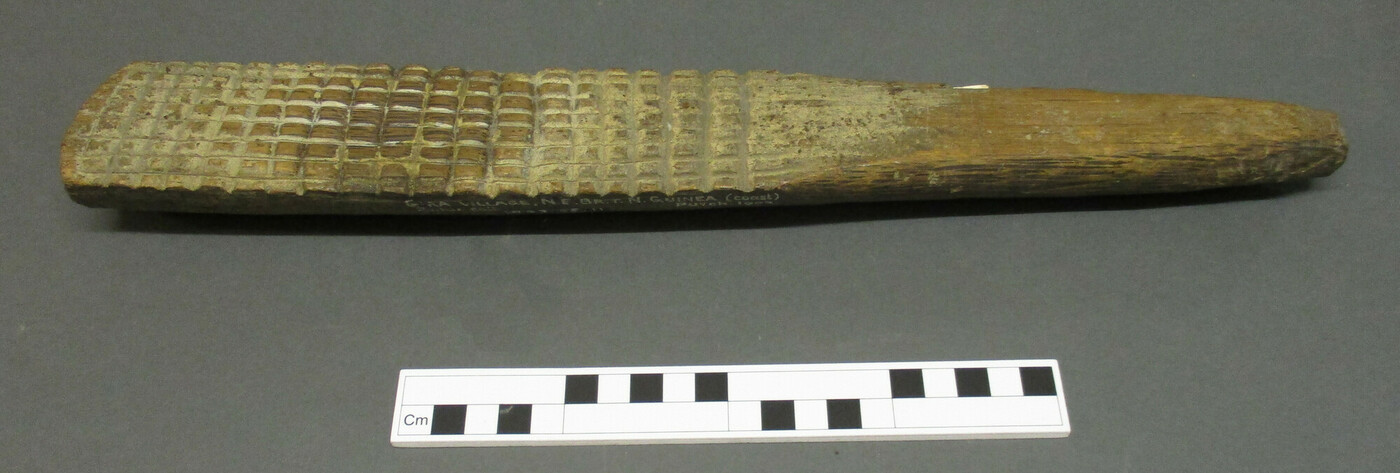 1903.55.11Wooden plano-convex barkcloth beater. The beater squares off at the end of the head, and tapers down at the handle. The flat surface of the head is carved with a grid pattern of rectangles in relief. [EH [OPS Move] 27/3/2017]1903.55.11
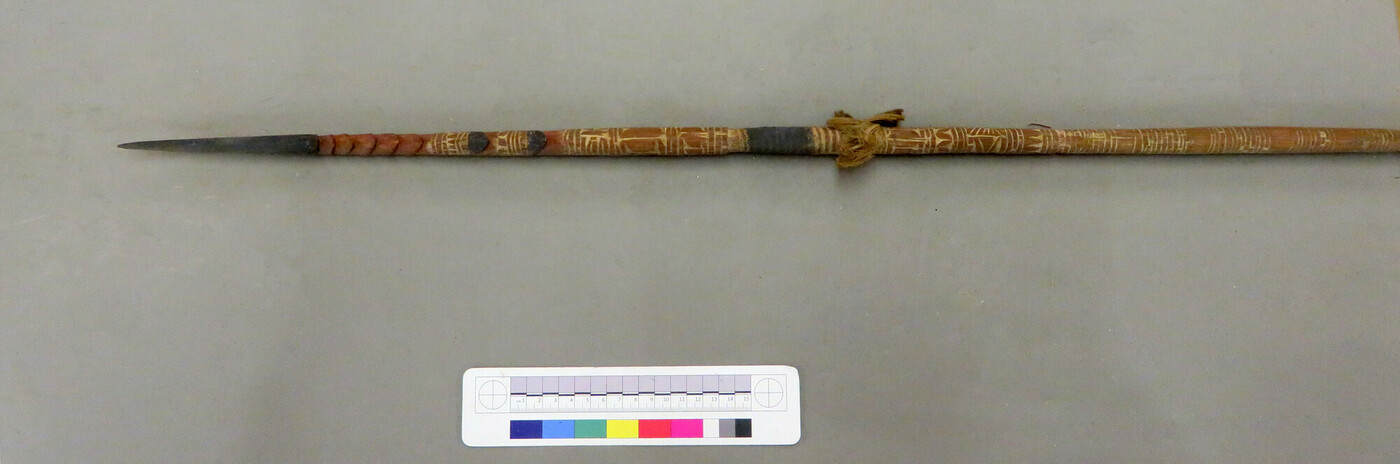 1911.64.20Spear made from wood, the head has carved barbs and incised geometric designs. There is a tassel of plant fibre beneath the head. The butt is of bamboo. [AB [OPS move] 16/8/2018]1911.64.20
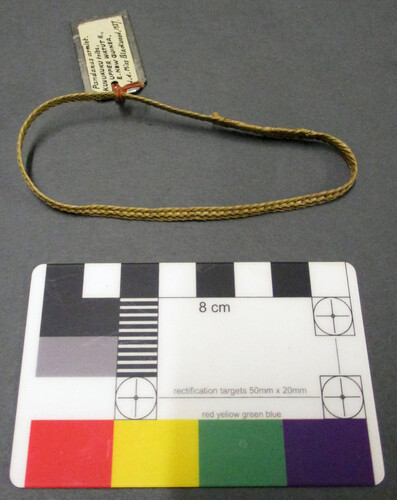 1938.36.628Armlet, of plaited strands of pandanus leaves creating a complete loop. Yellow / beige in colour. [ASh [OPS move] 9/11/2016]1938.36.628
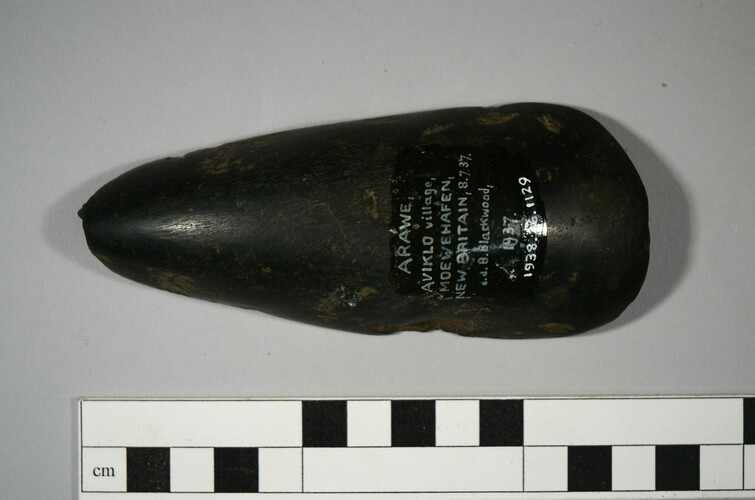 1938.36.1129Ground stone adze.1938.36.1129