
- Collection type
- Object
- Description
- Wooden carving of four rows of human figures holding hands, set in frame with flags on the side pieces. It is hung in houses to propitiate and scare evil spirits.
- Geographical reference
- Person
- Maker Unknown Maker
- Field collector Edward Horace Man
- PRM source Augustus Henry Lane Fox Pitt Rivers founding collection
- Date / Period
- Date made: Before 1884
- Date collected
- Prior to 1884
- Acquisition information
- Donated: 1884
- Materials and processes
- Material Wood Plant, Process Carved
- Dimensions
- Length x Width: max 1165 x 850 mm, Height 15 mm
- Object numbers
- Accession number: 1884.56.83 PR no.: 193/ ? 11935
- Associated publications
- Indian Antiquary, Feb. 1895, 'Catalogue of Nicobarese objects', p. 167 'Henta. Paintings, punctured sketches on Areca spathe screens or carvings on boards. They are somewhat ambitious in design, containing sometimes 7 or 8 pictures on a single screen, but ordinarily only 3 or 4. In the former, a representative of the sun surmounts the whole, or the sun and the moon are represented at the top right and left corners. The Creator (Deuse) is depicted as standing dressed in some quaint garb, on either side of him are usually shewn various weapons, implements and articles in daily use. In the sketch below him are seen huts, cocoanut trees, birds and sometimes men and women; below these domestic animals and poultry; below these again a row of men and women dancing; next come ships and canoes in full sail; and lowest of all are represented various descriptions of fishes, with the invariable merman or mermaid and crocodile. When first made, and at subsequent times of sickness, the henta is called henta-koi-henta. They are made and used in the Central and Southern Groups and at Teressa; but only in the Central Group are representations of Deuse (the Creator) ever introduced. The objects supposed to be served by the henta is, as is the case of the similar carvings and paintings, to gratify the good spirits (iwi-ka) and frighten away the demons (iwi-pòt etc).' [there are further descriptions of particular types of henta on this page]. It may be that this is the object referred to in the following letter from the PRM archives: PRM Tylor papers B 13 27.10.86 EH Man to EB Tylor....I think you would be pleased to receive a henta or picture on an Areca spathe. These are quite works of art for people such as the Nicobarese, but they are so fragile that I shd have to pack one separately or in a large partition if packed with other objects. Should you wish for one and would like me at the same time to send fresh specimens of any Nicobarese objects [insert unreadable on photocopy used for transcription] that they have reached you in a broken or damaged state I shall be happy to do my best in the matter on hearing from you. The wooden henta wh. I presented to Genl. Pitt Rivers (figured in A.I. [sic - Anthropological Institute) journal vol XI pl XV fig 1) is an insignificant one compared to many that are made in this portion of the Group. Another relevant letter is: PRM Tylor papers B13 26.6.87 EH Man to Tylor .... With regard to the collection sent to the British Museum wh was despatched on the 11th Inst and wh will I trust reach Mr Franks about the same time this letter is delivered to you, I should be glad if you could obtain a copy of the Catalogue which I sent with it and substitute it for that I prepared for you, as it embodies my latest information regarding the objects in question, and I found it necessary to correct my description of a few of the principal objects, viz the fetish-like ‘Kareau’ and ‘henta’ etc [AP Leverhulme project on founding collection 1995-1998]
Search terms: Religion, Dwelling, Figure, Furniture Dwelling, Amulet, House-ornament
Further items to explore
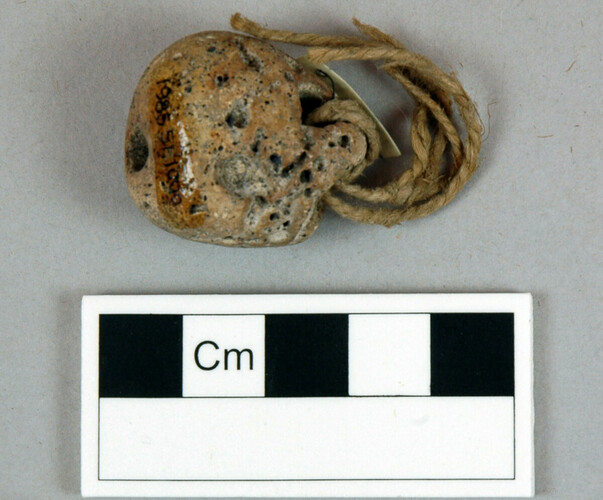 1985.51.1000Naturally holed stone, with a piece of string tied through it. Tied to a cow's horn to prevent fairies stealing milk. [SM 18/05/2011]1985.51.1000
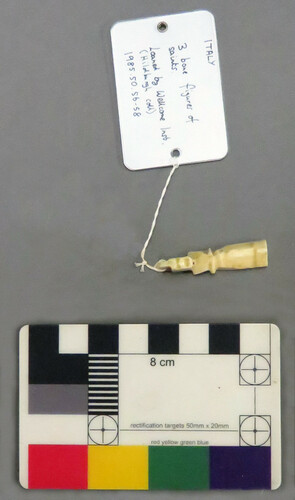 1985.50.58Amulet, bone Saint figure. [CW [OPS move] 19/9/2017]1985.50.58
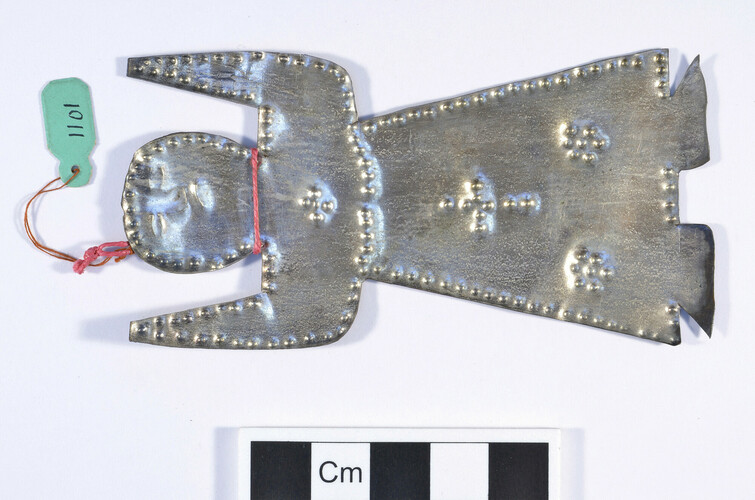 1985.52.580Amulet, silver ex-voto, the figure of a man, with embossed details including a cross. [RB 22/03/2012]1985.52.580
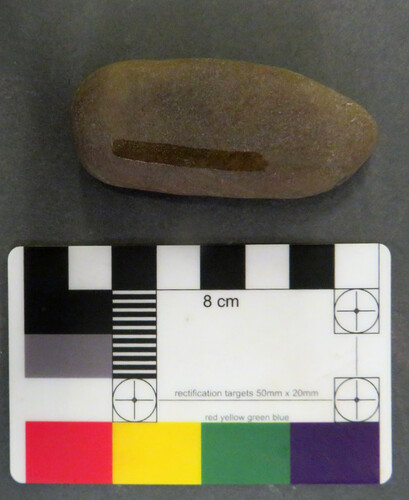 1985.54.2744Amulet. Brown stone, tombstone shaped with a pink hue. Smooth surfaces. Used to prevent jealousy. [ASh [OPS move] 21/11/2017]1985.54.2744