
- Collection type
- Object
- Description
- Iron anvil used in metalworking; part of a set with 1884.47.3 [RTS 9/8/2004].
- Long description
- Small anvil made from a single piece of iron, consisting of a narrow, slightly convex top, roughly round in section with edges splayed and slightly folded in where they have been hammered flat. The body below tapers out towards its base, and is circular at the top wih a roughly pecked surface, before becoming square and more smoothly finished two thirds the way down the body where the sides have been flattened to produce four flat faces with angular edges. The underside is flat and almost square, and has been polished smooth through use. The polish extends to the lower part of each flattened side. The anvil is complete and intact, but there is a large flaw in the metal just above the base, visible as a deep fissure that has created a void near one edge. It is currrently a metallic gray colour (Pantone 877C). It has a weight of approximately 1300 grams, is 141 mm long, and measures 16.7 by 16.5 mm across the top, 37.5 by 36.7 mm across the mid body, just before this becomes square, and 49.4 by 47.3 mm across the base [RTS 9/8/2004].
- Geographical reference
- Cultural groups
- Jur
- Person
- Maker Unknown Maker
- Field collector John Petherick
- PRM source Augustus Henry Lane Fox Pitt Rivers founding collection
- Date / Period
- Date made: Possibly before 1858
- Date collected
- 1858
- Acquisition information
- Donated: 1884
- Materials and processes
- Material Iron Metal, Process Forged (Metal), Process Hammered
- Dimensions
- Length 141 mm, Width: max 49.4 mm, Depth: max 47.3 mm, Weight 1300 g
- Object numbers
- Accession number: 1884.47.4
- Research and responses
This object is said to have been collected in 1858; in that year Petherick led a trading expedition through Bongo territory, an account of which is given in his 1861 volume, Egypt, The Sudan and Central Africa; he refers to this group as the Dor. The expedition entered Bongo territory on January 25, 1858, visiting villages called Djau, Kurkur, Maeha, Mura, Umbura, Modocunga, Miha, Nearhe, Gutu, Mungela, Ombelambe and Lungo. Later in February they passed back through the Bongo villages of Djamaga and Lungo again. This material was shipped back to England in 1859.
Both objects are used to illustrate a section on the Kytch (= cic Dinka?) not the Jur or Bongo, but in Petherick's original sketchbook, they were drawn on a page with the general title of 'Djour implements' (Wellcome Library MS 5789, p. 10), and Petherick certainly describes the Jur using objects of this type: ‘after securing their crops, the Djour, in large numbers, proceed in search of iron ore; and by means of small cupolas and charcoal fuel this is reduced on the spot to metal of the finest description.’ Once the slag is recovered by this process, it is broken into small pieces, which are ‘submitted to the heat of a smith’s hearth, and hammered with a large granite boulder on a small anvil presenting a surface of 1 1/2 inch square, stuck into an immense block of wood. By this process the metal is freed from its impurities, and converted into malleable iron of the best quality’. Once the iron is reduced to small ingots, they are ‘beaten into shape by the boulder, wielded by a powerful man; and the master smith, with a hammer, handleless like the pestle of a mortar, finishes them... Almost every Djour is employed in this manufacture, and by the disposal of the results of his labour, either in iron or grain, obtains an easy subsistence from the Dinka tribes’ (J. Petherick, 1861, Egypt, The Sudan and Central Africa, pp 395-6). The attribution in the various museum records 'Jur and Dor' seem to have originated from the auction catalogue, but the two items are a pair and belong together. This attribution may reflect no more than a comment that this type of tool was used by both groups.
Schweinfurth also illustrates a similar object amongst his Zande material (G. Schweinfurth, Artes Africanae, pl. XIII fig. 20, with the comment 'a smith's anvil for the manufacture of fine iron implements, serving also as a hammer, 0.12 metres long, 'Bande'); as well as amongst his Bongo finds (op.cit., pl. V no. 7 'quadrangular iron block, used as hammer and anvil... 'Berr')
- Associated publications
- This is probably the object illustrated by Katherine Petherick in Travels in Central Africa and Explorations of the Western Nile Tributaries, Vol. I, p. 163 top [RTS 4/1/2005].
Search terms: Tool, Metallurgy, Anvil
Further items to explore
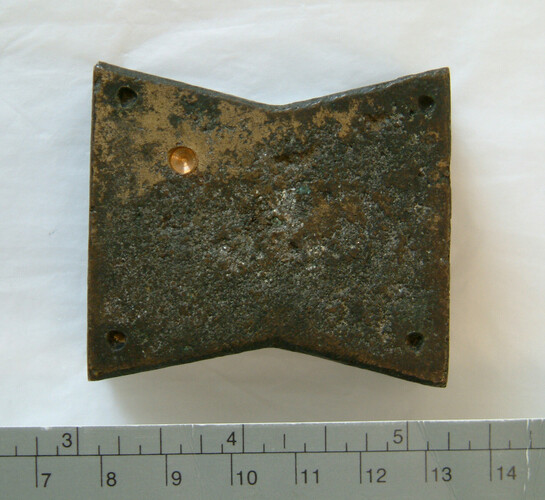 1884.119.233Bronze X-shaped object; ?anvil1884.119.233
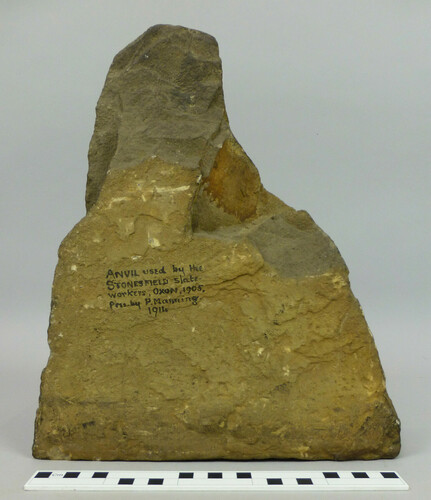 1911.29.80Anvil of stone, roughly triangular in shape. [EH [OPS move] 26/7/2017]1911.29.80
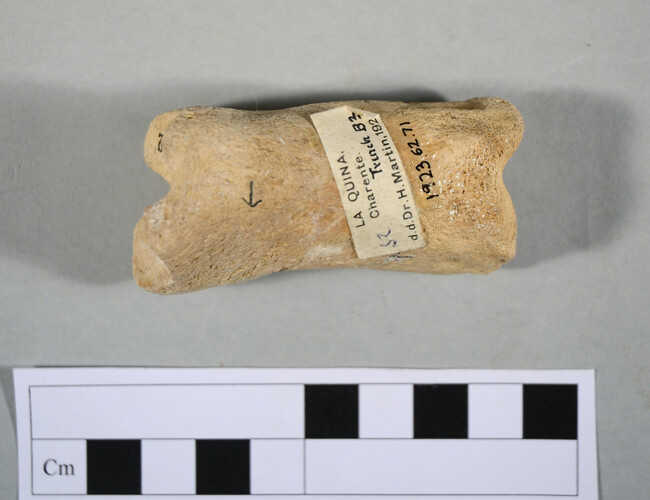 1923.62.71Fragment of animal bone showing cut marks. [RH [OPS Move] 8/5/2017]1923.62.71
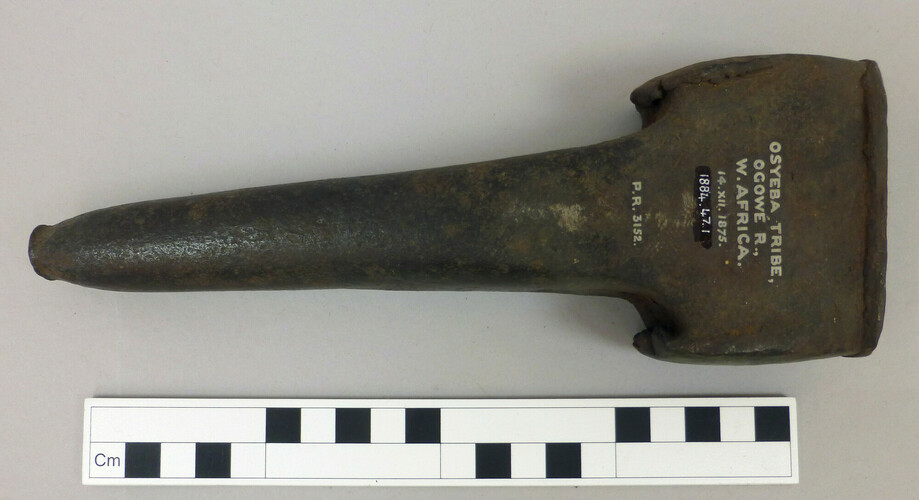 1884.47.1Iron anvil with three used surfaces and a tapering body [SM (Verve) 29/07/2014]1884.47.1
 1979.20.128Ivory pendant earring decorated with incised and inlaid ring and dot motif on the outer face [RTS 8/7/2004].1979.20.128
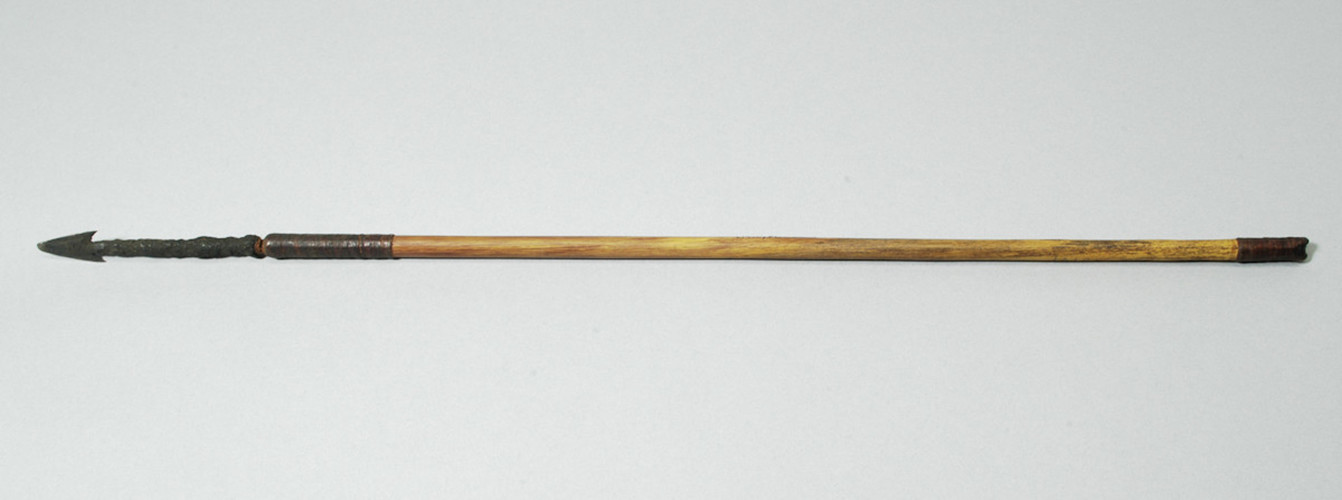 1934.8.113Poisoned arrow with triangular iron head, long circular sectioned tang and cane shaft with bound and nocked end [RTS 6/6/2005].1934.8.113
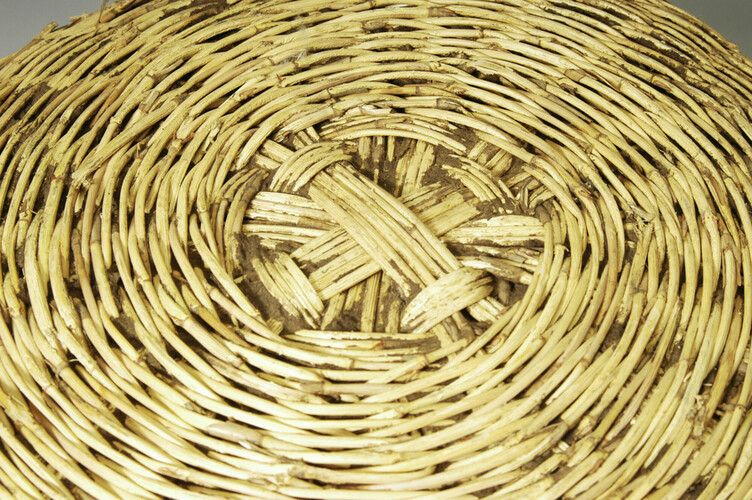 1979.20.48Large grass basket decorated with three brown bands around circumference, for carrying grain [RTS 2/8/2005].1979.20.48
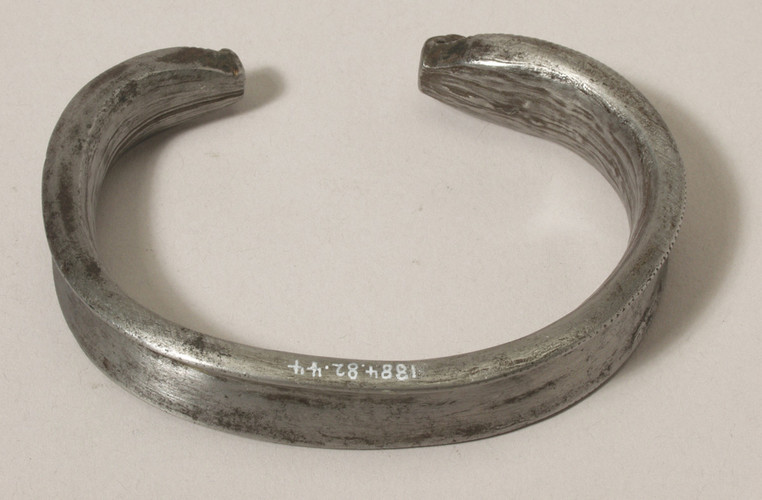 1884.82.44Penannular iron arm ornament with concave outer face and incised decoration [RTS 24/3/2004].1884.82.44