
- Collection type
- Object
- Description
- Antler comb
- Long description
- Antler weaving tool/comb. 4 teeth broken. Outer surface smooth from use. Distal end broken at point of perforation. Lightly incised geometric decoration [JW [Excav. PR] 10/06/2013]
- Geographical reference
- England West Sussex Adur Lancing
- Person
- Maker Unknown Maker
- Field collector James A.S. Medhurst
- PRM source Augustus Henry Lane Fox Pitt Rivers founding collection
- Date / Period
- Archaeological period: Iron Age
- Date collected
- By 1879 July 2
- Acquisition information
- Donated: 1884
- Materials and processes
- Material Animal Antler, Material Animal Bone, Process Carved
- Dimensions
- Length: max 81 mm, Width: max 32 mm, Thick: max 8 mm, Weight 11 g
- Object numbers
- Accession number: 1884.46.13 PR no.: 10/ 9680
- Research and responses
This object was probably among those purchased by Pitt-Rivers at a Sotheby auction on 2 July 1879, but is not listed individually in the catalogue. [Dan Hicks 22/07/2013]
This object was among the 5 combs mentioned by Pitt-Rivers in his 1881 paper on Mount Caburn: "...In my collection are several bone combs of the same kind; one from Lancing in Sussex, found by Mr. Medhurst, has nine teeth; another, from Lancing, has eight teeth and a cross on the handle; a third, from Lancing, has six very short teeth, not more than a quarter of an inch in length, and pointed so as to resemble rather a succession of points and scallops than a comb. One also in my collection, from Portland, near Weymouth, found by Mr. Medhurst, has seven teeth; another, from Jordan Hill, near Weymouth, has eight teeth ; these latter were associated with Roman remains." Pitt-Rivers 1881: 431 [Dan Hicks 08/07/2013]
However the provenance given in the delivery catalogue is different, there are many entries with the date 2.7.79 from Weymouth so this provenance may be correct, note however that the name of the object is also different. Note that there are two versions of the Green book entry, one on pages 97 and 98 and one on pages 100 to 102 [AP Leverhulme project on founding collection 1995-1998]
A number of the items from Lancing are also numbered 2.7.79. I suspect this item is more likely to be from Lancing, as there are 3 other Iron Age bone weaving combs which are definitely provenanced to Lancing. [CB 27/11/09]
According to the English Heritage maintained National Monuments Record (NMR) this object may have been excavated by James Medhurst from an Iron Age shrine and Romano-Celtic temple located to the immediate north of Lancing at TQ 1782 0669. Pitt Rivers is known to have purchased material excavated by Medhurst from the Jordan Hill Romano-Celtic temple near Weymouth (74 of these objects form part of the Museum's founding collection) and consequently it seems possible that some of the Lancing material was also acquired via a similar route. The NMR record describes the Lancing shrine/temple as follows: "Romano Celtic temple near Lancing Ring was excavated in 1828 and 1829 by a Mr Medhurst. Near the Building were thirty five graves one of which evidently contained an overhanging rim urn. Curwen notes that coins suggest an occupation 1st to 3rd centuries, but Frere commented that although some IA 'A' sherds were found the main occupation belongs to Belgic times, and in particular to the Tiberian and Claudian periods. Little or no specifically Roman pottery had been recovered from the actual temple site though quantities of Ro sherds occur about 50 yds down the hill to the south possibly the excavation spoil heap...The existence of Bronze and I A Sepulchral pottery suggests the existence of a sacred site before the Roman period. Finds in Pitt Rivers Museum Oxford". The site is recorded under Monument Number 395386, the record can be accessed online at http://pastscape.english-heritage.org.uk/hob.aspx?hob_id=395386. [MN 11/01/2010]
- Associated publications
- Pitt-Rivers, A.H.L.F. 1881. Excavations at Mount Caburn camp near Lewes, conducted in 1877 and 1878. Archaeologia 46: 423-495. Reference on page 431 [Dan Hicks 08/07/2013] Sotheby, Wilkinson and Hodge 1879. Catalogue of Antiquities and Works of Art including the collection of the Baron Heath...and the Musuem of Romano-British pottery and Roman personal ornaments formed by the late Mr James Medhurst of Worthing and Weymouth; comprising vessels in terra-cotta, bronze figures &c., cinerary urns, early Roman implements, beads, Roman coins...(1-2 July 1879). London: Dryden Press (Messrs Sotheby, Wilkinson and Hodge). Item 79 (page 5). I have placed a copy of this catalogue on file in the RDF for 1884.2.1 [Dan Hicks 08/07/2013] This comb, along with .11 &.12, are mentioned on page 70 of The Meare lake village: a full description of the excavations and relics from the eastern half of the West village, 1910-1933, Volume 1, written by Arthur Bulleid, Harold St. George Gray, M. Aylwin Cotton and privately published. [MN 11/01/2010]
Search terms: Textile, Tool, Weaving Accessory, Comb
Further items to explore
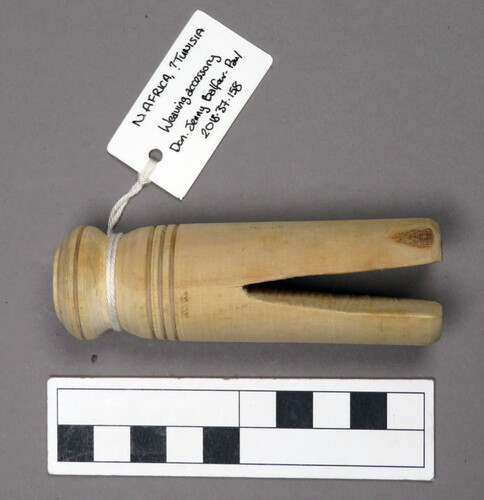 2018.37.158Weaving accessory ?heddle pulley. Made of wood in the shape of a dolly peg. One of four, for the others see 2018.37.159 - .161. [AF [EFCF project] 9/8/2019]2018.37.158
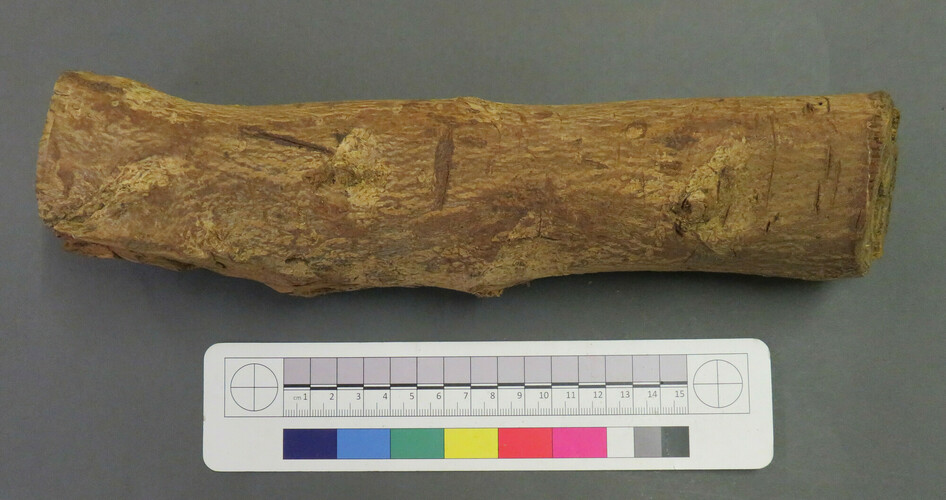 1941.4.18.18Block of wood, cylindrical in section, with one cut end. Bark on the exterior, which is peeling away in places. For associated spinning and weaving apparatus see [1941.4.18 .1 - .24 [EH [OPS Move] 15/5/2017]1941.4.18.18
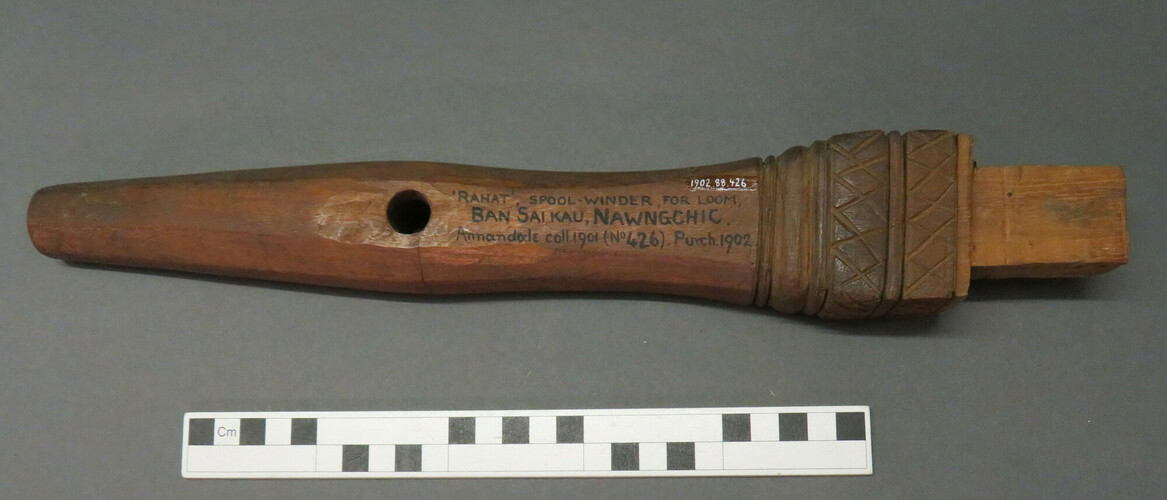 1902.88.426.2Part of a wheel for winding thread; upright piece of wood, spool winder, with carved decoration at one end and a plain carved tenon joint. [MJD (Verve) 9/5/2017]1902.88.426.2
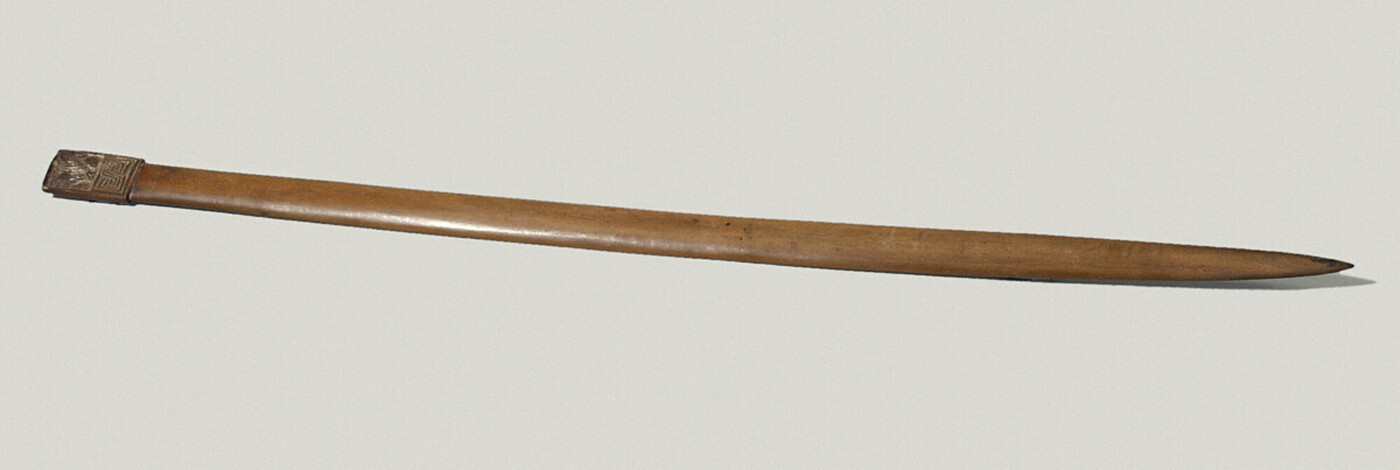 1991.13.37Wooden weaving sword. Undecorated except for a 70 mm section at the wider end. One face of this is decorated with an incised figure of a bird above a geometric motif, the other with wavy lines.1991.13.37
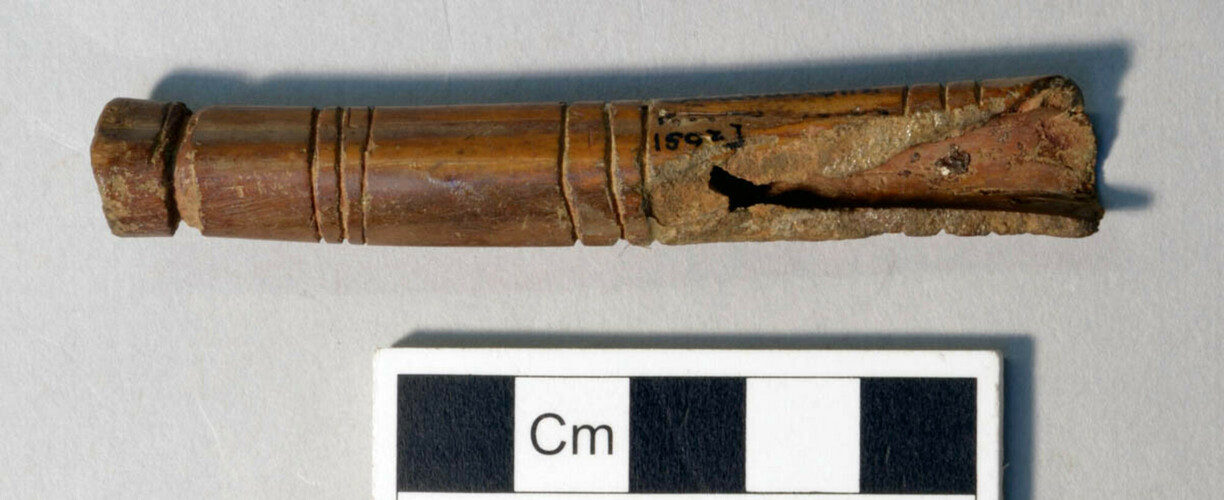 1884.118.242Bone handle1884.118.242
 1911.29.68.11One of twelve wooden pegs used in the game of 'merry-peg'. [El.B 'DCF 2004-2006 What's Upstairs?' 7/3/2005]1911.29.68.11
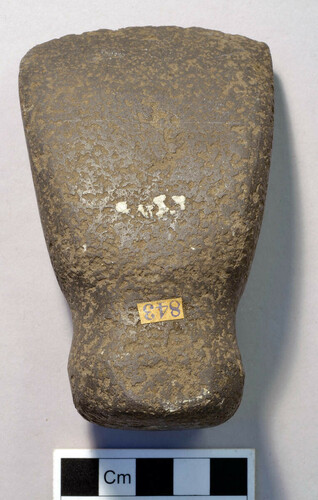 1884.140.1597.2Hammer-stone / axe which tapers to a point and has one groove for hafting. Polished in areas. Forgery. [CG [Excav. PR] 22/10/2013]1884.140.1597.2
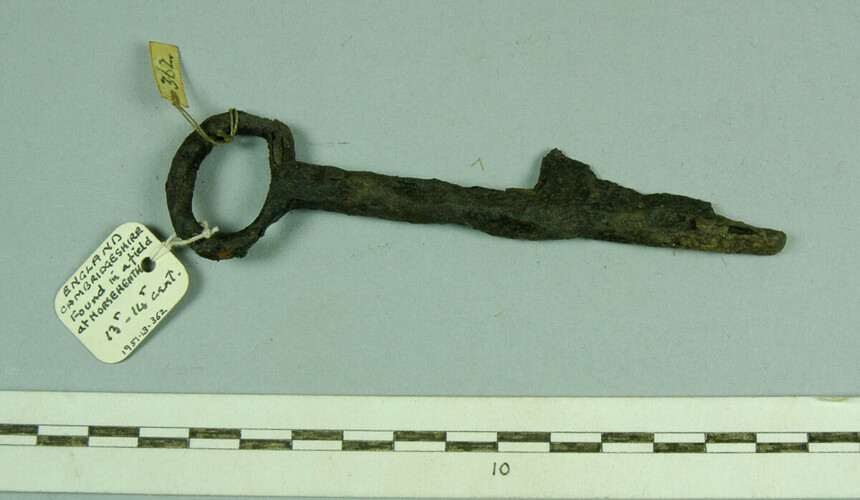 1951.13.362Iron key with oval bow, bit mostly broken off. [El.B 09/03/2009]1951.13.362