- Collection type
- Object
- Description
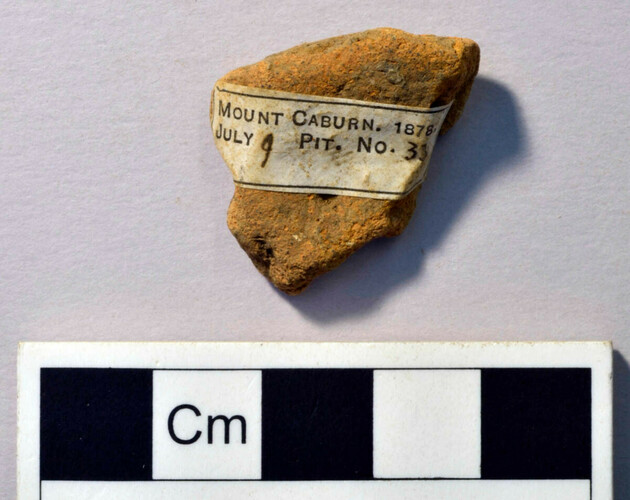
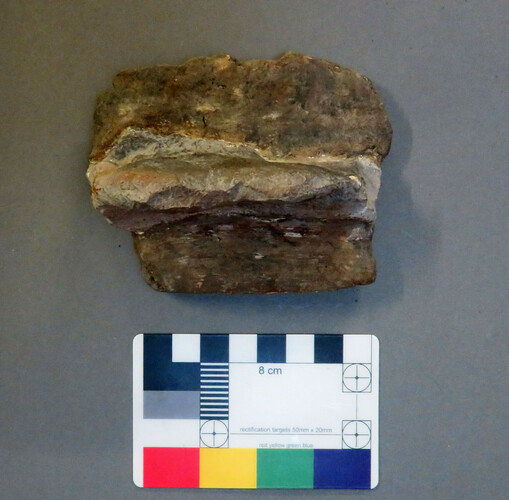
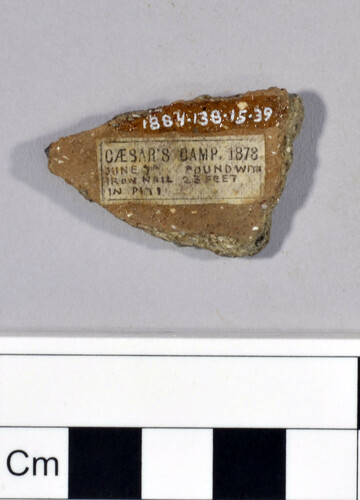
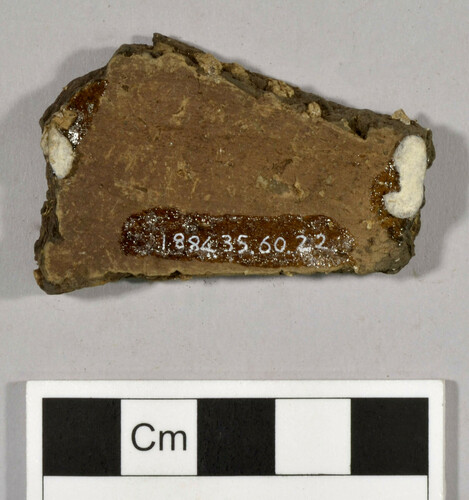
- Ceramic sherd
- Long description
- Body sherd of medium to coarse grained, reduce fired ceramic with mineral temper. [CG [Excav. PR] 27/06/2013]
- Geographical reference
- England Oxfordshire South Oxfordshire Dorchester Dorchester Dykes
- Person
- Maker Unknown Maker
- Field collector Augustus Henry Lane Fox Pitt-Rivers
- PRM source Augustus Henry Lane Fox Pitt Rivers founding collection
- Date / Period
- Archaeological period: Iron Age
- Date collected
- By 1874?
- Acquisition information
- Donated: 1884
- Dimensions
- Length: max 33 mm, Width: max 23 mm, Thick: max 12 mm, Weight 11 g
- Object numbers
- Accession number: 1884.41.180 PR Cat other PR nos: 1423 PR Cat other PR nos: 3256
- Research and responses
Dorchester Dykes (grid reference SU 573 936) is a fortified town or settlement probably of Late Iron Age date. Roughly rectangular in shape it is formed by two parallel running banks, with the Thames and Thame acting as natural barriers on the other two sides. The site is recorded in the Oxfordshire Historic Environment Record [HER] as PRN 3150, and is also a Scheduled Ancient Monument [OX17]. Although associated with the late Iron Age, evidence for Late Bronze Age/Early Iron Age and Anglo Saxon activity is also known from the site [see Kirk J.R and Leeds, E.T. 1953. Three Early Saxon Graves from Dorchester, Oxon. Oxoniensia XVII-XVIII: pp 63-76]. [MN 04/11/2008]
For general information on the Museum's collections of Oxfordshire archaeological material including lists of sites, grid references etc see Archaeological Material from Oxfordshire in the Collection of the Pitt Rivers Museum by Simon Thorpe (unpublished spiral bound report dated June 1996 (copy in RDF: Researchers File: Thorpe) [MN 04/11/2008]
- Associated publications
- Marc Bowden in his 1991 book Pitt Rivers: The Life and Archaeological Work of Lieutenant-General Augustus Henry Lane Fox Pitt Rivers [published by Cambridge University Press, page 76] records that Pitt Rivers read a short paper to the Ethnological Society in June 1870 on the threatened destruction of earthworks on the north bank of the Thames at Dorchester and Sinodun Camp hillfort near Little Wittenham. This paper was published in the 1870 edition of the The Journal of the Ethnological Society of London [for full reference please see below]. Pitt Rivers discusses examining "the section of a fresh cutting", although it is uncertain if this was cultivation disturbance or deliberate invasive archaeological investigation [Bowden, 1991: 76]. Nearby this cutting Pitt Rivers describes how "carefully searching the ground which had been excavated from the banks on the left flank and the cultivated ground in the interior of the camp, I found abundant evidence of the fabrication of flint implements (a number of cores flakes and chips from this spot were exhibited to the Society) but I did not succeed in finding any flint tool, with the exception of one fragment of a well-chipped spear head (pl xxvi fig 6 [this item does not appear to be in the museums collection]) I also found on the dykes several pieces of pottery of undoubtedly British production and a fragment of wheel made pottery of a later date" [Lane Fox 1870: 414]. The pottery sherds mentioned in the last sentence may be 1884.41.178 - 1884.41.182. The full article reference is: Lane Fox, A. 1870. On the Threatened Destruction of the British Earthworks near Dorchester, Oxfordshire. The Journal of the Ethnological Society of London (1869-1870) Vol. 2, No. 4: pp. 412-416. This article can be accessed on JSTOR. The stable URL is http://www.jstor.org/stable/3014372. This paper is also in the Related Documents File for 1884.128.37. [AP Leverhulme project on founding collection 1995-1998] [MN 03/11/2008]. For material from Sinodun Camp also mentioned in the 1870 article please see accession numbers: 1884.123.381 - 1884.123.384 and 1884.128.37. [MN 04/11/2008] On July 11th 1870 it appears that Pitt Rivers wrote a letter to The Pall Mall Gazzette [issue 1687] under the pseudonym A Late Assistant-Quartermaster-General. The similarities between the letter and the article presented to the Ethnological Society in June that year [particularly with reference to the fragment of a flint spearhead] strongly suggest that the author is Pitt Rivers [or Lane Fox as he was then]. In his letter Pitt Rivers refers to an article in The Saturday Review of politics, literature, science, and art [a London based periodical published between 1855 and 1938] which discussed the destruction of Dorchester Dykes. Pitt Rivers is supportive of the article for bringing the site to attention, but takes issue with a pronouncement that the dykes were Roman in origin stating that "Having twice examined the camp at Dorchester -and I may observe en passant that I know of no place that will so well repay the military officer who has an archaeological turn of mind for the trouble of visiting it- I have arrived at a totally different conclusion from the writer of the article. First, the camp is not Roman". He then goes on to explain why he reached this conclusion "I examined carefully, by pacing backwards and forwards, the whole of the interior of the camp at a time when the crops were off the ground; but I failed to discover a single fragment of Roman tile or pottery...On the other hand, evidence of British occupation was abundant; I found several fragments of undoubted British pottery in the materials excavated from the dykes, a fragment of a flint spearhead and debris of the fabrication of flint implements". On the basis of this letter it seems increasingly unlikely that the material in the museum [see other information for a list] was recovered from an archaeological excavation but from spoil heaps resulting from the removal of the banks during agricultural improvement of the land. This letter was found on the 19th Century British Library Newspapers website [http://gale.cengage.co.uk/britishlibrarynewspapers/]. The Gale document reference number is BB3200312474. A copy of this letter is also in the Related Documents File for 1884.128.37. [MN 18/11/2008]
1884.41.180
Ceramic sherd
1884.41.180
Digital asset copyright: Pitt Rivers Museum, University of Oxford
If you wish to order a high-resolution image and/or licence its use for print or web publication, exhibition, film, promotional product or any other use, whether in the academic or commercial sector of any print run, then please visit photographic services.