
- Collection type
- Object
- Description
- Frechen stoneware Bartmann (aka 'Bellarmine', 'Greybeard') jug. [JC 26 9 2013]
- Long description
- Glazed ceramic jug with conical base, globular body, narrow neck and loop handle (broken). The neck of the jar is broken but what remains has a impressed face with roundel eyes and curled beard. Around the body of the jar are six moulded circles with profiles of a man in them, leaf motifs and script running around the widest part of the body. Repaired. [CG [Excav. PR] 30/10/2013]
- Geographical reference
- Cultural groups
- English
- Person
- Maker Unknown Maker
- Field collector Unknown Collector
- PRM source Augustus Henry Lane Fox Pitt Rivers founding collection
- Date / Period
- Date made: Before 1878
- Date collected
- Possibly 1878 ?
- Acquisition information
- Donated: 1884
- Materials and processes
- Material Pottery, Process Inscribed, Process Repaired (local), Process Moulded
- Dimensions
- Height: max 206 mm, Depth: max 173 mm, Weight 1133 g
- Object numbers
- Accession number: 1884.40.33
- Research and responses
One of the other objects collected from this site (1884.40.34) is recorded as collected in 1878. I have therefore updated the 'when collected' field to read '1878?'. [Dan Hicks 15/08/2013]
See Henry Taunt photograph of this site at http://viewfinder.english-heritage.org.uk/story/slide.asp?StoryUid=17&totSlides=18&slideNo=2 [AP 05/04/2006]
See also http://www.headington.org.uk/oxon/high/tour/south/angel_hotel.htm which gives exact address and states that most of the Inn was demolished in 1876 to make way for the Examination Schools [AP 17/08/2006]
Dan Hicks advises that [some of] these jugs were used as apotropaic devices ('witch bottles'), in part through an association with the human body and its contents. They were placed under walls, under hearths, and in similar locations. The classic reference work on such practices is The Archaeology of Ritual and Magic, by Ralph Merrifiel, London: Batsford (1987). (See also his earlier study 'The Use of Bellarmines as Witch Bottles', in Guildhall Miscellany, no. 3 (February 1954), pp. 3-15.) The use of Bartmann jugs in this way continued at least into the mid 18th century, but similar practices with other vessels continued in England into the 20th century. The practice was especially common in south-east England (see 'The Archaeology of Counter-Witchcraft and Popular Magic', by Brian Hoggard, in Beyond the Witch Trials: Witchcraft and Magic in Enlightenment Europe, edited by Owen Davies and Willem de Blécourt, Manchester: Manchester University Press (2004), pp. 167-186). [AS 02/06/2009; JC 26 9 2013]
Search terms: Vessel, Pottery, Writing, Inscription
Further items to explore
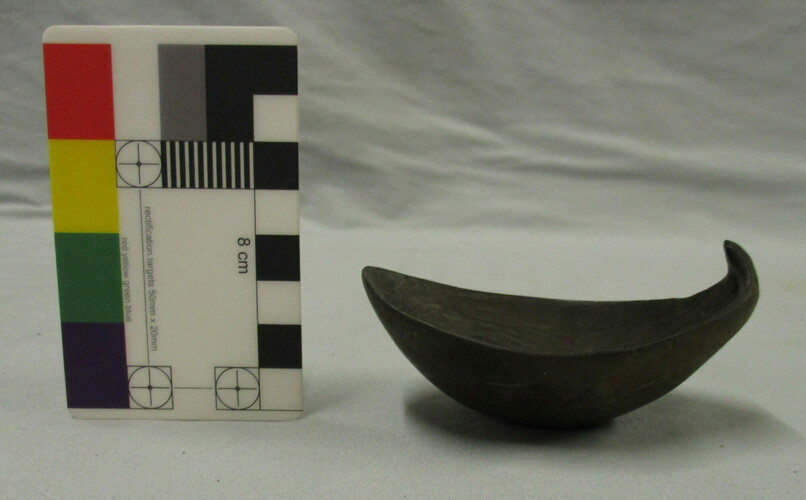 2016.59.1Carved coconut vessel. The vessel is oblong shaped with a perforated lug rising from the rim on one side. [CW [OPS move] 14/9/2016]2016.59.1
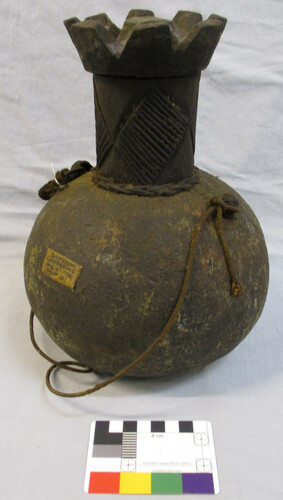 1942.13.1598Gourd vessel with globular body and cylindrical wooden neck. The gourd is covered in a thick, greasy layer [JU 3/3/2016]1942.13.1598
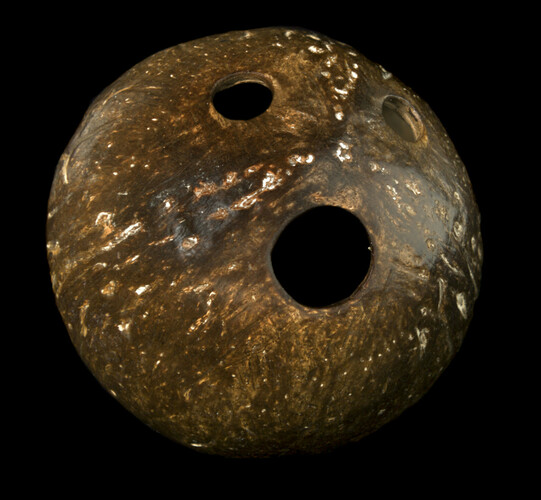 1965.12.109BSand vessel made of a young coconut.1965.12.109B
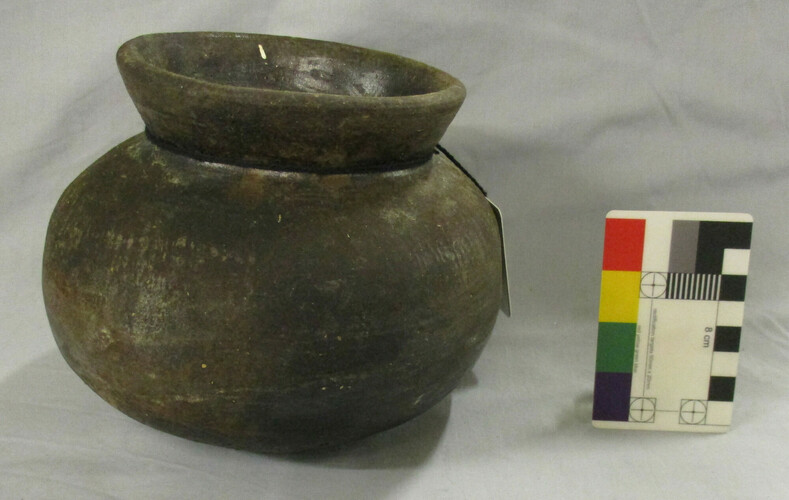 1994.14.57.1The vessel is glazed with a dark brown glaze. The lid for this vessel is 1994.14.57 .2. [MOBB [OPS move] 04/03/2016]1994.14.57.1
 1884.138.9.49Ceramic base sherd1884.138.9.49
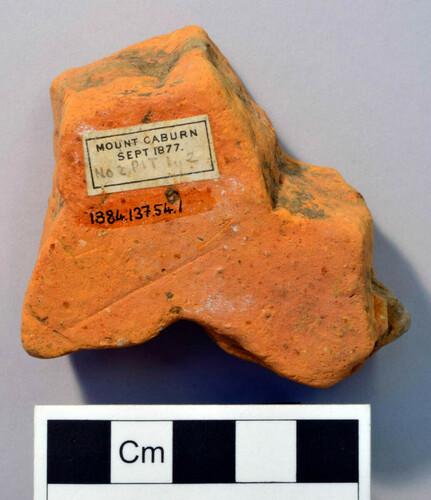 1884.137.54.1Ceramic brick fragment1884.137.54.1
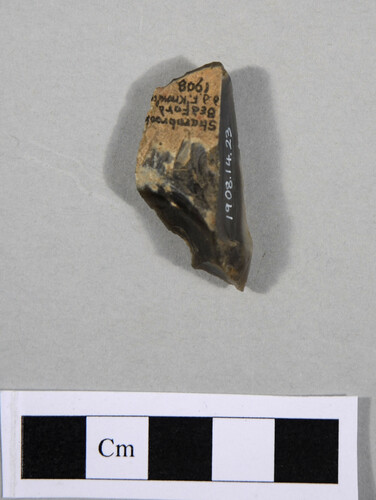 1908.14.23Stone tool, flake, dark grey flint. [MJD 07/08/2013]1908.14.23
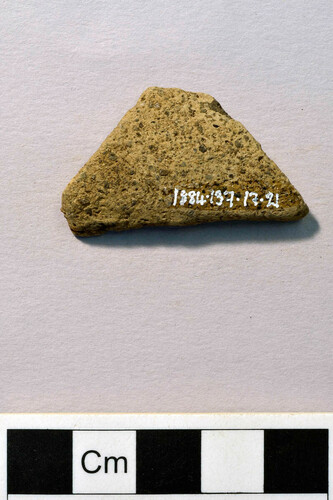 1884.137.17.21Ceramic sherd1884.137.17.21