
- Collection type
- Object
- Description
- Ceramic urn. This object has a flat bottom and expanding sides. This pottery urn is made of coarse brown ware with blackening spots. [MOBB [OPS move] 04/05/2016]
- Long description
- British urn of coarse pottery
- Geographical reference
- Wales Gwynedd Llanllechid Moel Faban
- Person
- Maker Unknown Maker
- Field collector Augustus Henry Lane Fox Pitt-Rivers
- PRM source Augustus Henry Lane Fox Pitt Rivers founding collection
- Date / Period
- Archaeological period: Neolithic
- Date collected
- 1869
- Acquisition information
- Donated: 1884
- Dimensions
- Height: max 205 mm, Diameter: max 185 mm
- Object numbers
- Accession number: 1884.35.32 Other numbers: 9 487 PR Cat other PR nos: 3487
- Research and responses
In October 1869 Pitt Rivers visited his maternal uncle Lord Penrhyn at Penrhyn Castle near Bangor. He opened two cairns on Moel Faben near the castle. [Bowden, 1991: 75] Pitt Rivers 'On the opening of two cairns near Bangor North Wales' Journal of the Ethnological Society of London NS 2 [1870] 306 - 324: 'In 1868 whilst on a visit at Penrhyn Castle, my attention was drawn to 2 conspicuous cairns upon the summit of Moel Faban .... The cairns stand out so conspicuously ... that I was unable to resist the temptation of examining them. Accordingly on 16th October 1869 I ascended the hill accompanied by the three gardeners whose services ... [had been] placed at my disposal ... in the south eastern corner [of the northern cairn] the urn [Pl xxiv fig 1] was found broken in several pieces ... All the pieces were found capable of being united, an operation which was kindly undertaken and efficiently executed by one of the ladies of the house ... it is of flowerpot shape, 8 inches high small at the bottom and widening to 6 1/2 inches at the top, two roughly formed welts run round the urn at 2 and 3 inches from the top the rim is bevelled in the inside and a row of punch marks along the bevelled surface form the only ornament [etc] ...'[AP Leverhulme project on founding collection 1995-1998]
The article published by Pitt Rivers on Moel Faban can be accessed online through JSTOR, the stable URL is http://www.jstor.org/stable/3014457. The full article reference is: Lane Fox, A. 1870. On the Opening of Two Cairns Near Bangor, North Wales. The Journal of the Ethnological Society of London Vol. 2, No. 3: pp. 306-324. [MN 07/07/2009]
The Moel Faban [SH 6315 6789] cairn cemetery excavated by Pitt Rivers is recorded on the Royal Commission on the Ancient and Historical Monuments of Wales National Monuments Record under NPRN 302854. The site is described as comprising an "extensive ridge-top cemetery of cairns, running for some 300m, aligned north-east to south-west with the ridge. Part of wider cemetery which extends to the west (NPRN 302854).". [MN 11/09/2009]
- Associated publications
- This urn is illustrated by Pitt Rivers in an 1870 article about his excavation at Moel Faban [see research notes] as figure 1 on Plate XXIV on an unnumbered page between pages 308 and 309. The article can be accessed online through JSTOR, the stable URL is http://www.jstor.org/stable/3014457. The full article reference is: Lane Fox, A. 1870. On the Opening of Two Cairns Near Bangor, North Wales. The Journal of the Ethnological Society of London Vol. 2, No. 3: pp. 306-324. [MN 07/07/2009]
Further items to explore
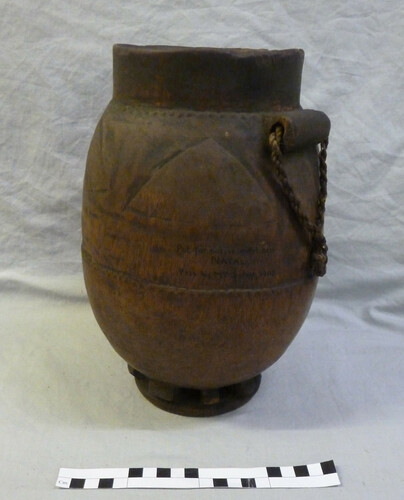 1906.20.158Wooden jar for millet beer, with carved triangle decorations. Eight small legs attached to a circular, flat base. A lug on one side is perforated and has a plant fibre cord running through it. [RM [OPS move] 19/9/2016]1906.20.158
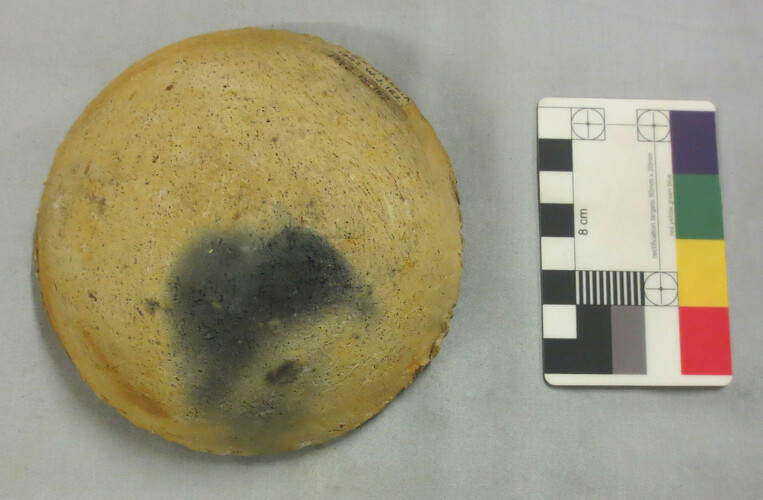 1942.13.162Small shallow round bowl, with notches along the edge of rim. [MOBB [OPS move] 25/02/2016]1942.13.162
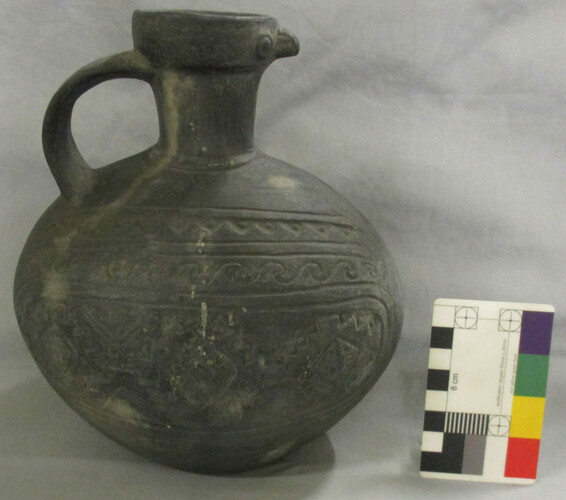 1921.78.1Ovoid pottery vessel of black ware with narrow neck and single strap handle. [MOBB [OPS move] 22/03/2016]1921.78.1
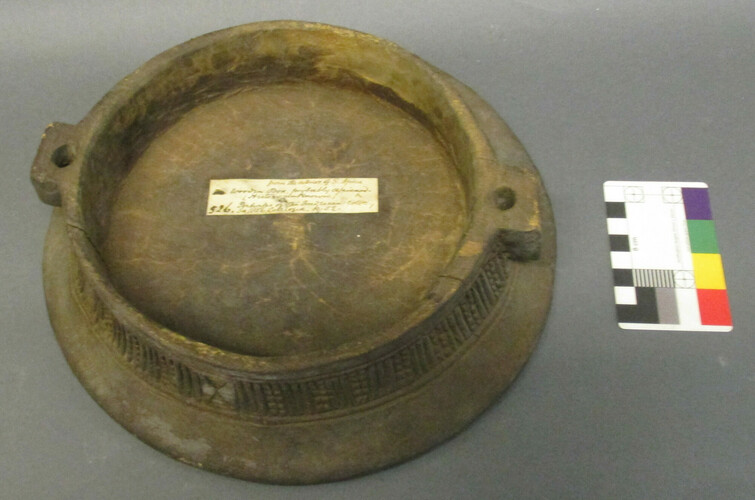 1886.1.526Cylindrical shaped carved wooden ?lid for a cylindrical box possibly used as a low ?stool. The rim of the lid projects beyond the body and it has an undecorated flattened top. There are two square lugs projecting from the sides of the lid each with a single perforation. There is a band of incised decoration running around the outside. [CW [OPS move] 13/9/2016]1886.1.526
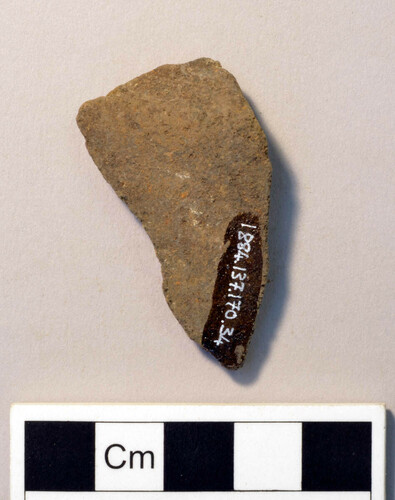 1884.137.170.34Ceramic base sherd1884.137.170.34
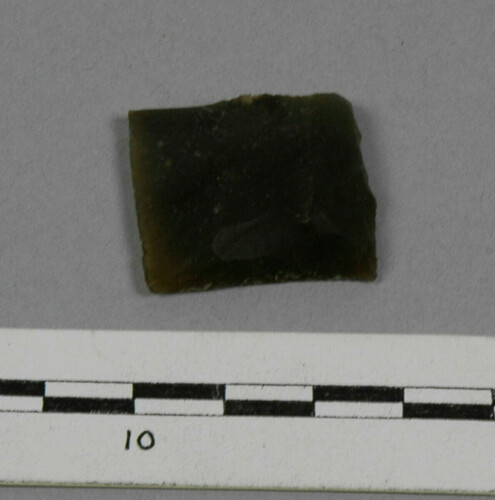 2007.101.5Gun flint, size '2' for a horse pistol. [El.B 19/11/2007]2007.101.5
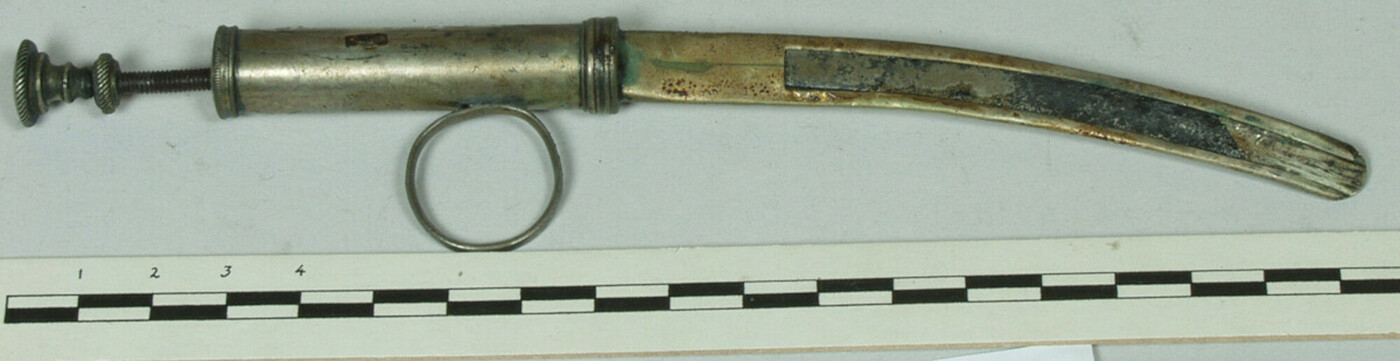 1945.11.153.43One of a collection of surgical instruments, in a wooden box. [L.Ph 'DCF 2004-2006 What's Upstairs?' 5/10/2004]1945.11.153.43
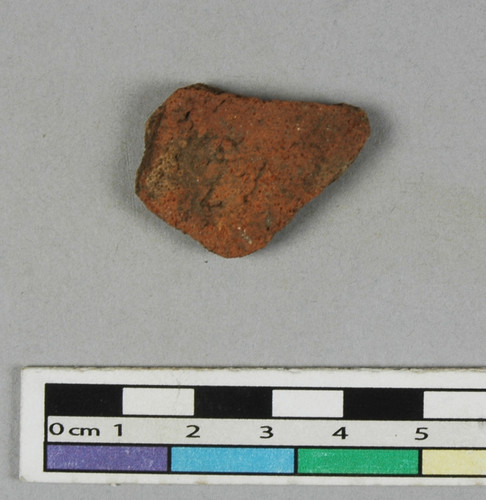 1884.138.4.138Ceramic sherd1884.138.4.138