
- Collection type
- Object
- Description
- Ancient bronze helmet with nose guard and eye holes ('M' outline) above face-slit [El.B 07/08/2007]
- Geographical reference
- Person
- Maker Unknown Maker
- Field collector Unknown Collector
- PRM source Augustus Henry Lane Fox Pitt Rivers founding collection
- Date / Period
- Date made: 700-200 BC Archaeological period: Ancient Greek Archaeological period: Iron Age
- Date collected
- By 1862 Aug 21
- Acquisition information
- Donated: 1884
- Materials and processes
- Material Bronze Metal, Process Forged (Metal), Process Hammered
- Dimensions
- Diameter: max 270 mm back of rim to tip of noseguard
- Object numbers
- Accession number: 1884.32.16 Other numbers: 291 PR Cat other PR nos: 137 PR Cat other PR nos: S 1530 ?
- Research and responses
The following notes are drawn from research compiled by Andy Mills as part of the DCF Cutting Edge project in 2006-2007. The Corinthian helmet is termed Corinthian by archaeologists, because cameos of the goddess Athena wear this helmet on Corinthian coins dating from the same period of its use. It was in use before the early 7th Century BC, and until the 3rd Century BC, across a wide area of mainland Greece, the Peloponnese, and those parts of southern Europe known as Magna Graeca or ‘Greater Greece’/ It is considered to be one of the first major achievements of European material culture which has no stylistic antecedent in Asia Minor or North Africa.
The Corinthian helmet was forged by hand from a single sheet of wrought bronze, and demanded great skill to achieve. The earliest examples of Corinthian helmets are taller than they are long, and consequently could not be worn pushed up onto the back of the head, as the later, longer types could be – a wearing style we associate with Classical Greek images of helmeted figures. By 600 BC, the helmet had been developed further, and various parts were reinforced with additional bronze plates – particularly the nasal (nose-guard) and rim. Later Corinthian helmets often bear incised decoration representing predatory animals such as lions or ornamental designs. These later helmets also became slightly concave under the back of the skull, to fit the head better.
Ultimately, the two major drawbacks of the Corinthian helmet were the fact that it covered the ears and heavily inhibited hearing, and that it was largely unfitted and cylindrical – meaning that, when struck, it would often turn on the head, and effectively blind the wearer as well.
This was a general warrior’s helmet, and was used equally by both hoplite warriors (heavy infantry, armed with a shield, helmet and spear) and cavalry. There was little standardisation of arms and armour among Greek forces of the period, as each warrior was responsible for providing his own arms.
Relevant Reading: Snodgrass, A.M. (1964) Early Greek Armour & Weapons: From the End of the Bronze Age to 600 BC. Edinburgh: Edinburgh University Press. Research Conducted for DCF Cutting Edge Project 2006/2007 [SM 08/05/2008]
Search terms: Armour Weapon, Clothing Headgear, Armour, Helmet
Further items to explore
 1920.16.13.2Mask, part of a complete suit of Japanese armour. [El.B 10/4/2007]1920.16.13.2
 1901.46.1.31Throat guard [.31], part of complete suit of Japanese armour. [El.B 4/4/2007]1901.46.1.31
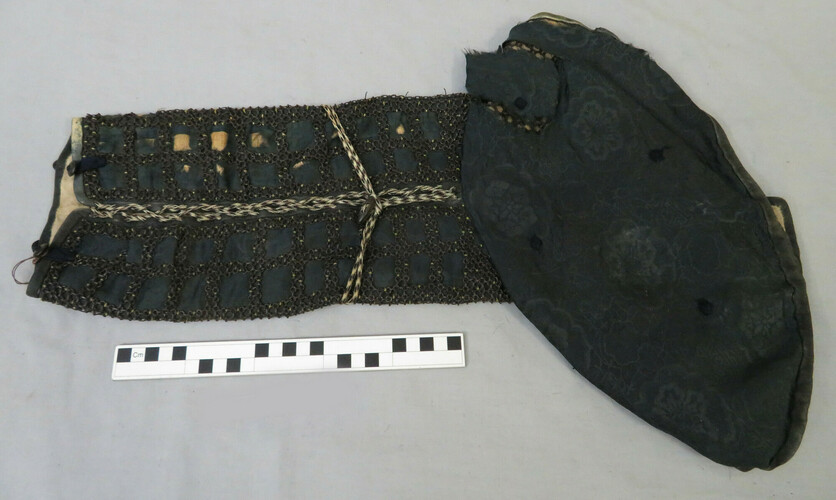 1898.50.1.10Sleeve [kote], part of Samurai armour set. It is made of green patterned textile with chain mail attached, and has a yellowish cloth lining. It is close-fitting around the arm and flares at the shoulder area. It is fastened together by a mottled braided cord. There are four lengths of black braided cord in the shoulder area, and four horn toggles near the cuffs.1898.50.1.10
 1985.46.1.2Leather gauntlet, right, with beadwork decoration and fringes. [N.B. 'DCF 2004-2006 What's Upstairs?' 31/3/2005]1985.46.1.2
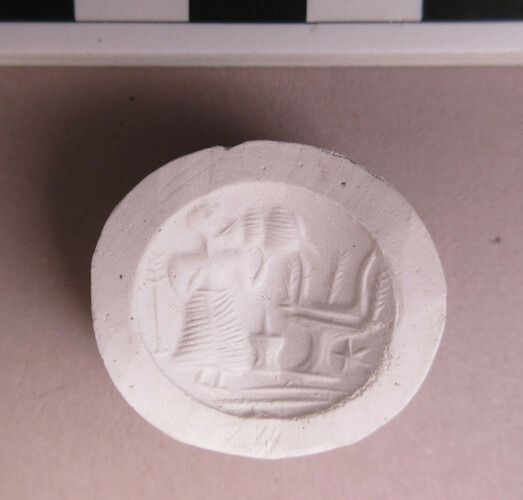 1940.12.557Cast of seal ("24").1940.12.557
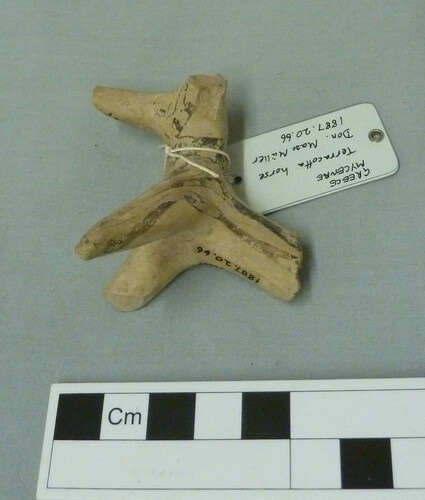 1887.20.66Terracotta figure of a horse or bull, painted with black vertical stripes. Missing the head, legs and tail. Has a roughly cylindrical main body, with five protrusions where the legs, head and possibly tail have broken off. [IL [OPS Move] 18/7/2017]1887.20.66
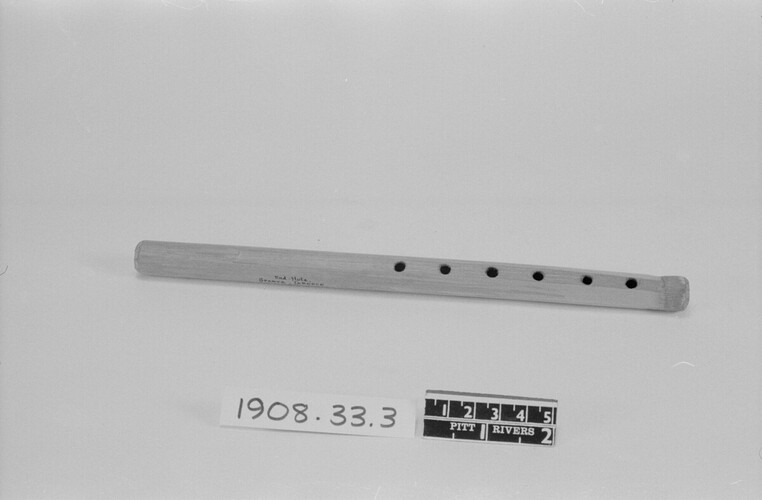 1908.33.3Reed end-flute.1908.33.3
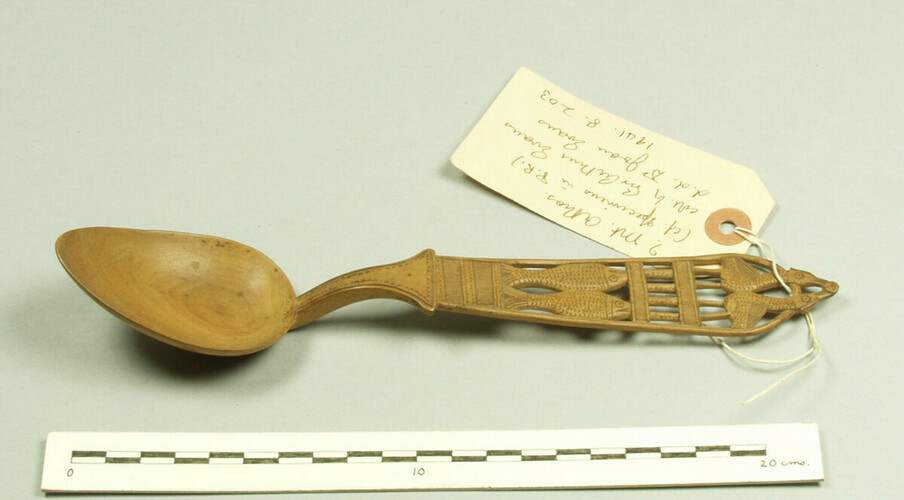 1941.8.203Wooden spoon with openwork handle depicting two fish and two birds. [El.B 'DCF 2004-2006 What's Upstairs?' 3/3/2006]1941.8.203