
- Collection type
- Object
- Description
- Head covering of chain mail with opening for face and long neck-guard (spreading on shoulders), jumped links. [MOBB [OPS move] 1/8/2017]
- Geographical reference
- Cultural groups
- Japanese
- Person
- Maker Unknown Maker
- Field collector Unknown Collector
- PRM source Augustus Henry Lane Fox Pitt Rivers founding collection
- Date / Period
- Date made: Possibly before 1874
- Date collected
- ?By 1874
- Acquisition information
- Donated: 1884
- Dimensions
- Length: max 430 mm, Width: max 405 mm, Depth: max 15 mm
- Object numbers
- Accession number: 1884.32.1 PR Cat other PR nos: 115
- Research and responses
Some interesting features of kabuto (Japanese helmets): The crown-tube (Tehen / Hamchiman-Za) is of particular interest. Historically, the construction of a hollow tube at the crown of the helmet is a feature acquired ultimately from the Mongols; the Japanese bushi of the remote past – alongside the Koreans and other peoples influenced by Mongol culture – drew his long hair up through the tehen, and wore it into battle as a natural plume. While the practice was abandoned, the hollow tube permitting this remained. In more recent times, the tehen came to be known as Hachiman-Za (‘the seat of Hachiman’). Hachiman is a Japanese Buddhist deity, the God of Worldly Prosperity and God of War, and the leader of the Shi-Tenno (Four Guardian Gods). He was the patron deity of bushi, and the tehen can consequently be seen as a means of taking the deity into battle. Hachiman is closely related to Bishamon – another major Japanese god of war, and both are understood by the Japanese to be forms of the martial bodhisattva Daibosatsu. Similarly, a number of Japanese helmets bear four rivets on their bowls - pointing NE, SE, SW, NW – which are known as the Shi-Tenno-Byo (‘Rivets of the Four Guardian Gods’). These, again, invoke major deities of protection and military success, and take them into battle (Arai, 1964: 49-51). When armourers worked, their finest pieces were invariably offered to Bishamon or Hachiman, in order to reciprocate his assistance in further works. The fore-crest (datemono) was often created from gilt brass, and those kabuto which do not bear datemono often bear a two-pronged oharaidate or ‘august prayer-slip stand’ – alluding to the fact that protective Buddhist texts on paper were historically worn over the forehead. Relevant Reading: Norman, F.J. (1905) The Fighting Man of Japan: The Training & Exercises of the Samurai. London: Archibald Constable & Co. Swann, P.C. (1958) An Introduction to the Arts of Japan. Oxford: Bruno Cassirer. Ryukasu, T., de Bary, W.T. & Keene, D. (1962) Sources of Japanese Tradition. New York: Columbia University Press. Arai, H. (1964 (1709-22) The Armour Book in Honcho-Gunkiko. London: The Holland Press. Robinson, H.R. (1965) A Short History of Japanese Armour. London: HMSO. Moad, M.I. (1982) An Exhibition of Japanese Armour from the L.J. Anderson Collection. Rochester-upon-Medway: City Council Guildhall Museum. Bottomley, I. & Hopson, A.P. (nd) The Samurai Armour at Snowshill Manor. London: The National Trust. Carey, J. (1995) Samurai Undressed. Torquay: The Devonshire Press. Research Conducted for DCF Cutting Edge Project 2006/2007 [AM]
Search terms: Armour Weapon, Clothing Headgear, Armour, Helmet
Further items to explore
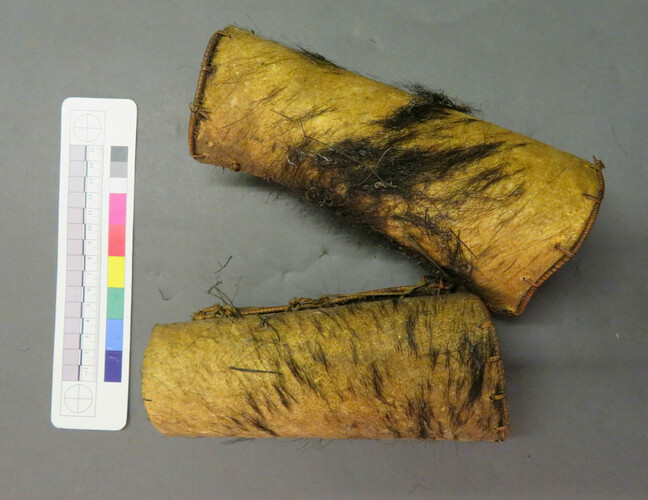 1934.82.25.1One of a pair of bear-skin gaiters (ankle guard) tied together with string. [BH [OPS move] 5/9/2017]1934.82.25.1
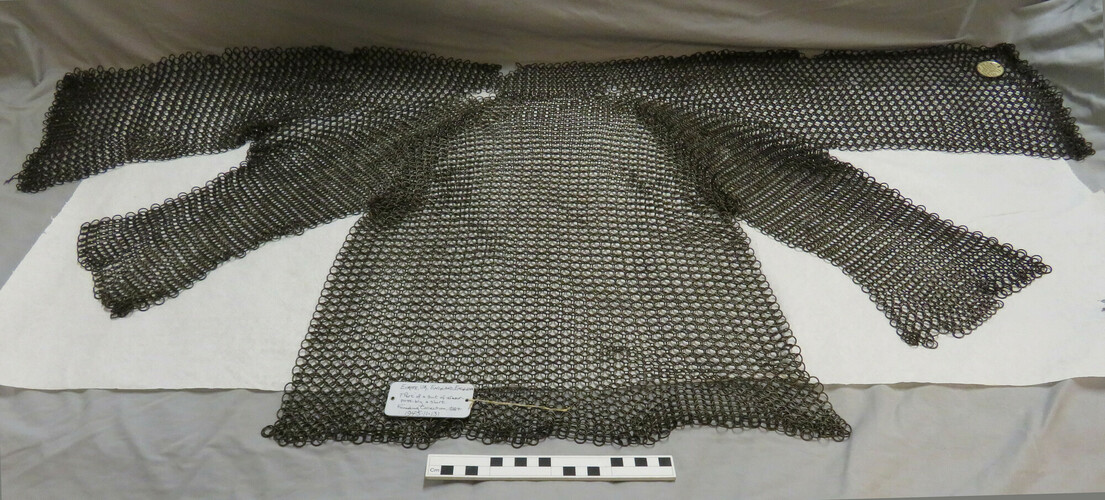 1945.11.131Part of suit of armour. Unfinished chain mail shirt. [MOBB [OPS move] 1/8/2017]1945.11.131
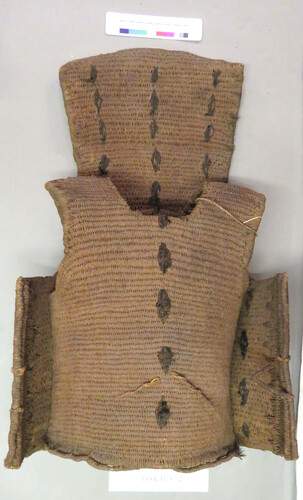 1884.31.37.1Coconut fibre cuirass, for a suit of coconut fibre cord armour. [BH [OPS move] 1/9/2017]1884.31.37.1
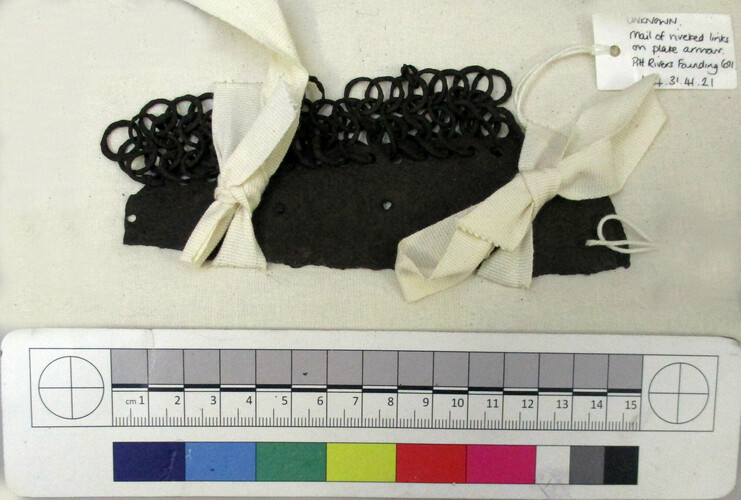 1884.31.41.21Specimen of mail with riveted links on plate armour. [SM (Verve) 23/10/2014]1884.31.41.21
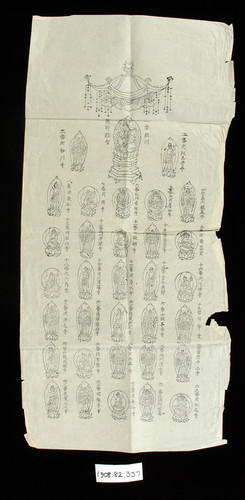 1908.82.337Catalogue of 33 shrines which pigrims should go to in the West of Japan. [SM 30/09/2008]1908.82.337
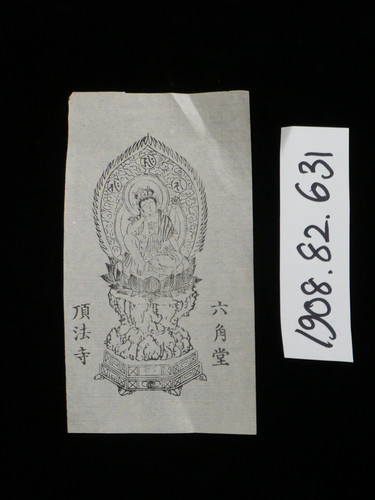 1908.82.631Print of Kannon.1908.82.631
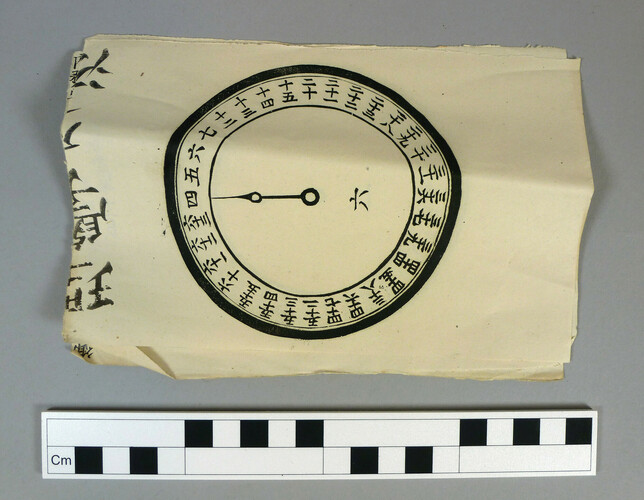 1985.53.297.4Paper charm. Piece of paper printed with Japanese characters in black ink in a circle like a clock face with three lines and a dial printed in the centre. The piece of paper is bound together with five others sheets with a plain band of paper - for sheets see [1985.53.297 .1 - .3] and [1985.53.297 .5 - .6] [MJD 18/03/2013]1985.53.297.4
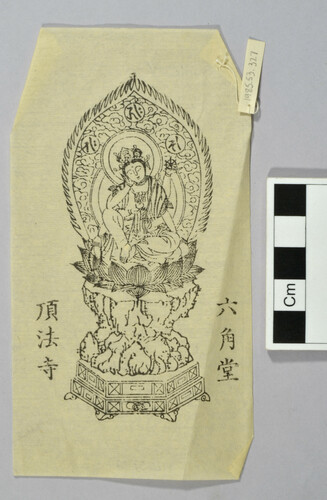 1985.53.327Paper charm with figure and characters in black ink. [MJD 20/03/2013]1985.53.327