
- Collection type
- Object
- Description
- Wooden reproduction of a small parrying shield with hand grip hollowed out on one side and groove down inside edge [RTS 22/6/2005].
- Long description
- Modern reproduction of a Mundu shield, copying an example from the Christy collection. This has been carved from a single piece of orange coloured wood (Pantone 729C), with the surface stained dark brown (Pantone 412C). It has a narrow body that reaches its maximum width at the centre, then tapers to either end. The central area has been hollowed out to make a hand grip, leaving a rectangular handle running across the top. The back of the handle is convex to make it easier to hold. A sharp ridge runs along the back of the shield, following a slight curve as the body slopes down to the rounded ends. The inside edge is straight, and has been cut away with a deep v-shaped groove that extends right to each end; the owner could rest a spear in this groove while carrying the shield. The object is nearly complete; the stain has worn off in places, while the handle has cracked across its grip and some chips of wood have been lost. Two small holes on one side seem to mark where a former display label had been attached. It has a weight of 914.5 grams, and is 680 mm long, with a maximum width of 98 mm and thickness of 96 mm at the centre; the groove is 35 mm wide, while the handle is 37 mm wide and 24.5 mm thick [RTS 22/6/2005].
- Geographical reference
- Cultural groups
- Mundu
- Person
- Maker Augustus Henry Lane Fox Pitt-Rivers
- Field collector Unknown Collector
- PRM source Augustus Henry Lane Fox Pitt Rivers founding collection
- Date / Period
- Date made: 1800-1874
- Date collected
- ?By 1874
- Acquisition information
- Donated: 1884
- Materials and processes
- Material Wood Plant, Process Carved, Process Stained
- Dimensions
- Length: max 675 mm, Width: max 100 mm, Height: max 94 mm, Weight 914.5 g
- Object numbers
- Accession number: 1884.30.23 PR Cat other PR nos: 63
- Research and responses
This model of a Mundu shield was made by Pitt Rivers to fit a 'missing gap' in one of his series. The original for his copy was at that time part of the Christy collection. A large number of Christy collection objects were subsequently acquired by the British Museum, and it may be that the original is now held there. Christy most probably acquired his shield from John Petherick, who mounted several trading expeditions into the Sudanese interior between 1853 and 1858 during which he amassed a considerable collection of ethnographic objects. Petherick entered Mundu territory for the first time in his fifth expedition, visiting the villages of Umbolea and Baer (note that Petherick calls the Mundu the 'Baer' in his 1861 publication, Egypt, The Sudan and Central Africa, and subsequently the Mundo). Petherick did not venture into this region again, with his collection being shipped back to England in 1859. His description of Mundo shields certainly matches this type of object: "'The Mundo tribe ... [use] a shield formed of a single narrow piece of hard wood with a boss in the centre as a guard to the hand ...' (J. Petherick, 1861, "On the Arms of the Arab and Negro Tribes of Central Africa, Bordering on the White Nile", Journal of the Royal United Services Institution 4 no. 13, p. 176 ). Shields of this type were not confined to the Mundu, but appear amongst other Nilotic groups, including the Dinka (1931.66.10, 1934.8.9 and 1936.10.11).
G Schweinfurth, 1878, The Heart of Africa [vol I p. 274] suggests that the Bongo call the Zande Mundo. On page 99 [vol I] he says 'The fact is, that Mundo is the name ordinarily given by the Bongo to a small tribe calling itself Bubackur, which has contrived to wedge in its position between the borders of the Bongo and the Niam-niam. On the eastern limit the Bongo denote the Niam-niam themselves by this name of Mundo'. On page 130 [vol II] he says 'All the Niam-niam of whom I was able to make inquiries assured me that the natives of Mundo are a distinct people, differing from themselves both in habits and in dialect; their precise ethnographical position I could never determine, but I should presume that they approximate most nearly to their Mittoo neighbours on the north, and more especially to the Loobah and Abakah. This Mundo or Moodoo is not to be confused with the Mundo to the south of the Bongo, which Petherick reports that he visited in February 1858; it is the western enclave of the scattered Babuckur'. As the only source which suggests that the shield is the Mundo also associated with the Babuckur was written during the Second World War, the only safe assumption is that the provenance is not yet fully worked out [AP Leverhulme project on founding collection 1995-1998].
- Associated publications
- Pitt Rivers 1874, pl. I, fig. 2.
Search terms: Weapon, Model, Reproduction, Shield
Further items to explore
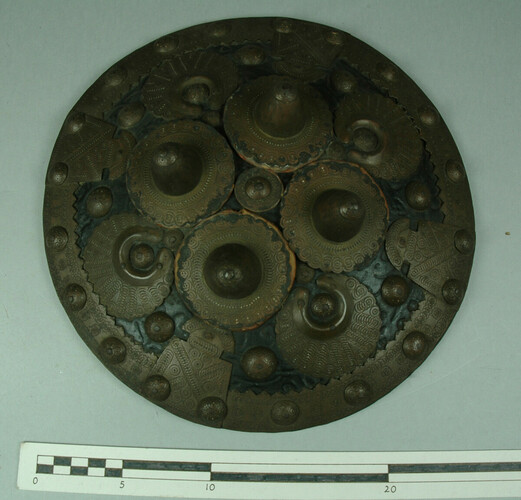 1941.8.297Convex circular shield of embossed animal hide, with four large bosses and numerous smaller bosses and plaques, all of brass. [MJD DDF Body Arts Project 2010/2011 13/09/2010]1941.8.297
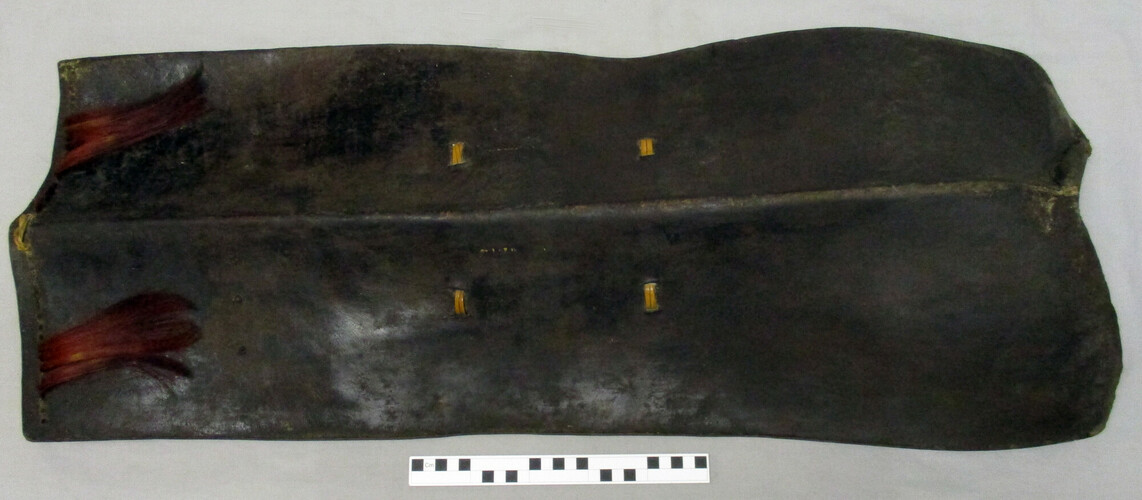 1923.84.162Rectangular shaped hide shield with sloping sides. Along the upper edge of the shield there are a series of perforations through with dyed ?Goat hair is threaded decoratively. On the reverse of the shield there is a woven cane work handle and an additional strap made from braided leather. [CW [OPS move] 23/8/2016]1923.84.162
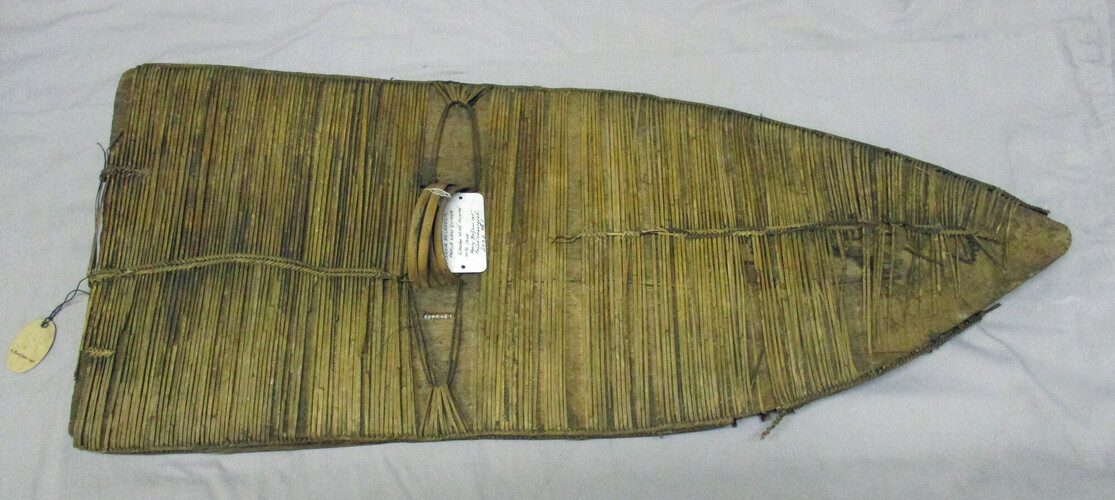 2002.46.1Shield. Made from wood with overlaid cane work. The shield is pointed at one end and curves inwards more pronounced here than at the straight end. Small cane handle in the centre of the shield. Plaited decoration on the exterior running from the tip of the shield in a straight line to the base. [AB [OPS Move] 1/8/2016]2002.46.1
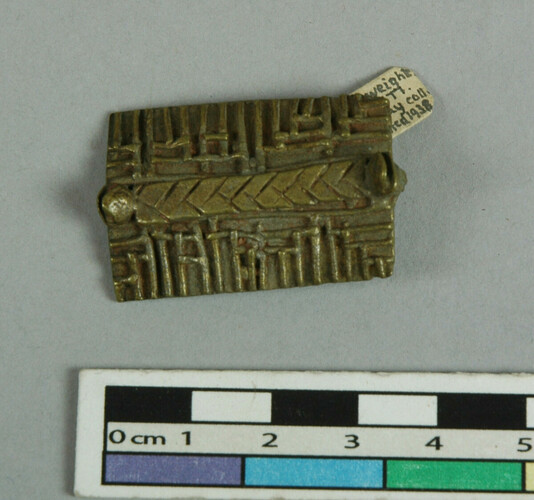 1938.18.599Copper alloy weight representing a shield with raised geometric pattern. [MJD 15/06/2011]1938.18.599
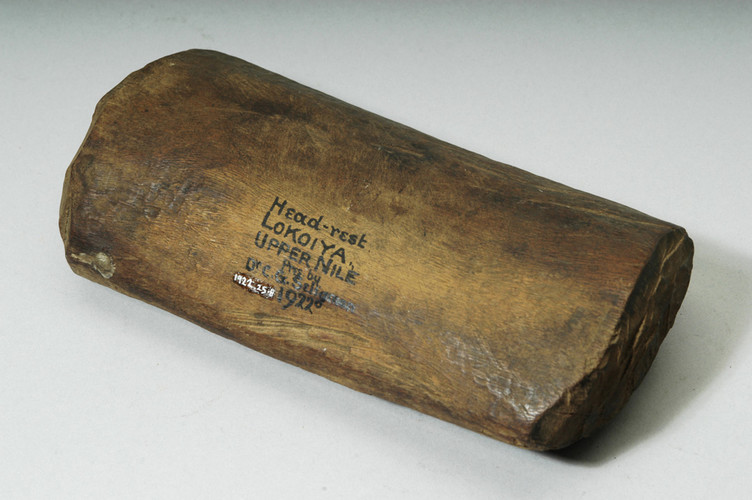 1922.25.8Rectangular headrest with convex upper face, carved from a single block of wood [RTS 27/5/2005].1922.25.8
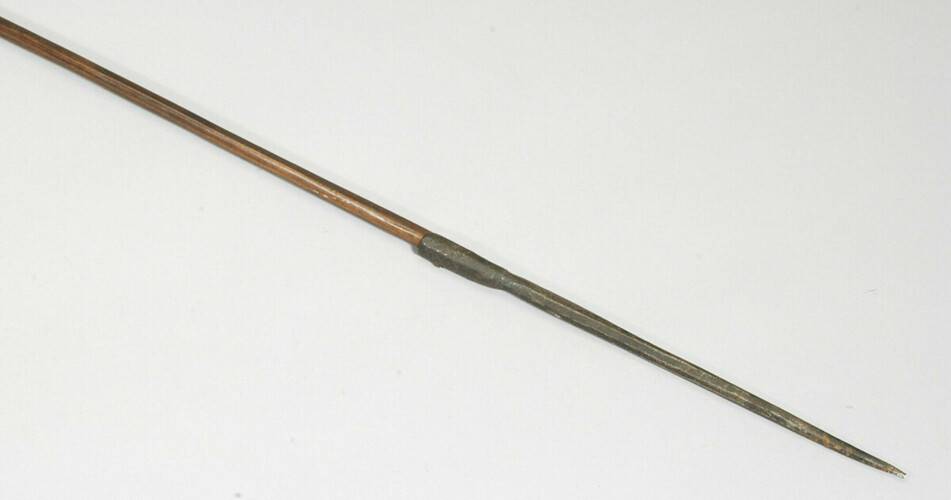 1969.29.106.1Socketed iron head with ogee-sectioned blade and barbed shank. [AFS [OPS move] 5/7/2018]1969.29.106.1
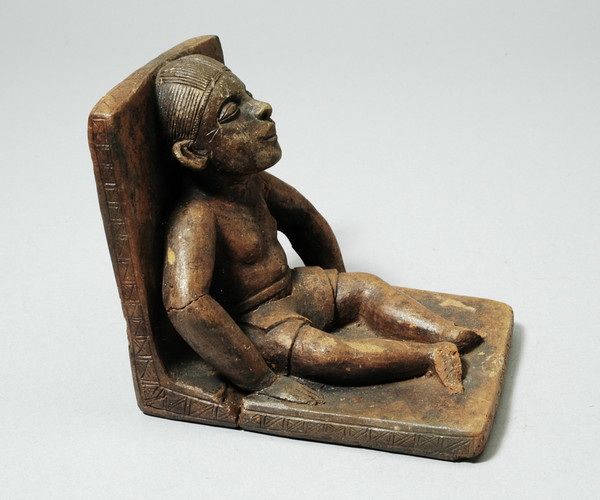 1934.8.135L-shaped pottery book-end with a seated male figure wearing shorts sculpted in high relief [RTS 28/1/2005].1934.8.135
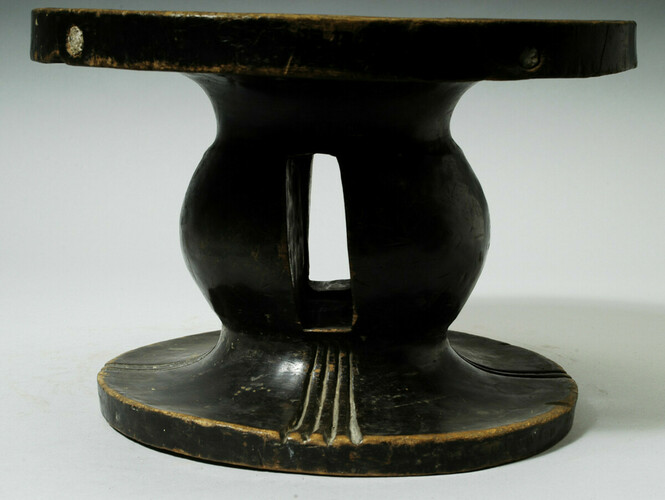 1970.38.10Slightly oval wooden stool with lentoid hand grip cut near the edge of the seat. [RTS 14/4/2005].1970.38.10